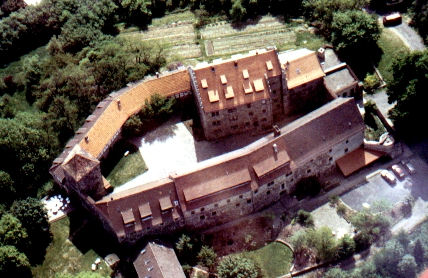
Burg Hauneck stands as a remarkable medieval hill castle ruin perched atop the 524-meter-high Stoppelsberg in the municipality of Haunetal, Germany. This imposing fortress, primarily constructed from local dark basalt stone, reflects a rich history dating back to the 14th century. Originally built by the noble knights of Haune, whose ancestral seat was the nearby Burghaun castle, Burg Hauneck was strategically positioned to guard the valley and oversee a vital medieval trade route known as the Antsanvia. The castle's location within the Hessian Kegelspiel uplands and the Kuppenrhön region underscores its military and economic significance in the Middle Ages.
The earliest surviving documentation mentioning Burg Hauneck dates from around 1397, with some sources suggesting slightly later references in 1402 or 1403. These records emerge in the context of conflict when Landgrave Hermann II of Hesse defeated the local knights, resulting in partial destruction of the castle and its subsequent absorption into Hessian territory. By 1409, the castle was repaired and formally sold to Landgrave Hermann II, marking its transition from a noble family stronghold to a regional administrative and judicial center. The incorporation of nearby villages such as Oberstoppel and Unterstoppel into the landgrave’s domain further enhanced the castle’s role as a seat of power and governance.
Historical conflicts and reconstruction
Burg Hauneck's history is marked by episodes of warfare and rebuilding. In 1469, during the turbulent Hessian brother war, the castle was again besieged and damaged. This civil war within the ruling family saw Simon von Buchenau attack the fortress amid broader hostilities involving Landgrave Heinrich III of Hessen-Marburg and various noble factions. The conflict left the castle in a state of disrepair until a comprehensive reconstruction took place between 1482 and 1490.
The rebuilding efforts were overseen by the skilled fortress master builder Hans Jakob von Ettlingen, who also became the castle’s first official Amtmann (bailiff). Under the direction of Wilhelm III, the restoration preserved many defensive and residential elements, integrating late Gothic architectural features that remain visible in the ruins today. This period of renewal secured Burg Hauneck's function as an administrative seat until around 1560, when the administrative office relocated to Holzheim.
Architectural features and layout
The bergfried and defensive structures
The castle’s most prominent surviving feature is the bergfried, a tall central tower whose base rests on striking hexagonal basalt columns. This tower is the oldest part of the castle, dating back to the original 14th-century construction. Positioned centrally within the courtyard, the bergfried provided extensive views over the surrounding landscapes including the Kuppenrhön, Seulingswald, and Knüll forests. A modern survey marker installed at its summit attests to its continued prominence as a landmark.
Encircling the summit is a formidable ring wall approximately 1.5 meters thick and reaching heights of up to 15 meters in some sections. This defensive enclosure protected the entire mountaintop and included a gatehouse on the southeast side featuring a double gate. While only the outer walls of the gatehouse remain above the arches, original stone hinges for internal gate doors are still visible, offering insight into the castle’s defensive mechanisms.
Residential and service buildings
Adjacent to the southern corner of the ring wall lies the palas, the main residential building of the castle. This structure is distinguished by a pointed Gothic gate and measures roughly 17.5 meters long by 3.5 meters wide. Evidence suggests it had at least two floors, supported by remnants of outer walls and ceiling supports. Inside the ground floor are narrow arrow slits for defense and a vaulted cellar that provides access to a cistern in the courtyard near the kitchen stairs.
A central hearth located between the cellar entrance and kitchen staircase was integral to heating the palas. This hearth connected to a tiled stove on the upper floor, known as the Dürnitz, a heated hall accessible via an external staircase beside the gatehouse. This arrangement reflects the medieval emphasis on comfort and defense within castle living quarters.
Extending northwest from the palas is the kitchen wing, which includes a Gothic gate opening into the courtyard. Archaeological remains reveal the base of an original hearth, drainage stones, paved flooring, and the foundation for a cooking fireplace supported by stone columns. The chimney remains and a narrow spiral staircase base indicate vertical connections to upper floors, likely facilitating service and access to the heated hall above.
Additional defensive elements and outbuildings
The ring wall continues from the kitchen wing back toward the gatehouse, retaining traces of a lower battlement walkway where defenders would have patrolled. Although no further stone structures survive along this section, it is believed that wooden outbuildings such as stables once stood within the enclosed courtyard area, supporting the castle’s operational needs.
Decline and preservation
After its administrative functions ceased around 1560, Burg Hauneck gradually fell into disuse. It disappears from official records after 1572, suggesting abandonment. The castle likely suffered further damage during the Thirty Years’ War in the early 17th century, accelerating its decline into ruin.
Despite centuries of decay, the ruins of Burg Hauneck have been preserved through modern conservation efforts. The dramatic contrast between the dark basalt construction and the white sandstone elements sourced from the nearby Lange Steine natural monument highlights the castle’s unique architectural character. Today, the site offers visitors a tangible connection to medieval history, military architecture, and the regional heritage of Hesse.
Visitors to Burg Hauneck can explore the extensive remains of the bergfried, the ring wall, the gatehouse, and the ruins of the palas and kitchen wing. The panoramic views from the summit provide a striking perspective on the surrounding forests and uplands that once defined the castle’s strategic importance.
Frequently asked questions (FAQ)
- How do I get to Burg Hauneck?
- Burg Hauneck is located in Germany and can be accessed by car or public transportation. The nearest train station is a short drive away, and local buses also connect to the castle, making it convenient for visitors.
- What is the historical significance of Burg Hauneck?
- Burg Hauneck is a medieval castle with roots dating back to the 13th century. It played a crucial role in regional politics and defense during its time, reflecting the architectural style and military strategies of the era.
- When was Burg Hauneck built?
- Burg Hauneck was constructed in the early 13th century, with its foundation laid around 1200. Over the centuries, it has undergone various renovations, preserving its historical essence while adapting to changing needs.
- Can I visit Burg Hauneck year-round?
- Yes, Burg Hauneck is open for visitors throughout the year, although opening hours may vary seasonally. It's best to check the official website for the most accurate and up-to-date information regarding visiting times.
- Why is Burg Hauneck a popular destination for tourists?
- Burg Hauneck attracts visitors due to its stunning architecture, rich history, and picturesque views of the surrounding landscape. Its well-preserved structures provide a glimpse into medieval life, making it an educational and enjoyable experience.
- Is it possible to take guided tours of Burg Hauneck?
- Yes, guided tours are available at Burg Hauneck, providing visitors with in-depth insights into the castle's history and architecture. These tours are often led by knowledgeable guides who enhance the experience with engaging stories and facts.
- What are the ticket prices for visiting Burg Hauneck?
- Ticket prices for Burg Hauneck are generally affordable, with discounts available for students and seniors. It's advisable to check the official website for current pricing and any special offers that may be available during your visit.
- What are the opening hours for Burg Hauneck?
- Burg Hauneck typically opens at 10 AM and closes at 6 PM during the peak season. However, these hours may vary during the off-season, so checking the official site before your visit is recommended.
- Are there any nearby attractions to visit after Burg Hauneck?
- Yes, there are several nearby attractions, including scenic hiking trails and picturesque villages that showcase local culture. Additionally, other historical sites and natural parks in the region make for a perfect day trip after visiting the castle.
Information
Loading map...
Visitor reviews
No reviews yet. Been here? Write the first review and help other travelers!
Write the first reviewVisited this castle? Share your experience
Your review helps other travelers and adds first-hand knowledge to our encyclopedia.