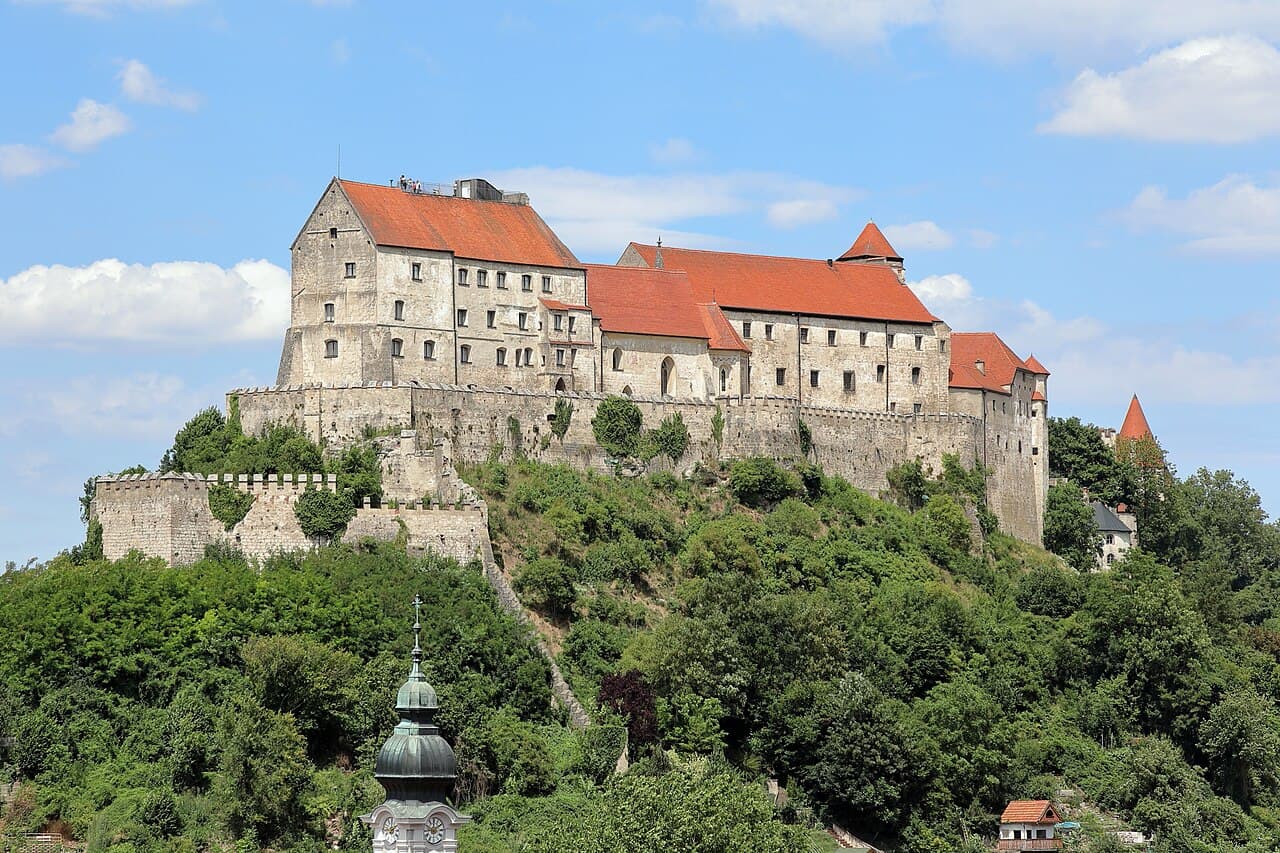
Burghausen Castle
Burghausen Castle stands as an extraordinary monument of medieval fortification and aristocratic residence, renowned as the longest castle complex in the world with a length exceeding 1,000 meters. Nestled on a narrow ridge above the town of Burghausen in Bavaria near the Austrian border, the castle’s strategic location between the Salzach River and the Wöhrsee lake has shaped its historical and military importance since its earliest days.
The castle’s origins trace back to before 1025, with the site itself showing evidence of continuous settlement since the Bronze Age. Over centuries, it evolved from a modest stronghold into a sprawling Gothic fortress complex comprising a main castle with an inner courtyard and five extensive outer courtyards, each fortified with defensive walls, towers, gates, and ditches. This architectural ensemble reflects the castle’s dual role as a ducal residence and a formidable military bastion.
Historical development and significance
The castle was originally the seat of the Counts of Burghausen, a branch of the Sieghardinger family, before passing to the Wittelsbach dynasty in 1168. Following their appointment as Dukes of Bavaria in 1180, the Wittelsbachs expanded the castle significantly under Duke Otto I, marking the beginning of its transformation into a major ducal fortress.
With the partition of Bavaria in 1255, Burghausen Castle became the second residence of the Dukes of Lower Bavaria, complementing the primary seat at Landshut. The period from 1392 to 1503, under the Bavaria-Landshut line, was especially crucial for the castle’s development. Dukes such as Henry XVI and Georg the Rich undertook extensive expansions and fortifications, culminating in the castle’s reputation as one of the strongest fortresses in the region.
The castle also served important dynastic and domestic functions. It was the residence of the ducal consorts and widows, a place for the education of ducal children, and a secure repository for the ducal treasury, including gold and silver treasures. The famous Landshut Wedding of 1475, a grand dynastic celebration commemorated in the castle’s decorations, highlights its cultural significance.
After the Landshut War of Succession (1504–1515), the castle lost its status as a primary residence but retained military importance, especially during the Thirty Years’ War, when it served as a prison for notable captives such as Swedish Field Marshal Gustav Horn. The castle’s role as a border fortress was reinforced after the Treaty of Teschen in 1779, which shifted regional boundaries.
The castle suffered damage during the Napoleonic Wars, including the destruction of northern outer defenses by French troops around 1800. Napoleon himself declared the fortress obsolete in 1809. The Bavarian army maintained a garrison until 1891, after which local efforts prevented its demolition. Restoration and archaeological work have since revealed much about its layered history.
Architectural features and layout
Burghausen Castle is a hill castle built primarily from tuff blocks, a type of travertine stone, stretching along a ridge approximately 420 meters above sea level. The castle complex is divided into six courtyards arranged linearly from south to north, culminating in the main castle at the southern tip of the ridge.
Main castle and inner courtyard
The main castle houses the Palas, the ducal residence featuring a blend of late Romanesque and Gothic architectural elements. Notable are the rib vaults and oak beam ceilings that characterize the interior spaces. The Dürnitz, a large two-aisled hall with a back-loading stove, served as a dining and gathering hall. The Kemenate is a three-story residential building for the duchess’s court, distinguished by late Gothic vaults and 16th-century wooden ceilings.
The inner castle chapel of St. Elizabeth, constructed in 1255, is the oldest early Gothic church in southern Bavaria. It contains valuable 14th-century frescoes, a choir altar dating from 1524, and a bell from 1474. The castle gate complex includes the Elsbethen Gate with its imposing seven-story bergfried (keep) and a shield wall equipped with a portcullis, underscoring the castle’s defensive sophistication.
Outer courtyards and defensive structures
The first courtyard protected the main castle and included stables, a brewery, and a bakery, though much of this area was later altered for military purposes. The second courtyard contains the large arsenal building dating to at least 1427, constructed of tuff blocks. This building stored grain on the upper floor and weapons below, including a significant artillery collection recorded in 1533. The courtyard is guarded by the Saint George’s Gate (1494), adorned with a late Gothic coat of arms celebrating the Bavarian-Polish alliance linked to the Landshut Wedding.
The third courtyard features the Grain Tower and the Grain Measure Tower, used historically for stabling and storing animal feed. Defensive elements include three small gun turrets known as “Pfefferbüchsen” and a smithy for weapon maintenance.
The fourth courtyard once contained the large stable called the Haberkasten, constructed between 1387 and 1427, later rebuilt as a youth hostel. It also includes the Aventinus House, a former defensive tower, and the Folterturm or torture tower, which now serves as a museum showcasing early modern torture devices and preserving the castle dungeon.
The fifth courtyard is home to the well-preserved late Gothic Chapel of St. Hedwig, built between 1479 and 1489 by Duchess Hedwig and Duke Georg. The chapel is architecturally notable for its rib vaults over a curved plan, red marble columns, sandstone statues, and late medieval votive reliefs. It houses a late 15th-century altar retable on loan from the Bavarian National Museum.
The sixth courtyard is broader and more densely built, containing three 14th-century defensive towers that were converted into administrative offices between the 16th and 18th centuries. This area includes the Kanzler Tower and the Christophs Gate, the latter providing access to the town below.
Additional fortifications and features
Throughout the complex, defensive features such as multiple outer wards (zwingers), a deep moat (now filled in), a long battlemented wall, and a powder tower dating from around 1500, emphasize the castle’s military strength. The powder tower’s walls are up to five meters thick, with four stories and a deep well to ensure water supply during sieges.
Archaeological excavations beneath the Dürnitz have uncovered early medieval graves and wall remains, now displayed in the visitor center. Decorative elements throughout the castle include painted coats of arms from 1523, frescoes depicting the Three Magi, and heraldic motifs celebrating dynastic marriages.
Cultural heritage and current use
Today, Burghausen Castle is owned predominantly by the Free State of Bavaria and functions as a cultural and historical landmark. It houses several museums within the Palas, Kemenate, and other buildings, showcasing the rich history and art of the region, including the Bavarian State Picture Collection with its late Gothic paintings.
The castle’s extensive grounds and well-preserved structures attract numerous visitors annually. Public amenities include a café in the second courtyard, and the castle hosts cultural events that celebrate its storied past. Restoration efforts continue to preserve this high medieval Gothic fortress as a testament to Bavarian history and architectural heritage.
Frequently asked questions (FAQ)
- What is the historical significance of Burghausen Castle?
- Burghausen Castle is one of the largest medieval castles in Europe and has played a strategic role throughout its history. It was built in the 11th century and served as a residence for the Dukes of Bavaria, showcasing the region's political importance during the Middle Ages.
- When was Burghausen Castle built?
- Construction of Burghausen Castle began in the early 11th century, with significant expansions and enhancements made over the following centuries. The castle's architecture reflects various styles, marking its evolution over time as it adapted to changing military and residential needs.
- Can I visit Burghausen Castle?
- Yes, Burghausen Castle is open to the public, allowing visitors to explore its impressive grounds, towers, and museums. Guided tours are also available to enrich your understanding of the castle's history and architecture.
- What are the opening hours for Burghausen Castle?
- Burghausen Castle is typically open daily, with varying hours depending on the season. It is advisable to check the official website or visitor center for the most current opening times before your visit.
- Is it possible to access Burghausen Castle with limited mobility?
- While Burghausen Castle offers stunning views and historical insights, the site includes steep paths and staircases that may be challenging for visitors with limited mobility. It is recommended to contact the castle administration in advance to inquire about accessibility options and assistance.
- What is the best time to visit Burghausen Castle?
- The best time to visit Burghausen Castle is during the spring and early autumn when the weather is pleasant, and the surrounding scenery is particularly beautiful. Additionally, visiting during local festivals can enhance your experience with cultural events and activities.
- How much does it cost to enter Burghausen Castle?
- Ticket prices for Burghausen Castle are generally affordable, with discounts available for students and seniors. Entry fees can vary based on whether you choose a guided tour or individual access, so it's best to check the official website for the latest pricing information.
- What nearby attractions can I visit while in Burghausen?
- While visiting Burghausen Castle, you can also explore the charming old town of Burghausen, known for its picturesque streets and historic buildings. Additionally, the Salzach River offers scenic walks and opportunities for outdoor activities, making it a great complement to your castle visit.
Photo gallery

Information
Website
Visit websiteFeatured in
Articles on the Castlopedia blog that feature Burghausen Castle.
Sources & official resources
Verify the information above using these authoritative references.
Loading map...
Visitor reviews
No reviews yet. Been here? Write the first review and help other travelers!
Write the first reviewVisited this castle? Share your experience
Your review helps other travelers and adds first-hand knowledge to our encyclopedia.


