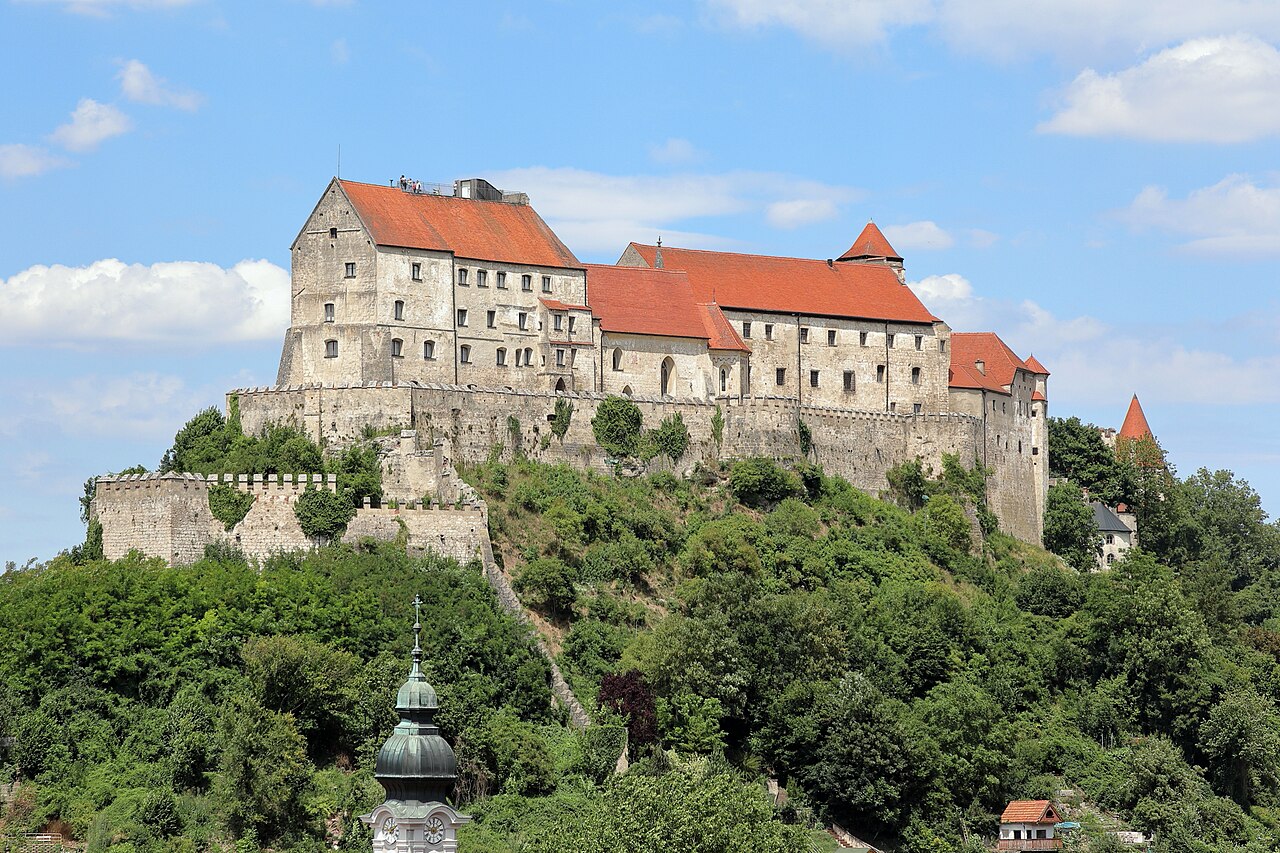
Schloss Wildshut
Schloss Wildshut stands prominently in the village of Wildshut within the municipality of St. Pantaleon, Austria. This hill castle occupies a strategic position atop a steep river terrace overlooking the Salzach River, a natural defensive feature that has been exploited since its earliest fortifications in the early medieval period. The castle's origins trace back to the early Middle Ages, with the first recorded mention dating to 1115, when it was known as castrum Hutte. At that time, the noble lord Albert de Hutte was documented as its occupant, indicating the site’s initial role as a fortified noble residence during the High Middle Ages.
Medieval origins and strategic importance
The castle’s early history is closely tied to the border region between the Duchy of Bavaria and the Archbishopric of Salzburg. Its location made it a vital point for both military defense and administrative control. Over the centuries, the name evolved to Wildshut, reflecting linguistic changes and the continuity of settlement in the area.
By the late 14th century, Schloss Wildshut had evolved into a hunting lodge for the dukes of Bavaria, emphasizing its dual role as a leisure retreat and a symbol of ducal authority. In 1402, it became the administrative center for the Weilhart district court, an important local judicial institution. The castle was granted as a fief to the Nußdorfer family, underscoring its status as a seat of regional power and governance.
Renaissance renovations and administrative role
Around 1500, control reverted to the Bavarian dukes, who undertook significant renovations to modernize and fortify the castle. These modifications reflect the architectural and military demands of the Renaissance period, introducing new defensive features and structural improvements that remain visible today. Governance was managed by appointed stewards such as Hans Offenheimer (1500–1521) and David Aigl (until 1548), who oversaw both the estate and judicial functions.
In the 17th century, the stewards began managing the estate from their own residences rather than living on-site, reflecting changing administrative practices. Following the 1779 transfer of the Innviertel region to Austria, Schloss Wildshut continued to serve as a district court until the early 21st century, maintaining its judicial importance for over six centuries.
Architectural features and preservation
The castle is surrounded by a ring wall dating back to the early 12th century, providing a protective perimeter that has endured through multiple construction phases. The present fortified appearance largely results from the 16th-century renovations, which added Renaissance defensive elements while preserving medieval foundations.
Adjoining the defensive wall is a small chapel containing a notable mid-19th century altar painting titled Maria Hilf, highlighting the castle’s religious and cultural heritage. Within the central courtyard lies a masonry-lined draw-well approximately 150 meters deep, fully restored to working order, emphasizing the importance of sustainable water supply for castle inhabitants.
The exterior masonry exhibits a stylistic purity that reflects careful construction and maintenance. Although many original interior furnishings have been lost, the castle houses a historic tiled stove from 1683, relocated from the Upper Austrian State Museum in Linz to the castle’s concert hall, linking the site to regional cultural history.
Recent renovations under current ownership include the installation of shell limestone floor tiles on the first story, salvaged from the old Linz train station, and a sundial in the courtyard commemorating major restoration efforts. These updates blend historical preservation with contemporary adaptation, enhancing the castle’s usability as a residence and event venue.
Historical significance and cultural legacy
Schloss Wildshut’s continuous use as a noble residence, hunting lodge, administrative center, and judicial seat over nearly a millennium illustrates its enduring strategic and cultural importance in the region. Its layered architectural styles—from early medieval fortifications to Renaissance renovations—offer valuable insights into evolving defensive techniques and noble lifestyles.
The castle’s location on the Salzach River and its role in border control between Bavaria and Salzburg highlight its geopolitical significance. Its preservation and restoration efforts in recent decades ensure that Schloss Wildshut remains a vital cultural landmark, bridging Austria’s medieval past with contemporary heritage appreciation.
Frequently asked questions (FAQ)
- When was Schloss Wildshut originally built?
- Schloss Wildshut was first recorded in 1115, with origins tracing back to early medieval fortifications established by Germanic settlers.
- What architectural styles are visible at Schloss Wildshut?
- The castle features a blend of early medieval defensive structures and significant Renaissance renovations from around 1500, reflecting evolving military and residential needs.
- Can visitors see the chapel and altar painting at Schloss Wildshut?
- Yes, the small chapel adjoining the castle's defensive wall contains a notable mid-19th century altar painting titled "Maria Hilf," accessible during visits.
- What is the significance of the draw-well in the courtyard?
- The masonry-lined draw-well, approximately 150 meters deep, was crucial for the castle's water supply and has been fully restored to working order.
- Who currently owns Schloss Wildshut and what is its use today?
- The castle is owned by Georg Florens Traugott and functions as a residence and event venue, with ongoing restoration preserving its historical fabric.
Information
Sources & official resources
Verify the information above using these authoritative references.
Loading map...
Visitor reviews
No reviews yet. Been here? Write the first review and help other travelers!
Write the first reviewVisited this castle? Share your experience
Your review helps other travelers and adds first-hand knowledge to our encyclopedia.