Burg Wernstein
Burg Wernstein stands as a remarkable example of a medieval hill castle strategically positioned in the municipality of Wernstein am Inn, Austria. Constructed in the early 12th century, around 1126, by the Counts of Formbach, this castle played a pivotal role in controlling the vital Inn River region. Its location atop a granite outcrop opposite the Bavarian Schloss Neuburg am Inn underscores its importance as a defensive stronghold and administrative center during the High Medieval period.
The castle's initial purpose was not as a noble residence but as a fortified outpost managed by appointed Burgvogts (castle stewards) under the authority of the Counts of Formbach. This arrangement reflects the feudal system of the era, where such castles were integral to regional control and military oversight. Over time, ownership of Burg Wernstein shifted among prominent noble families, including the Counts of Andechs-Meran and the Babenbergs, illustrating the complex dynastic ties and territorial disputes characteristic of medieval Central Europe.
Historical context and ownership transitions
The castle's history is marked by significant political and military events, particularly in the 13th century. In 1257, the castle was seized by King Premysl Ottokar II of Bohemia during his campaigns asserting claims related to the Babenberg succession crisis. This conflict highlights Burg Wernstein's strategic value in regional power struggles. Subsequently, the castle came under the control of various lords, including Eberhard V. von Walsee in the mid-14th century, who redeemed it from a financial pledge tied to the Bishopric of Passau. Later, it was pledged as collateral by Duke Albert III and held by Imperial Field Marshal Niklas Graf Salm in the early 16th century, confirming its ongoing military and administrative significance.
During the 17th century, Burg Wernstein underwent notable functional transformations. Acquired by Count Georg Ludwig von Sinzendorf in 1654, it briefly housed a mint between 1664 and 1666, followed by a silver and gold thread factory established around 1670. These industrial uses reflect shifts in the castle's role from purely military to economic purposes. Ownership later passed to Count Jakob von Hamilton and then to Count Carl Josef von Lamberg-Sprinzenstein in 1719. In 1731, the castle became ecclesiastical property under the Bishopric of Passau until secularization reforms in 1803 transferred it to private hands.
Architectural features and defensive structures
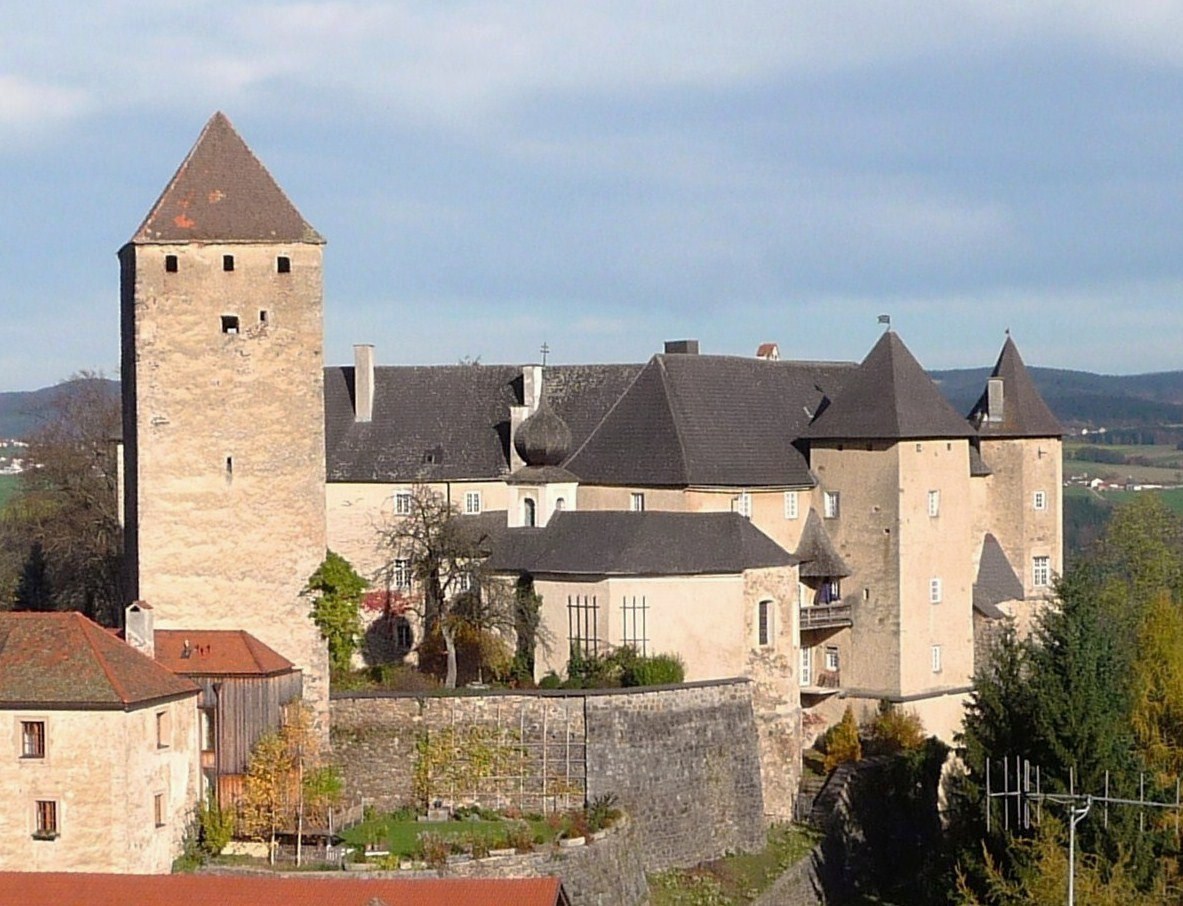
Burg Wernstein exemplifies the mantle castle typology, characterized by a protective curtain wall encircling the site without separate internal buildings beyond this enclosure. The castle's position on a granite hill overlooking the Inn River provided a natural defensive advantage enhanced by substantial man-made fortifications.
Moats, ponds, and earthworks
Encircling the rocky hill is a deep and wide moat meticulously carved into the bedrock, dating from the castle's original construction phase. This moat served as a formidable obstacle against attackers. In front of the moat lies a pond, likely designed to augment the defensive water barrier and supply water to the castle. These water defenses illustrate the sophisticated medieval engineering employed to protect Burg Wernstein.
Gate complex and outerworks
Access to the castle was heavily fortified with a multi-layered defense system. The entrance was guarded by two outerworks (Vorwerke) and a zwinger, a narrow enclosed courtyard acting as a killing zone for attackers trapped between defensive walls. To the right of the entrance stood a tower with an adjoining long residential building designed to accommodate the castle garrison. Although the tower has been partially dismantled, the adjacent covered longhouse remains and is currently used for agricultural purposes.
Residential buildings and modifications
On the left side of the gate is the main residential building, which has undergone numerous modifications over centuries. These changes gradually diminished its military features in favor of domestic comfort, reflecting evolving uses from fortress to habitation. Despite these alterations, the castle's walls, gatehouse, and earthworks are largely preserved, allowing visitors to appreciate the original defensive layout.
Cultural heritage and restoration efforts
In front of Burg Wernstein stands a replica of a Marian column, modeled after a 1646 design by Johann Jacob Pock. This religious monument symbolizes the intertwining of spiritual authority and territorial claims during the early modern period, adding cultural depth to the castle's forecourt.
The castle's water defenses, curtain walls, and gatehouse have been documented in historical engravings and modern photographs, demonstrating the continuity of its visible archaeological features. Although Burg Wernstein fell into disrepair over time, it underwent restoration in the late 20th century, preserving its significant medieval character for future generations.
Burg wernstein in the context of regional fortifications
Burg Wernstein's proximity and historical connection to Neuburg Castle highlight its role within a network of fortifications controlling the Inn River corridor. This strategic positioning was crucial for monitoring trade routes and military movements between Austria and Bavaria. The castle's enduring presence exemplifies the military architecture and feudal dynamics of the High and Late Medieval periods in Central Europe.
Today, the municipality of Wernstein am Inn encompasses the historical settlement around the castle and the village of St. Georgen am Inn, reflecting the castle's influence on local development. Visitors to Burg Wernstein can explore its well-preserved fortifications and appreciate the layered history embedded in its stones, from medieval stronghold to early modern industrial site.
Frequently asked questions (FAQ)
- How do I get to Burg Wernstein?
- Burg Wernstein is located in Wernstein am Inn, Austria, near the Inn River. It is accessible by local roads and is best reached by car or regional public transport services.
- What is the historical significance of Burg Wernstein?
- Burg Wernstein served as a strategic hill castle controlling the Inn River region since the early 12th century. It played a role in regional power struggles, including the Babenberg succession crisis and Bohemian incursions.
- Can visitors explore the castle's fortifications?
- Yes, visitors can observe the well-preserved curtain walls, gatehouse, moat, and earthworks that illustrate the castle's medieval defensive design. Some residential buildings remain, showing historical adaptations.
- When was Burg Wernstein built?
- Burg Wernstein was constructed in the early 12th century, around 1126, by the Counts of Formbach.
- Is Burg Wernstein open to the public?
- As a historic site, Burg Wernstein is accessible for viewing its exterior fortifications and surroundings. However, access to interior buildings may be limited due to preservation and private ownership.
Information
Website
Visit websiteSources & official resources
Verify the information above using these authoritative references.
Loading map...
Visitor reviews
No reviews yet. Been here? Write the first review and help other travelers!
Write the first reviewVisited this castle? Share your experience
Your review helps other travelers and adds first-hand knowledge to our encyclopedia.