Burg Vichtenstein
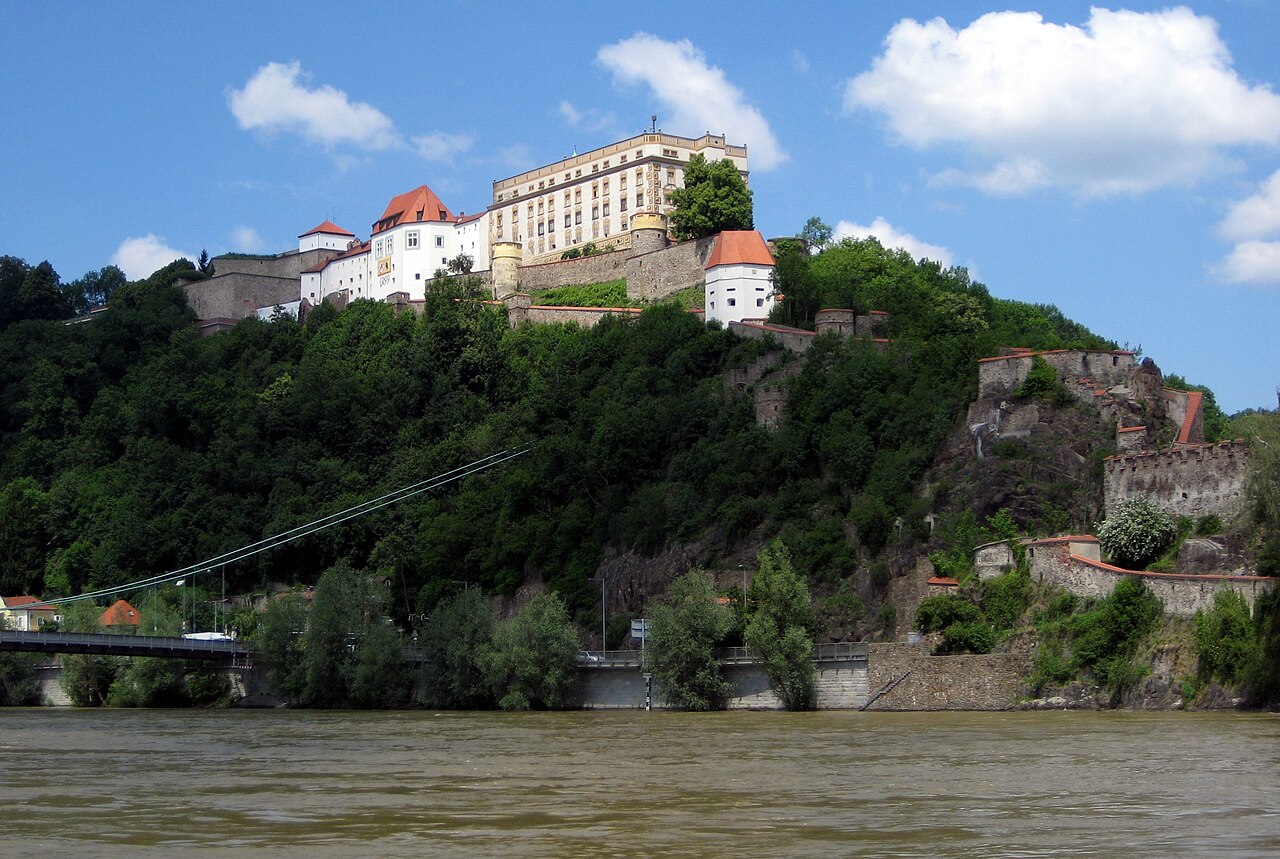
Burg Vichtenstein is a striking medieval hill castle perched on a rocky promontory overlooking the Danube valley in Upper Austria. Its commanding position above the river and the surrounding landscape has made it a significant strategic and administrative site since its origins in the early 11th century. The castle's long and complex history is intertwined with the noble families of the region, the powerful Bishopric of Passau, and later secular authorities, reflecting the shifting political and military landscape of medieval and early modern Central Europe.
The castle’s earliest origins are believed to date back to around the year 1100, possibly constructed on the site of an earlier Roman watchtower, which underscores the strategic importance of this location since antiquity. The noble Formbach family, who held comital rights in eastern Bavaria from the 9th century, are considered likely founders, with figures such as Count Tiemo I von Vornbach and Heinrich II von Formbach (died 1090) associated with its early history. The name "Vichtenstein" first appears in a document from 1070 issued by Bishop Altmann of Passau, derived from the abundant spruce trees ("Vichten") in the area.
Historical development and ownership transitions
In the 12th century, the castle passed from the Formbach counts to the Benedictine Abbey of Vornbach in 1125, marking a significant shift in ownership from secular to ecclesiastical hands. Subsequently, through marriage alliances in the mid-1100s, the castle came under the control of the Counts of Hall and Wasserburg. However, these new owners focused their power bases elsewhere, which diminished the castle's strategic prominence.
During the early 13th century, Count Konrad von Wasserburg-Vichtenstein participated in crusades and used the castle as collateral for a loan to the Bishopric of Passau. This financial arrangement led to disputes and ultimately resulted in the castle gradually coming under the bishopric's control between 1230 and 1244. Under the bishopric, Burg Vichtenstein served multiple functions, including as a hunting residence and an occasional prison. It was managed by episcopal custodians until the secularization of church lands in 1803.
The castle’s history during the late medieval period is marked by frequent pledging and sales. Notable figures involved include Andreas Haller, a city judge and leader of a citizen revolt in Passau, Friedrich von Puchberg, and the Counts of Schaunberg. After political conflicts, the castle reverted to the possession of the Bishopric of Passau.
Following secularization, the castle became property of the Austrian state. Between 1810 and 1816, it briefly belonged to Bavaria before passing into private ownership. Industrialist Laurenz Fölser acquired it in 1862, followed by Count Julius von Falkenhayn and the Pachta family from 1868. During and after World War II, the castle was used as a transit camp for refugees, leading to damage caused by overcrowding. Restoration efforts began after 1955, and today the castle remains privately owned by the Schulz-Wulkow family.
Architectural features and layout
Castle structure and defensive elements
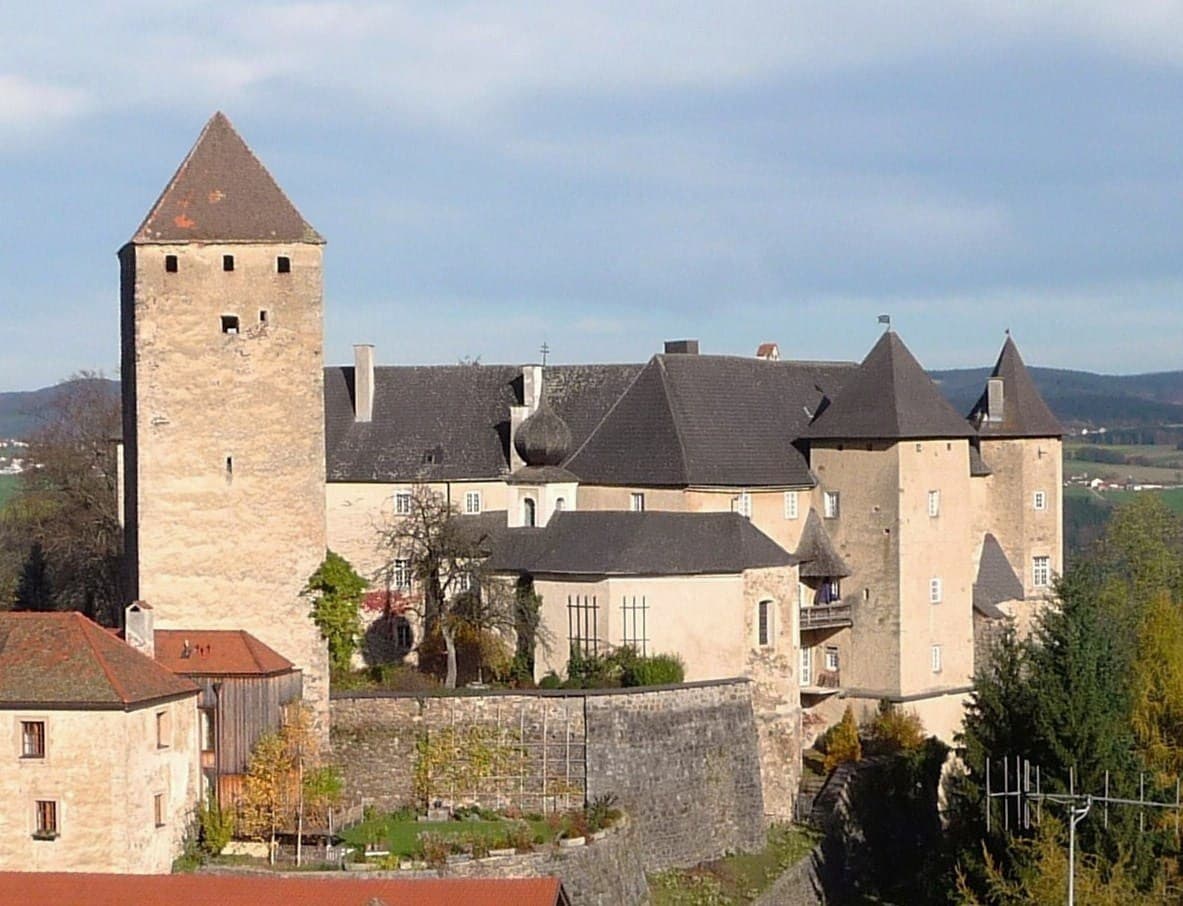
Burg Vichtenstein is a classic example of a hill castle designed to maximize natural defenses by utilizing the rocky promontory above the Danube. Access to the castle is gained via a brick bridge spanning a moat, leading to a high Gothic pointed-arch gate. The gate retains slots indicating the former presence of a drawbridge, a typical defensive feature of medieval fortifications.
Beyond the gate lies an elongated outer courtyard enclosed by curtain walls. These walls were reinforced with projecting towers designed to enable flanking fire, a defensive tactic to protect the castle’s perimeter. The outer courtyard opens into the inner courtyard, which contains the main residential and service buildings.
Residential buildings and keep
The inner courtyard is lined along the northern and eastern curtain walls by three-story residential buildings. These structures preserve Romanesque foundations in their basements and feature a Romanesque arched portal on the western side, showcasing the castle’s architectural layering through centuries.
The most prominent architectural feature of the castle is its massive square keep, or bergfried, which rises nearly 35 meters tall. The lower four floors of the keep have walls between 2.5 and 3.5 meters thick, constructed from quarry stone with granite blocks reinforcing the corners for added strength. The upper three floors were added later in the Gothic period, featuring thinner walls and topped by a steep pyramidal roof.
Each facade of the keep is adorned with three Romanesque arched windows. These windows were designed without views from below, indicating they served a symbolic rather than defensive purpose. A stone staircase is integrated within the wall thickness at the upper levels, allowing access to the higher floors.
Chapel and additional defensive towers
Adjacent to the keep stands a chapel dedicated to Saint Hippolytus. The chapel is architecturally notable for its combination of an 11th-century presbytery with ribbed vaulting and a 17th-century nave featuring barrel vaulting. These two parts are joined at an obtuse angle, a distinctive architectural feature. A small tower with an onion dome rises from the chapel, adding to the castle’s silhouette.
The castle’s defensive curtain walls included three projecting towers: a square western tower originally housing stairs and later converted for residential use; a square southeast tower also used for residential purposes; and a round shell tower at the northeast corner. The shell tower is the oldest defensive tower and was later modified with an octagonal top.
Former stables located between the chapel and keep were removed during 19th-century demolitions of curtain walls. The castle’s ring wall is reinforced by towers designed to allow flanking fire, a testament to its medieval defensive planning.
Cultural significance and preservation
Burg Vichtenstein is recognized as a cultural monument by the Republic of Austria under monument number 38365, highlighting its importance as a heritage site. The castle retains much of its original medieval character despite extensive rebuilding and restoration efforts spanning from the 16th to the 20th century.
The incorporation of a Roman relief bust as spolia within the castle walls underscores the site’s deep historical layering and connection to earlier periods. The castle’s preservation and ongoing private ownership ensure that it remains a significant landmark reflecting the region’s medieval history and architectural heritage.
Frequently asked questions (FAQ)
- How do I get to Burg Vichtenstein?
- Burg Vichtenstein is located in the municipality of Vichtenstein, Upper Austria. It is accessible by regional roads, and visitors can reach the castle by car or local transport to nearby towns, followed by a walk to the hilltop site.
- What is the historical significance of Burg Vichtenstein?
- Burg Vichtenstein has a rich history dating back to the early 11th century, serving as an administrative center for the Bishopric of Passau and reflecting medieval power struggles in the region.
- Can I visit the interior of Burg Vichtenstein?
- Burg Vichtenstein is privately owned, and public access to the interior is limited. Visitors can explore the castle grounds and appreciate its architecture from the outside.
- When is the best time to visit Burg Vichtenstein?
- The best time to visit Burg Vichtenstein is during the warmer months from late spring to early autumn, when the weather is favorable for exploring the castle grounds and enjoying views of the Danube valley.
- Are there guided tours available at Burg Vichtenstein?
- As Burg Vichtenstein is privately owned, guided tours are not regularly offered. Visitors should check local tourism offices for any special events or occasional openings.
Photo gallery

Information
Sources & official resources
Verify the information above using these authoritative references.
Loading map...
Visitor reviews
No reviews yet. Been here? Write the first review and help other travelers!
Write the first reviewVisited this castle? Share your experience
Your review helps other travelers and adds first-hand knowledge to our encyclopedia.