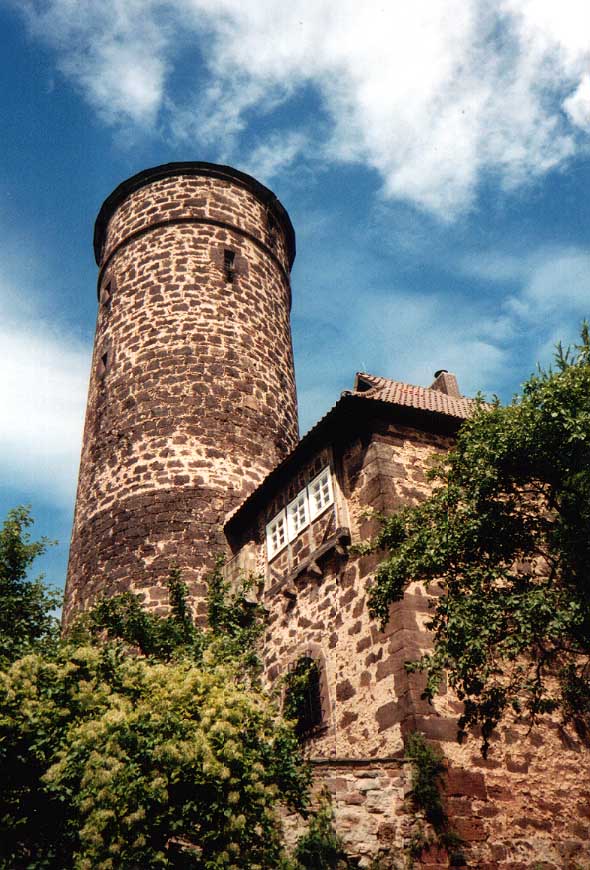
Burg Sensenstein
Burg Sensenstein stands as a significant example of a medieval hill castle (Höhenburg) located in the municipality of Nieste, Germany. Constructed in the 14th century, it was strategically positioned atop Gerholdsberg hill at approximately 355 meters above sea level, commanding extensive views over the Nieste valley and the wider Kassel basin. This vantage point was critical for its original role as a military fortress, designed to protect the Hessian territories from incursions by the neighboring Duchy of Brunswick during a period marked by frequent border disputes.
The castle's foundation began around 1372 under the direction of Landgrave Hermann of Hesse, who was co-ruler of the land at the time. Burg Sensenstein was part of a broader network of fortifications intended to secure the borders of Hesse and assert control over the contested Kaufunger Forest region. Its placement on a prominent hilltop was typical of hill castles, maximizing natural defensive advantages and enabling surveillance of the surrounding landscape.
Historical development and ownership
The earliest documented mention of Burg Sensenstein dates to 1438, when Landgrave Ludwig I of Hesse granted the castle as a fief to the knight Sittich von Berlepsch. This transfer marked the beginning of a period during which the castle's military importance gradually diminished. In 1461, von Berlepsch exchanged Burg Sensenstein for Schloss Berlepsch, signaling a shift in the castle's function from a fortress to a more domestic and recreational role.
Subsequently, Burg Sensenstein became a favored hunting lodge for the Landgraves, capitalizing on its location within the richly forested Kaufunger Forest. From 1483 to 1561, the castle and its lands were held as a Hessian fiefdom by the Counts of Berlepsch. During this era, the estate experienced a decline in strategic and residential significance, compounded by frequent changes in ownership which contributed to its physical deterioration.
By the late 16th century, specifically around 1585, the castle had largely fallen into ruin, with only a manor farm remaining on the site. This farm continued to operate until 1626, after which the property was abandoned for several decades. In 1677, the estate was acquired by Count Dietrich von Kunowitz, who ordered the demolition of the remaining castle structures. The most prominent feature, the bergfried—a fortified central tower approximately 22 meters tall—was destroyed using explosives, marking the definitive end of Burg Sensenstein as a medieval fortress.
The property changed hands multiple times thereafter. In 1699, it was purchased by Amalia of Courland and her son Maximilian. Later, in 1767, ownership passed to Generalmajor Martin-Ernst von Schliefen. Eventually, the estate reverted to the Hessian state. The last tenant left the property in 1900, after which the surrounding lands were managed from the nearby village of Windhausen.
Legend and cultural significance
The names Burg Sensenstein and the nearby Burg Sichelnstein derive from a local legend symbolizing the historic rivalry and border tensions between Hesse and Brunswick. The names translate to "Scythe Stone" and "Sickle Stone," respectively, metaphorically representing traditional farming tools as emblems of the opposing territories. This folklore reflects the castle’s role not only as a military installation but also as a cultural landmark embodying regional identity and historical conflict.
Architectural features and current remains
Originally, Burg Sensenstein was a classic hill castle designed to exploit its elevated position for defense. The castle's layout included a central bergfried, defensive walls, and extensive earthworks forming high ramparts, primarily on the northwestern side. These ramparts delineated the fortified perimeter and provided protection against attackers.
Today, the castle’s original stone buildings no longer survive. The bergfried, once a towering 22 meters tall, was demolished in 1677, and no vertical masonry remains are visible. What remains are significant earthworks—large mounds and ditches—that outline the former defensive structures and provide archeological evidence of the castle’s medieval fortifications. The site is legally protected as a Bodendenkmal (archaeological monument), ensuring preservation of these ground features.
The Jugendburg Sensenstein youth center
Adjacent to the castle ruins lies the Jugendburg Sensenstein, a youth and sports education center established in the mid-20th century. The center occupies roughly 20 hectares of land near the original castle site and includes modern facilities such as a gymnasium, swimming pool, sports fields, guesthouses, and an auditorium. The Jugendburg serves as a hub for educational programs and recreational activities, continuing the site's legacy as a place of community and learning.
The Jugendburg complex also preserves historical architecture, including a well-maintained half-timbered house that once functioned as a guesthouse in the early 20th century. This building now serves as the administration office for the youth center.
Artistic and cultural installations
The entrance area of Jugendburg Sensenstein features notable artistic elements that connect the site’s rural and historical heritage. Among these is a striking metal sculpture named "Der Riese" (The Giant), created by artist Robert Colnago and installed in 2004. Standing over four meters tall, this sculpture symbolizes strength and resilience.
Additionally, a gate constructed in 2006 incorporates 250 kilograms of iron fragments sourced from old agricultural tools, reinforcing the site's connection to the local farming traditions and the symbolic meaning behind the castle's name.
Visiting burg sensenstein today
Access to the castle ruins and earthworks is managed by the Jugendburg administration to protect the archaeological site. Visitors can explore the earthworks and enjoy occasional views through the forest toward the Kassel basin and the Kaufunger Forest. While no medieval structures remain standing, the site offers a tangible connection to the region’s medieval past and the strategic importance of hilltop fortresses.
The Jugendburg Sensenstein youth center provides educational programs and recreational opportunities, making the site a vibrant location for both historical interest and contemporary community engagement.
Frequently asked questions (FAQ)
- When was Burg Sensenstein built and by whom?
- Burg Sensenstein was constructed around 1372 by Landgrave Hermann of Hesse as a strategic fortress to protect Hessian lands.
- What remains of Burg Sensenstein can visitors see today?
- Today, visitors can see extensive earthworks and ramparts outlining the former castle's defensive perimeter, but no original stone buildings remain.
- What is the Jugendburg Sensenstein?
- Jugendburg Sensenstein is a youth and sports education center established on the castle site, offering modern facilities and educational programs.
- Why was the bergfried of Burg Sensenstein demolished?
- The bergfried was demolished in 1677 by Count Dietrich von Kunowitz due to the castle's decline and disuse, marking the end of its medieval military function.
- Is Burg Sensenstein accessible to the public?
- Access to the ruins is controlled by the Jugendburg administration to preserve the site, but visitors can explore the earthworks and surrounding forest paths.
Information
Sources & official resources
Verify the information above using these authoritative references.
Loading map...
Visitor reviews
No reviews yet. Been here? Write the first review and help other travelers!
Write the first reviewVisited this castle? Share your experience
Your review helps other travelers and adds first-hand knowledge to our encyclopedia.