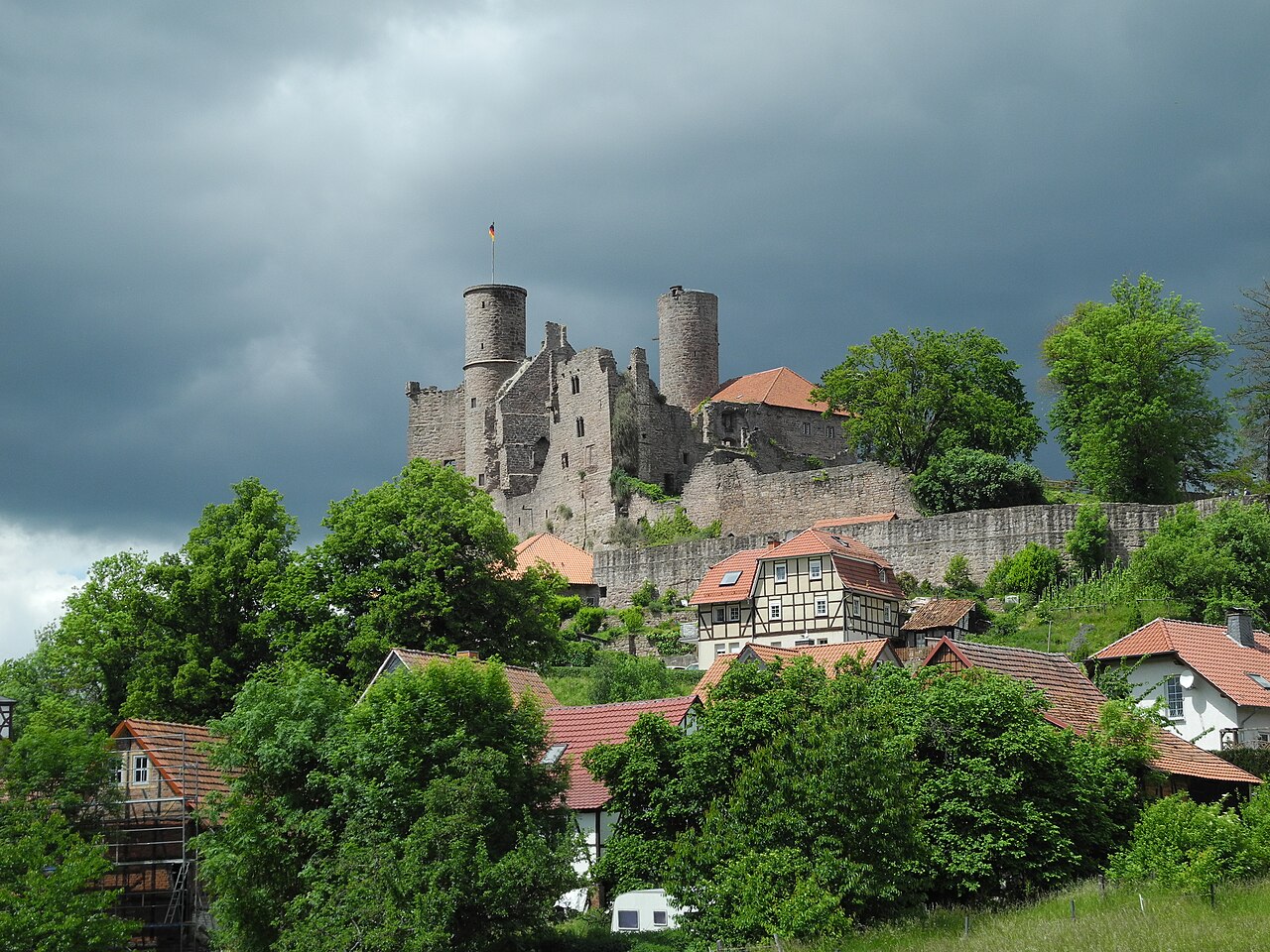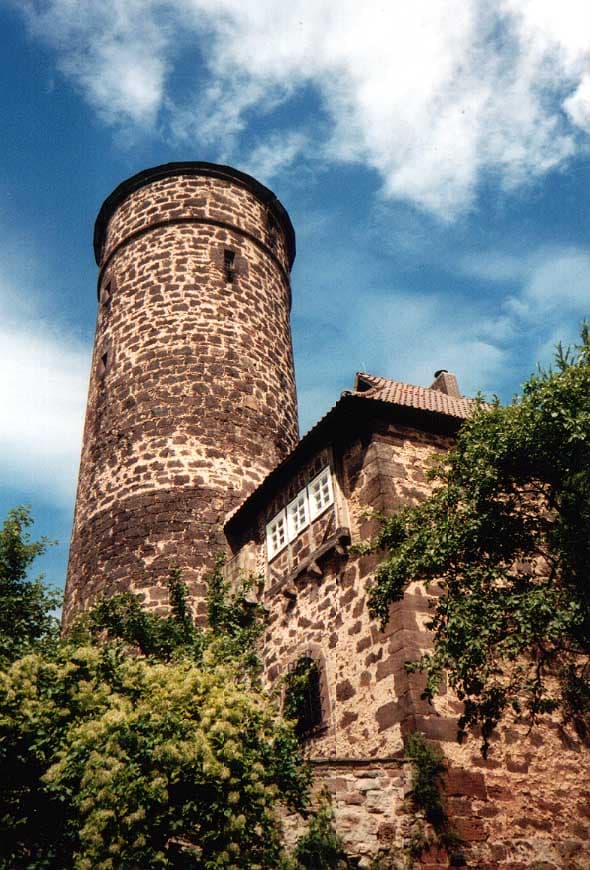
Ludwigstein Castle
Ludwigstein Castle stands as a remarkable example of a late medieval hill castle nestled in the northern foothills of the Soodener Bergland near Werleshausen, Germany. Founded in 1415 by Landgrave Ludwig I of Hesse, this fortress was strategically constructed to guard the contested border between the Landgraviate of Hesse and the Electorate of Mainz’s Eichsfeld territory. Its location atop a 236-meter-high hill provided a commanding view of the surrounding landscape, crucial for its defensive and administrative roles.
The castle's original purpose was primarily military and administrative. It served as the residence of a Hessian Amtmann, a local official responsible for governance and legal authority over the Werra region. This role anchored Ludwigstein as a regional stronghold rather than a seat of broader political power. Throughout the 15th and 16th centuries, it was closely tied to noble families who managed the castle and its surrounding lands, reflecting its importance within Hessian territorial administration.
Architectural features and layout
Ludwigstein Castle’s architecture embodies the functional design typical of a medieval fortress. The castle features a rectangular core composed of four wings enclosing a narrow inner courtyard. The walls, built predominantly from rubble stone masonry, serve both as external defenses and the structural backs of the inner buildings. This compact layout reflects the dual need for defense and administrative efficiency.
The bergfried and defensive elements
The bergfried, or main tower, is a significant defensive feature positioned adjacent to the castle’s western gate. This round tower’s lower two floors have vaulted ceilings, indicative of robust medieval construction aimed at withstanding attacks. The upper floors feature flat wooden ceilings, and the tower’s pointed roof, added in 1857, distinguishes the silhouette from its original medieval form. Notably, the castle lacks a moat or ditch, with the entrance gate leading directly into the courtyard, suggesting a focus on administrative control rather than heavy fortification.
Residential and functional wings
The eastern wing houses a wide residential building with a steep roof, originally containing the kitchen on the ground floor and living quarters above. These quarters were equipped with garderobes (medieval toilets) and fireplaces, highlighting the castle’s role as a residence. The northern and southern wings are narrower and two stories tall; the northern wing’s ground floor served as a stable, while its upper floor was subdivided into multiple rooms, likely converted from a former large hall. The southern wing also contained residential spaces, supporting the castle’s function as a local administrative center.
16th-century remodeling and half-timbered construction
Between 1560 and 1580, Ludwigstein underwent significant remodeling that reflected a shift from military defense to administrative use. The inner faces of the wings were reconstructed with half-timbered construction, combining wooden frames with infill panels. This architectural style was typical in the region and period, providing a lighter and more flexible structure. Windows were renewed with pointed arches featuring interior seating niches, enhancing comfort and functionality within the courtyard-facing rooms.
Notable interior spaces
A particularly noteworthy room is located at the southeastern corner of the castle, retaining its original rubble stone masonry interior. This robust construction likely served as a fireproof archive or secure storage room, emphasizing the castle’s administrative importance. Additionally, a wooden gallery dating from 1702 remains above the courtyard, providing an elevated passageway and vantage point.
Historical significance and ownership
Founded during a period of territorial disputes, Ludwigstein Castle played a pivotal role in the defense and administration of the Hessian frontier. It was initially established to counter the influence of the Electorate of Mainz, particularly its possession of Hanstein Castle nearby. Over time, the castle’s ownership and administrative functions evolved in response to political changes within Hesse.
The role of the amtmann and noble families
The castle served as the seat of the Amtmann, a local official overseeing governance and justice. The first Amtmann, Hans von Dörnberg the Elder, was appointed in 1416, establishing a noble lineage connected to Ludwigstein’s management. The Amtmann’s jurisdiction expanded over the 15th and 16th centuries, incorporating numerous villages documented in registers from 1466 onward.
Fiefdom and reintegration
From 1545 to 1574, Ludwigstein briefly functioned as a fief and independent court under Christoph Hülsing, a chamberlain who received the castle through a family agreement from Landgrave Philip. This period ended when Philip’s son, Wilhelm IV, reclaimed the castle, reintegrating it into the Landgrave of Hesse’s domain.
Administrative changes and decline
In 1627, the castle and its district became part of the Rotenburger Quart, a subdivision of Hesse-Kassel granted to Landgrave Moritz’s second wife and descendants. Ownership passed through the Hessen-Rotenburg line until 1834, when control returned to the main Hesse-Kassel family. After 1664, the Amt Ludwigstein merged with the Schultheißenamt Witzenhausen, ending the castle’s role as an independent administrative seat. Subsequently, it was occupied by agricultural tenants, and the outer bailey was demolished starting in 1862. By 1882, the castle was released from formal upkeep and fell into neglect.
20th-century revival and cultural importance
At the dawn of the 20th century, Ludwigstein Castle gained new significance through its association with the Wandervogel and the broader German Youth Movement. These groups sought to revive youth culture and national identity, acquiring the castle in 1920 as a memorial to around 50,000 Wandervogel members who died in World War I. Restoration was labor-intensive, involving manual transport of stone from the Werra valley to the hilltop site.
Use during the national socialist period
During the Nazi era beginning in 1933, the castle was repurposed as a regional leadership school for the Hitler Youth. It was exclusively used for Nazi youth organizations until the Jugendburg Ludwigstein Association was banned in 1941.
Post-war restoration and youth education center
After World War II, Ludwigstein briefly served as a refuge for displaced persons before being returned to the Jugendburg Ludwigstein Association in 1946. The castle resumed its role as a hub for youth groups including Wandervögel, scouts, and Jungenschaften. It now hosts the Archives of the German Youth Movement, integrated into the Hessian State Archives in 1970, and operates an educational center promoting youth movement history and values since 1982.
Cultural events and educational programs
Ludwigstein Castle continues as a vibrant cultural venue, hosting markets, singing evenings, guided tours, and folk dance festivals with participants from Germany and across Europe. It functions as a youth hostel accommodating 174 guests and offers educational programs such as medieval role-playing and research on youth opposition groups during the Nazi era, including the White Rose and Edelweißpiraten.
Recognition and awards
The castle’s contributions to education and sustainability have earned it several honors, including the Einheitspreis in 2007, designation as part of the 365 Orte im Land der Ideen initiative in 2010, and recognition as a UNESCO Decade Project for Education for Sustainable Development. It has also been commemorated on German postage stamps in 1977 and 2011, the latter celebrating the scenic "two-castle view" alongside nearby Hanstein Castle.
Preservation and modern adaptations
While Ludwigstein Castle has undergone modern renovations, particularly during its 20th-century use as a youth center, its medieval core and many original architectural features remain intact. The castle includes multiple meeting rooms, a large festival hall, and a spacious campsite, supporting its ongoing role as a cultural and communal site. Although the outer bailey no longer exists physically, the castle’s historic character and architectural heritage are well preserved, offering visitors a tangible connection to its rich past.
Frequently asked questions (FAQ)
- How do I visit Ludwigstein Castle and what are the opening hours?
- Ludwigstein Castle is open to visitors primarily during public events and guided tours. Opening hours may vary seasonally, so it is recommended to check the Jugendburg Ludwigstein Association's official website or contact them directly for current visiting times.
- What is the historical significance of Ludwigstein Castle?
- Ludwigstein Castle was founded in 1415 as a defensive and administrative center for the Landgraviate of Hesse. It played a key role in regional governance and border defense against the Electorate of Mainz and later became a cultural hub for the German Youth Movement.
- Can I stay overnight at Ludwigstein Castle?
- Yes, Ludwigstein Castle operates as a youth hostel with accommodation for 174 guests. It offers educational programs and facilities suitable for group stays, making it an ideal location for youth groups and cultural events.
- What architectural styles are represented in Ludwigstein Castle?
- The castle features a mix of medieval rubble stone masonry and later half-timbered construction from the 16th century. Its architecture reflects its evolution from a fortified stronghold to an administrative residence and cultural center.
- Is Ludwigstein Castle accessible for people with disabilities?
- Due to its medieval structure and hilltop location, parts of Ludwigstein Castle may be challenging for visitors with mobility impairments. It is advisable to contact the management in advance to inquire about specific accessibility accommodations.
Photo gallery

Information
Sources & official resources
Verify the information above using these authoritative references.
Loading map...
Visitor reviews
No reviews yet. Been here? Write the first review and help other travelers!
Write the first reviewVisited this castle? Share your experience
Your review helps other travelers and adds first-hand knowledge to our encyclopedia.