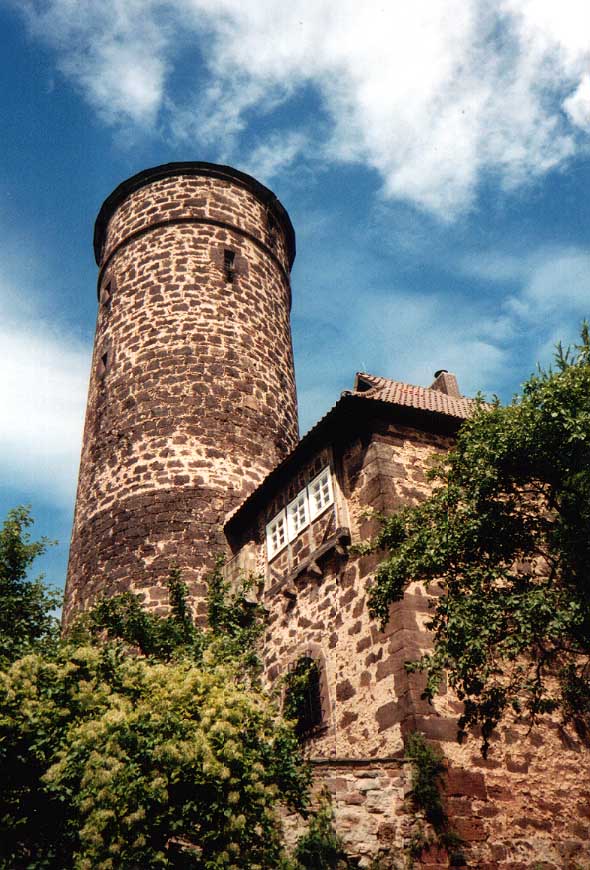
Burg Reichenbach
Burg Reichenbach stands as a significant medieval hill castle ruin near Hessisch Lichtenau in the German state of Hesse. Originally constructed in the mid-11th century, this castle was founded by a branch of the noble Counts Gozmar, who adopted the title Counts of Reichenbach from 1089 onwards. The earliest documented figure in this lineage, Count Gozmar II, served as the high advocate of Fulda Abbey between 1117 and 1139, underscoring the family's regional influence during the High Medieval period.
Strategically perched atop the Schlossberg at an elevation of 522.3 meters, Burg Reichenbach commands sweeping views over the valleys carved by the Losse, Hollsteine, Vockebach, and Essebach streams. Its location within the Reichenbacher Kalkberge nature reserve, known for its distinctive limestone formations, highlights the castle's role in controlling the volatile borderlands between Hesse and Thuringia. Throughout the Middle Ages, the castle's position made it a focal point in territorial disputes involving powerful entities such as the Ludowingians, the Archbishopric of Mainz, and the Landgraves of Hesse.
Historical significance and ownership
By the early 13th century, the Counts of Reichenbach contributed to the religious and military landscape of the region by donating a nunnery and its lands to the Teutonic Order in 1207. This donation marked the Order's first establishment on German soil, reflecting the castle's connection to broader European religious-military developments. Over subsequent centuries, Burg Reichenbach transitioned from a primarily defensive stronghold to serve administrative and leisure functions. From at least 1315, it functioned as a hunting lodge and the seat of a local government district (Amt) under the Landgraves of Hesse.
The castle's military importance persisted into the late 14th century, evidenced by its involvement in the Sternerkrieg (1376–1380), a regional conflict that underscored ongoing power struggles in the border region. Notably, Burg Reichenbach is recorded as the place of death of Landgrave Ludwig II in 1471, adding to its historical prominence. However, after 1490, its administrative role diminished as the nearby town of Lichtenau assumed these responsibilities. Subsequently, the castle was repurposed as a tithe barn until around 1540, reflecting a shift from military and administrative uses to agricultural storage.
The Schmalkaldic War (1546–1547) precipitated the castle's decline when imperial authorities ordered its destruction circa 1550 to prevent its use in further conflicts. While some towers endured into the late 17th century, the castle gradually fell into ruin. The southeast tower collapsed in 1820, and local quarrying further accelerated the degradation of the masonry. Archaeological interest revived in the late 19th century under conservators such as Gottfried Ganßauge, who led excavations and preservation efforts. Between 1899 and 1901, the castle's bergfried (main tower) was restored and converted into an observation tower, a function it retains today.
Architectural features and layout
Burg Reichenbach exemplifies a typical Romanesque fortress design adapted to its borderland context. The castle's most striking surviving feature is the bergfried, a tall, robust tower that served as both a defensive stronghold and a lookout post. Restoration efforts in the late 19th and 20th centuries reinforced its masonry and sealed battlements to enhance stability and visitor safety. From the bergfried, visitors can enjoy panoramic views of the surrounding landscape, including the Kaufunger Wald forest, the Hohen Meißner and Eisberg hills in the Stölzinger Gebirge, and the Himmelsberg within the Melsunger Bergland.
Another critical defensive element is the shield wall (Schildmauer), a massive barrier designed to protect the castle's most vulnerable side against siege engines and direct assault. This wall, combined with two neck ditches—deep, dry moats known as the small and large Halsgraben—created formidable obstacles that isolated the castle from the adjoining hill ridge. These features highlight the castle's strategic emphasis on defense in a contested frontier region.
The southeast tower, once complementing the bergfried, succumbed to collapse in 1820, marking a significant loss in the castle's silhouette. The ruins today reveal the castle's layout, which included residential quarters, defensive walls, and service buildings arranged to maximize both protection and administrative functionality. Although decorative elements and inscriptions have not been extensively documented, archaeological excavations have uncovered structural details that illuminate medieval construction techniques and the castle's evolution over time.
Preservation and modern significance
Following centuries of decline, the late 19th and 20th centuries saw renewed efforts to preserve Burg Reichenbach's remains. The restoration of the bergfried into an observation tower between 1899 and 1901 symbolized a shift toward heritage conservation and public engagement. The establishment of a local preservation society in 1966 further ensured ongoing maintenance and improvements, including the installation of a new external staircase in 2004 to improve visitor access.
Today, Burg Reichenbach stands as a well-preserved hill castle ruin that offers valuable insights into medieval military architecture, regional power dynamics, and the adaptive reuse of castles over time. Its commanding position within a protected natural landscape enhances its appeal for tourists and history enthusiasts alike. The site serves not only as a monument to the turbulent history of the Hesse-Thuringia border but also as a cultural landmark that connects visitors to Germany's rich medieval heritage.
Visitors to Burg Reichenbach can explore the ruins, climb the restored bergfried for expansive views, and appreciate the castle's role in shaping the historical and geographical identity of the region. The castle's integration with the surrounding limestone formations and natural beauty of the Reichenbacher Kalkberge nature reserve further enriches the experience, making it a notable destination for both cultural and ecological tourism.
Frequently asked questions (FAQ)
- What is the historical significance of Burg Reichenbach?
- Burg Reichenbach, built in the 13th century, holds great historical significance as a medieval fortress that played a crucial role in the regional defense strategy. It reflects the architectural styles of its time and offers insights into the feudal system that prevailed in Germany during the Middle Ages.
- When was Burg Reichenbach constructed?
- Burg Reichenbach was constructed in the early 13th century, with its origins dating back to around 1250. The castle has undergone various modifications over the centuries, which highlight the evolving architectural styles and defensive needs of the time.
- Can I visit Burg Reichenbach?
- Yes, visitors are welcome to explore Burg Reichenbach. The castle is open to the public, providing an opportunity to delve into its rich history and enjoy the scenic views from its towers.
- What are the opening hours for Burg Reichenbach?
- Burg Reichenbach typically opens its doors to visitors from 10 AM to 6 PM during the peak season, which runs from April to October. It's advisable to check the official website for any seasonal changes or special events that may affect opening hours.
- Is it possible to access Burg Reichenbach with mobility aids?
- While Burg Reichenbach is a historic castle, access may be challenging for those with mobility aids due to uneven paths and staircases. However, the staff are generally willing to assist and provide information about the most accessible routes.
- What are the ticket prices for visiting Burg Reichenbach?
- Tickets to Burg Reichenbach are reasonably priced, with adult admission typically around €5, while discounts may be available for children and seniors. It's recommended to check the castle's official website for the most current pricing and any special offers.
- When is the best time to visit Burg Reichenbach?
- The best time to visit Burg Reichenbach is during the spring and early autumn months when the weather is pleasant and the surrounding landscape is particularly beautiful. Additionally, visiting during weekdays can help avoid the larger crowds often present on weekends.
- Are there any nearby attractions to visit alongside Burg Reichenbach?
- Yes, there are several nearby attractions worth visiting, including the charming town of Hessisch Lichtenau and the scenic hiking trails in the surrounding area. The region is rich in history and natural beauty, providing a full day of exploration for visitors.
Information
Website
Visit websiteSources & official resources
Verify the information above using these authoritative references.
Loading map...
Visitor reviews
No reviews yet. Been here? Write the first review and help other travelers!
Write the first reviewVisited this castle? Share your experience
Your review helps other travelers and adds first-hand knowledge to our encyclopedia.