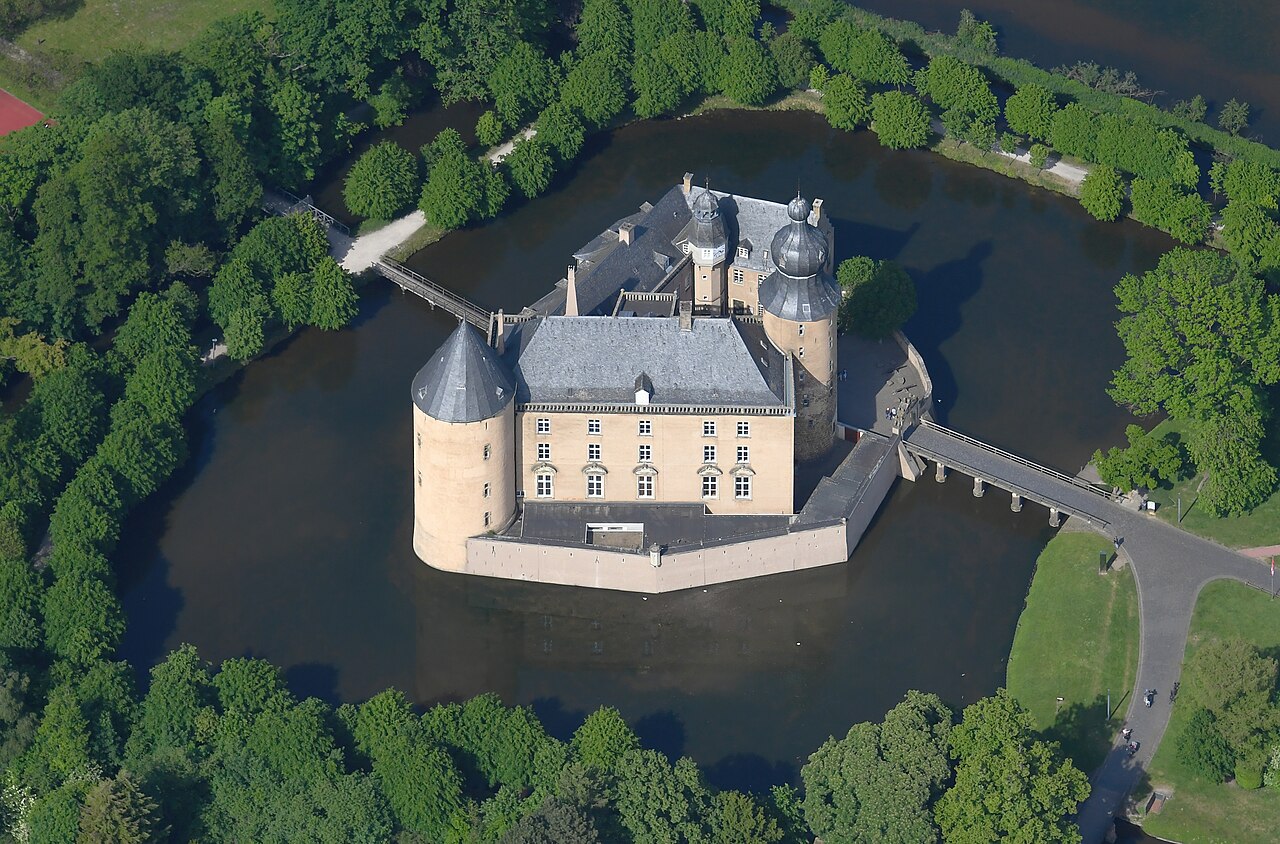
Burg Rhede was a significant medieval castle located in the municipality of Rhede, within present-day Germany. Originally constructed in the mid-13th century, it served as a fortified residence for the noble Rethe family, specifically Gerlach von Rethe gen. Bitter, who were ministeriales under the Bishop of Münster. This connection highlights the castle's strategic and administrative importance within the ecclesiastical territories of the region during the High Medieval period.
The castle's initial construction reflected typical medieval defensive architecture, characterized by its classification as a motte castle. This type of fortification was distinguished by a raised earth mound or motte, often accompanied by a surrounding moat, providing a formidable defense against attackers. Historical cadastral maps document the site as oval-shaped with traces of a moat and a rectangular building foundation atop the motte, indicating the location of the main residential or administrative structure.
Historical context and construction phases
Origins and early history
The Rethe family, serving the Bishop of Münster from at least the 12th century, established Burg Rhede as a symbol of their territorial control and feudal authority. The castle's construction around the mid-13th century coincided with a period of territorial consolidation and fortification across the region. The strategic placement "auf dem Berge" or "on the hill" provided natural defensive advantages, typical of hill castles, allowing surveillance over the surrounding landscape.
Destruction and rebuilding in the 14th century
In 1324, Burg Rhede was destroyed by the Bishop of Münster amid regional conflicts, reflecting the turbulent political landscape of the time. Approximately fifty years later, around 1370, the castle was reconstructed by the Rhemen family. This rebuilding phase likely maintained the motte castle design, emphasizing the continued military and administrative significance of the site. By 1379, records show Burg Rhede as an episcopal fief, indicating its governance under the bishop's authority.
However, the castle's stability was short-lived. In 1388, it was destroyed again, this time by citizens from the nearby town of Bocholt. This event underscores the tensions between ecclesiastical authorities and emerging urban centers during the late medieval period. Following this destruction, any further construction required explicit permission from the bishop and his cathedral chapter, reinforcing the castle's ecclesiastical ties.
Later developments and transformation
While there may have been additional damage after 1392, the castle was definitively rebuilt in 1426 on the opposite side of the Rheder Bach stream, where Schloss Rhede now stands. A construction phase mentioned around 1451 remains unclear, but by 1507, the castle, then referred to as "Oldeborg," had become united with the neighboring estate of Dörbröcking. From this point, its ownership history closely followed that of Schloss Rhede.
In the 19th century, the original medieval site of Burg Rhede was transformed with the construction of a representative residential building in 1844. This building later became part of the St. Gudula monastery, established between 1924 and 1925, which incorporated the 19th-century residence as its southern wing. The monastery itself was converted into the Catholic educational center Akademie Klausenhof in 1983, marking the site's continuous adaptation through centuries.
Architectural features and site layout
The defining characteristic of Burg Rhede was its motte castle layout, a common medieval fortification style designed to maximize defense through elevation and water defenses. The oval-shaped motte was surrounded by a moat, a water-filled ditch that served as a protective barrier against siege attempts. The rectangular foundation within the motte likely supported the main residential or administrative building, constructed using typical medieval materials and techniques, although specific details remain undocumented.
Despite the lack of surviving physical structures, historical records and cadastral maps provide valuable insights into the castle's original configuration. The presence of the moat and earthworks indicates the application of standard defensive strategies of the time, including controlling access and enhancing visibility for defenders.
Subsequent overbuilding and loss of medieval remains
Over the centuries, the original site of Burg Rhede has undergone extensive transformation. The 19th-century residential building and the 20th-century St. Gudula monastery have completely overbuilt the medieval footprint, resulting in the loss of visible medieval structural elements. Today, no physical remains of the castle survive above ground, with knowledge of its layout and features derived primarily from historical documentation and regional mapping.
Cultural and historical significance
Burg Rhede exemplifies the evolution of medieval fortifications in the Rhineland-Westphalia region, reflecting the shifting political, religious, and social dynamics from the 13th to the 15th centuries. Its repeated destruction and rebuilding highlight the contested nature of territorial control between ecclesiastical authorities and local urban powers.
The castle's association with the Bishop of Münster and families like the Rethe and Rhemen underscores the intertwined nature of feudal and ecclesiastical governance during the High and Late Medieval periods. Furthermore, the site's later adaptation into religious and educational institutions illustrates the enduring legacy of medieval sites within modern cultural landscapes.
Archaeological potential
Although no visible ruins remain, Burg Rhede's site holds archaeological significance due to its documented motte layout and historical importance. Future archaeological investigations could potentially uncover subsurface remains, providing deeper insights into medieval construction techniques, material culture, and the daily life of its inhabitants.
Information
Loading map...
Visitor reviews
No reviews yet. Been here? Write the first review and help other travelers!
Write the first reviewVisited this castle? Share your experience
Your review helps other travelers and adds first-hand knowledge to our encyclopedia.