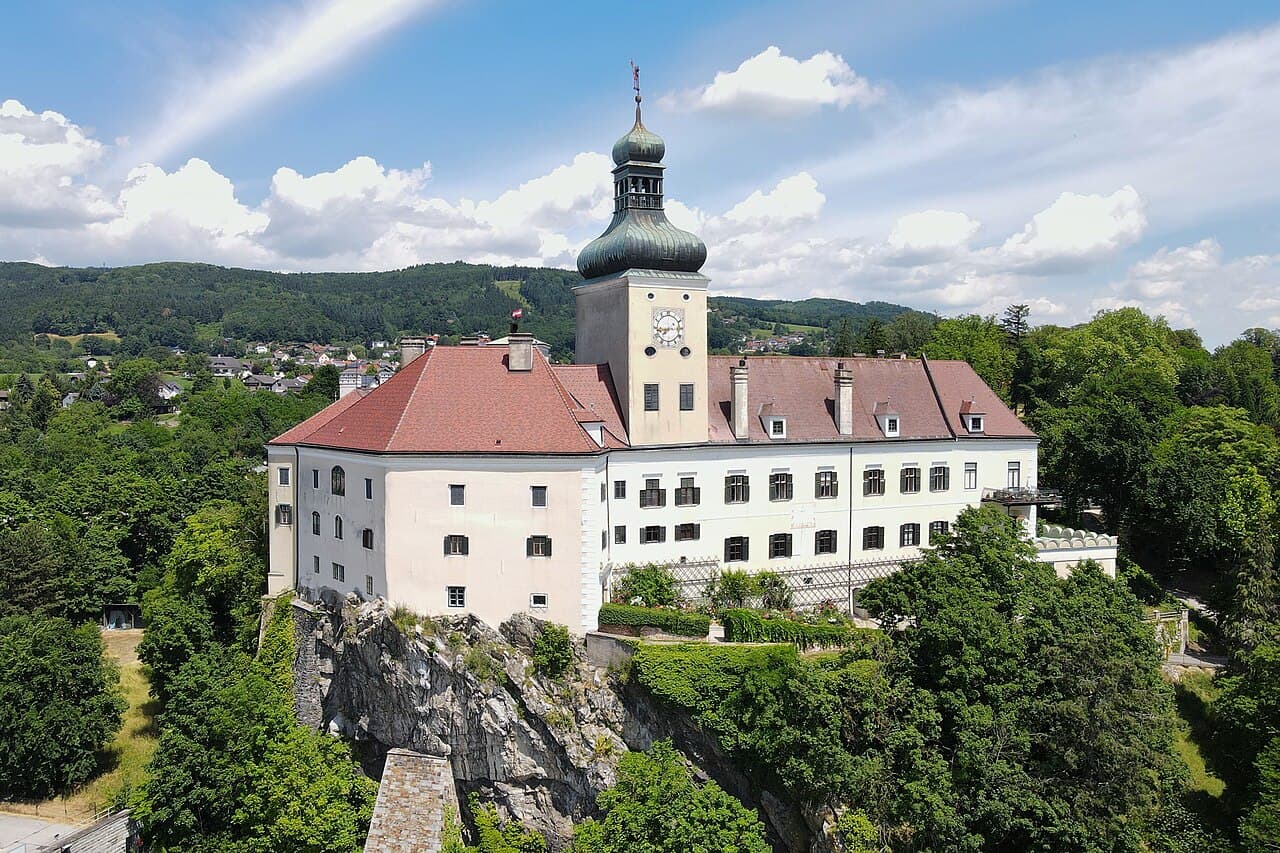
Persenbeug Castle
Persenbeug Castle stands as a remarkable example of a historic hill castle strategically perched above the Danube River in the municipality of Persenbeug, Austria. Its origins trace back to the early medieval period, specifically the year 970 AD, when the Bavarian Count of Sempt and Ebersberg fortified the site, originally known as "Bösenberg." This early fortification served as a critical defensive position overseeing the river and surrounding lands, marking the castle's initial role as a military stronghold in the region.
The castle's history is deeply intertwined with prominent noble families and the Habsburg dynasty, which held ownership until the late 16th century. The castle's present architectural form primarily reflects extensive renovations carried out during the 16th century Renaissance period under the noble Hoyos family, who transformed it from a medieval fortress into a stately residence. Later, in the early 19th century, ownership passed to Emperor Francis I of Austria, who acquired the estate as a private property, further cementing its significance within Austrian imperial heritage.
Early history and foundation
The earliest documented phase of Persenbeug Castle dates to around 907 AD, when Sieghart, Count of Sempt and Ebersberg, took possession of the site then called "Bösenberg." He fortified the hilltop location, establishing a defensive stronghold that would serve as the foundation for the castle's future development. This period also marks the beginning of the Sempt-Ebersberg lineage associated with the castle, which lasted until 1045.
A notable historical event occurred on 27 May 1045 during an inheritance settlement held in the castle's knights' hall. The gathering was attended by King Henry III along with high-ranking clergy and nobility. Tragically, the hall's floor collapsed under the weight of the assembled crowd, causing several deaths including Bishop Bruno of Würzburg, Abbot Altmann of Ebersberg, and Richlind, widow of Adalbero II. King Henry III survived with minor injuries, underscoring the castle's role as a significant political and social venue in medieval Austria.
Ownership transitions and architectural evolution
Following the end of the Sempt-Ebersberg family line in 1045, Persenbeug Castle passed through various noble hands. The Habsburg dynasty maintained possession of the castle until 1593, when it was acquired by the Hoyos family. The Hoyos undertook significant remodeling efforts, transforming the castle's medieval military architecture into a more comfortable and representative noble residence. These renovations incorporated elements of the Renaissance architectural style, which was prevalent in Europe during the 16th century.
In the early 1800s, the castle's ownership changed again when Emperor Francis I of Austria purchased Persenbeug Castle and its surrounding estate on 3 December 1800. This acquisition included the nearby Gutenbrunn estate, further expanding imperial holdings in the region. The properties later came under the possession of Emperor Franz Joseph I, who in 1916 gifted them to his daughter Marie Valerie, illustrating the castle's continued importance within the Habsburg family.
The castle and the last emperor
Persenbeug Castle holds a special place in Austrian history as the birthplace of Charles I of Austria, the country's last emperor. Born within the castle walls on 17 August 1887, Charles I's connection to Persenbeug underscores the estate's significance as a royal residence. Today, the castle and its lands, encompassing approximately 13,700 hectares of predominantly forested terrain, remain in the care of descendants from the Habsburg-Lorraine and Waldburg-Zeil families.
Architectural features and preservation
The core of Persenbeug Castle is situated on the hill historically known as "Bösenberg," offering a natural vantage point above the Danube River. The castle's architecture reflects its evolution from a medieval stronghold to a Renaissance noble residence. While detailed records of the castle's structural layout and dimensions are limited, the castle's construction utilizes traditional regional materials consistent with its periods of development.
Major renovations by the Hoyos family in the late 16th century introduced Renaissance elements, softening the fortress's defensive character and emphasizing residential comfort and aesthetics. This transformation included the addition of refined living quarters, representative halls, and possibly ornamental features typical of Renaissance noble estates.
Persenbeug Castle is officially protected as a historic monument in Lower Austria, reflecting its cultural and architectural value. It forms part of a network of aristocratic estates in the area, including Schloss Rorregg and Schloss Gutenbrunn, highlighting the region's historical pattern of noble estate management and social organization.
Current condition and use
Today, Persenbeug Castle is well preserved and maintained as a historic site. It is available for private events such as weddings and parties, offering visitors a chance to experience its historical ambiance. The castle's extensive grounds and scenic location add to its appeal as a venue for special occasions.
Cultural significance and heritage
Persenbeug Castle's rich history, architectural evolution, and connection to prominent historical figures contribute to its status as a significant cultural landmark in Austria. Its preservation ensures that the legacy of medieval fortifications, Renaissance noble residences, and imperial heritage continues to be appreciated by present and future generations.
Frequently asked questions (FAQ)
- How do I visit Persenbeug Castle?
- Persenbeug Castle is primarily a private estate and event venue, so public access may be limited. It is best to check in advance for any public tours or special events that allow visitors.
- What is the historical significance of Persenbeug Castle?
- Persenbeug Castle is historically significant as an early medieval fortified site, a noble residence remodeled in the Renaissance, and the birthplace of Austria's last emperor, Charles I.
- When was Persenbeug Castle built?
- The castle's origins date back to around 970 AD when it was first fortified by the Bavarian Count of Sempt and Ebersberg.
- Can I rent Persenbeug Castle for events?
- Yes, Persenbeug Castle is available for private events such as weddings and parties, offering a unique historic setting for special occasions.
- Why is Persenbeug Castle important in Austrian history?
- The castle is important due to its continuous ownership by notable noble families, its architectural evolution, and its connection to Emperor Charles I, Austria's last monarch.
Photo gallery

Information
Current owner
Descendants of the Habsburg-Lorraine and Waldburg-Zeil families
Website
Visit websiteSources & official resources
Verify the information above using these authoritative references.
Loading map...
Visitor reviews
No reviews yet. Been here? Write the first review and help other travelers!
Write the first reviewVisited this castle? Share your experience
Your review helps other travelers and adds first-hand knowledge to our encyclopedia.


