Burg Ottenstein
Burg Ottenstein is a prominent hilltop castle located in the picturesque Waldviertel region of Lower Austria, perched above the Ottenstein reservoir. This castle stands as a remarkable testament to medieval fortification and architectural evolution, with origins tracing back to the 12th century. Its strategic location on a high hill provided defensive advantages and commanding views over the surrounding landscape, typical of hill castles designed for surveillance and protection.
The castle's architectural and historical significance is underscored by its castle chapel, which contains rare frescoes from the late 12th century. These early artworks reveal the castle's long-standing religious and cultural heritage. Over the centuries, Burg Ottenstein underwent various phases of construction, renovation, and stylistic transformation, reflecting the changing tastes and needs of its noble owners.
Early history and medieval origins
The earliest documented mention of Burg Ottenstein dates to 1177, referencing Hugo de Ottenstaine, a member of the founding Ottensteiner family. This noble lineage was connected to the lords of Rauheneck near Baden, indicating the castle's integration into the regional feudal network. The Ottensteiner family maintained control of the castle until the early 15th century, overseeing its initial development as a fortified residence.
In the mid-15th century, the castle changed hands to Tobias von Rohr. His ownership ended dramatically after a siege in 1448, during which he was captured following misconduct. This event highlights the castle's military importance during a turbulent period marked by local conflicts and power struggles.
Renaissance additions and lamberg family tenure
By 1516, Burg Ottenstein was acquired by Paul Stodoligk, whose son Eustach initiated significant renovations including the construction of the outer bailey, a fortified courtyard that enhanced the castle's defenses. This addition reflects Renaissance military architectural trends emphasizing layered fortifications.
In 1536, the noble Lamberg family purchased the castle, beginning an extensive period of ownership that lasted over four centuries. The Lambergs elevated their status during this time, becoming barons in 1544 with the title Freiherren von Ortenegg und Ottenstein, and later counts in 1667. Their stewardship saw the castle through several military challenges, including surviving sieges during the Thirty Years' War in 1622 and 1640, and repelling a Swedish attack in 1645.
Baroque transformation and artistic heritage
Starting in 1679, Burg Ottenstein underwent extensive Baroque remodeling. This phase introduced ornate decorative elements, including stucco work in the chapel dedicated to Saint Florian, crafted by the artist Lorando Aliprandi. The chapel's interior became a showcase of early Baroque artistry, contrasting with the underlying medieval frescoes discovered during later restoration.
A unique feature from this period is the "Päpstezimmer" or "Popes' room," adorned with portraits of 241 popes, reflecting the castle's cultural and religious significance. This collection is a rare example of aristocratic patronage of ecclesiastical history and art.
In 1822, the castle's artistic legacy was further recognized when Franz Adam von Lamberg donated the family's art collection to the Vienna Academy of Fine Arts. Simultaneously, the castle archives were transferred to the Lower Austrian State Archive, preserving its historical records for scholarly research.
Romantic historicism and 19th-century renovations
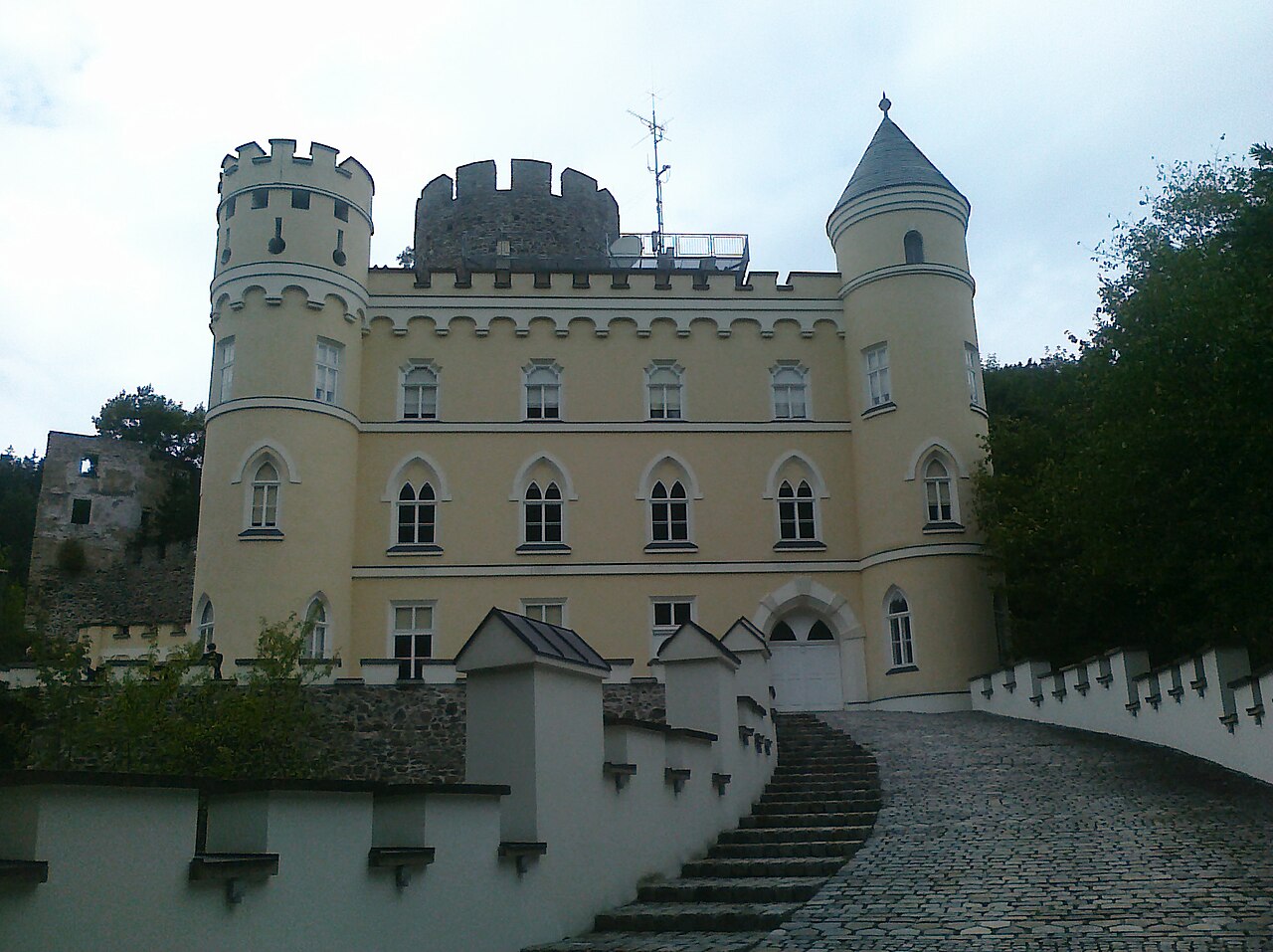
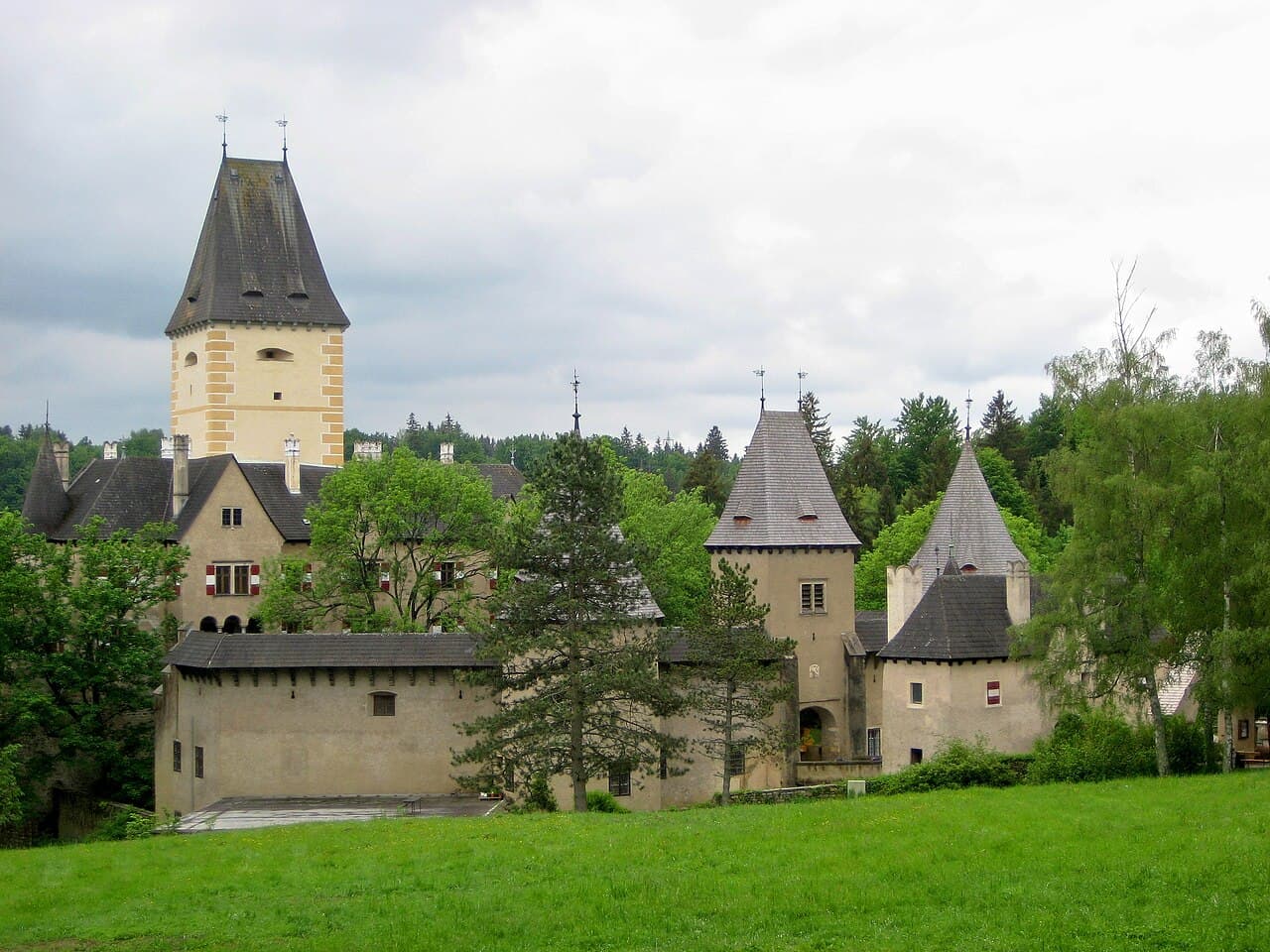
Between 1867 and 1878, Burg Ottenstein was renovated in the Romantic style, a movement that idealized medieval architecture and aesthetics. The castle's roofs were altered from their earlier Baroque onion domes to conical and tent-shaped roofs, adding picturesque silhouettes that enhanced its fairy-tale appearance.
Additionally, the installation of red, white, and red window shutters echoed the national colors of Austria, symbolizing patriotic pride during a period of rising nationalism. These stylistic changes reflect broader 19th-century trends in castle restoration, blending historical reverence with contemporary tastes.
20th-century history and modern usage
In the 20th century, the castle's fortunes were affected by geopolitical events. Around 1940, the surrounding area was cleared to establish the Döllersheim military training ground. Burg Ottenstein was sold to Nazi Germany and later came under Soviet administration as part of the USIA (Soviet Property Administration) after World War II.
During Soviet control, the castle served as officers' quarters but suffered damage due to neglect and military use. Since 1958, the castle has been leased by the EVN energy company and is owned by the Windhag’sche Stipendienstiftung foundation. The outer bailey once housed a restaurant, which operated until its closure in 2014. Currently, the restaurant space is used for pre-arranged groups and events, maintaining the castle's role as a cultural venue.
Architectural features and preservation
Burg Ottenstein's complex includes the main castle and the outer bailey, the latter constructed in the early 16th century to bolster defense. The outer bailey features gates that were originally connected by a drawbridge, replaced at the end of the 17th century by a permanent bridge, illustrating evolving defensive technologies.
The main castle exhibits a blend of architectural styles, prominently featuring Baroque elements from the 17th and 18th centuries. The chapel is a highlight, with its early Baroque stucco decorations by Lorando Aliprandi overlaying the medieval frescoes discovered during restoration in the 1970s.
The late 19th-century Romantic historicism renovations brought distinctive conical and tent-shaped roofs that replaced earlier Baroque onion domes, enhancing the castle's visual appeal and historical ambiance. The red-white-red shutters add a vivid nationalistic touch to the facade.
The interior's "Päpstezimmer" remains a unique cultural treasure, with its extensive collection of papal portraits symbolizing the castle's longstanding connection to religious history.
Despite damage sustained during its use as Soviet officers' quarters, restoration efforts in the 1960s helped preserve key architectural and artistic features. Today, Burg Ottenstein stands as a well-preserved example of a high medieval hill castle that has adapted through centuries of architectural styles and historical events.
Frequently asked questions (FAQ)
- How do I get to Burg Ottenstein?
- Burg Ottenstein is located in Rastenfeld, Austria, and can be reached by car or public transportation. If you are driving, follow the signs from the nearby towns, or you can take a train to the nearest station and then use a taxi or local bus service.
- What is the historical significance of Burg Ottenstein?
- Burg Ottenstein dates back to the 11th century and played a crucial role in the region's defense during various conflicts. Its rich history includes tales of noble families and strategic military importance, making it a fascinating site for history enthusiasts.
- When was Burg Ottenstein built?
- Burg Ottenstein was founded in the 11th century, with its construction reflecting the architectural styles of the medieval period. Over the centuries, it has undergone several renovations and expansions, showcasing the evolution of castle architecture.
- Can I visit Burg Ottenstein year-round?
- Yes, Burg Ottenstein is open to visitors year-round, although the best time to visit is during the spring and summer months when the weather is pleasant. Be sure to check the specific opening hours, as they may vary by season.
- Why is Burg Ottenstein considered an architectural gem?
- Burg Ottenstein features a blend of Romanesque and Gothic architectural styles, with impressive stonework and stunning views of the surrounding landscape. The castle's design and preservation make it a significant example of medieval architecture in Austria.
- Is it possible to tour the interior of Burg Ottenstein?
- Yes, guided tours of the interior of Burg Ottenstein are available, allowing visitors to explore its historic rooms and learn about its history. Reservations are recommended, especially during peak tourist seasons.
- What are the ticket prices for visiting Burg Ottenstein?
- Ticket prices for Burg Ottenstein are quite reasonable, with discounts available for students and seniors. It’s advisable to check the official website for the most up-to-date pricing and any special offers.
- What are the opening hours for Burg Ottenstein?
- Burg Ottenstein typically opens from 9 AM to 5 PM during the tourist season, but hours may vary in the off-season. Always check the castle’s official website or contact them directly for the latest information on opening hours.
- Are there any nearby attractions to visit while at Burg Ottenstein?
- Yes, nearby attractions include beautiful hiking trails, local wineries, and other historical sites in the area. Exploring the scenic surroundings can enhance your visit to Burg Ottenstein.
Photo gallery

Information
Website
Visit websiteSources & official resources
Verify the information above using these authoritative references.
Loading map...
Visitor reviews
No reviews yet. Been here? Write the first review and help other travelers!
Write the first reviewVisited this castle? Share your experience
Your review helps other travelers and adds first-hand knowledge to our encyclopedia.