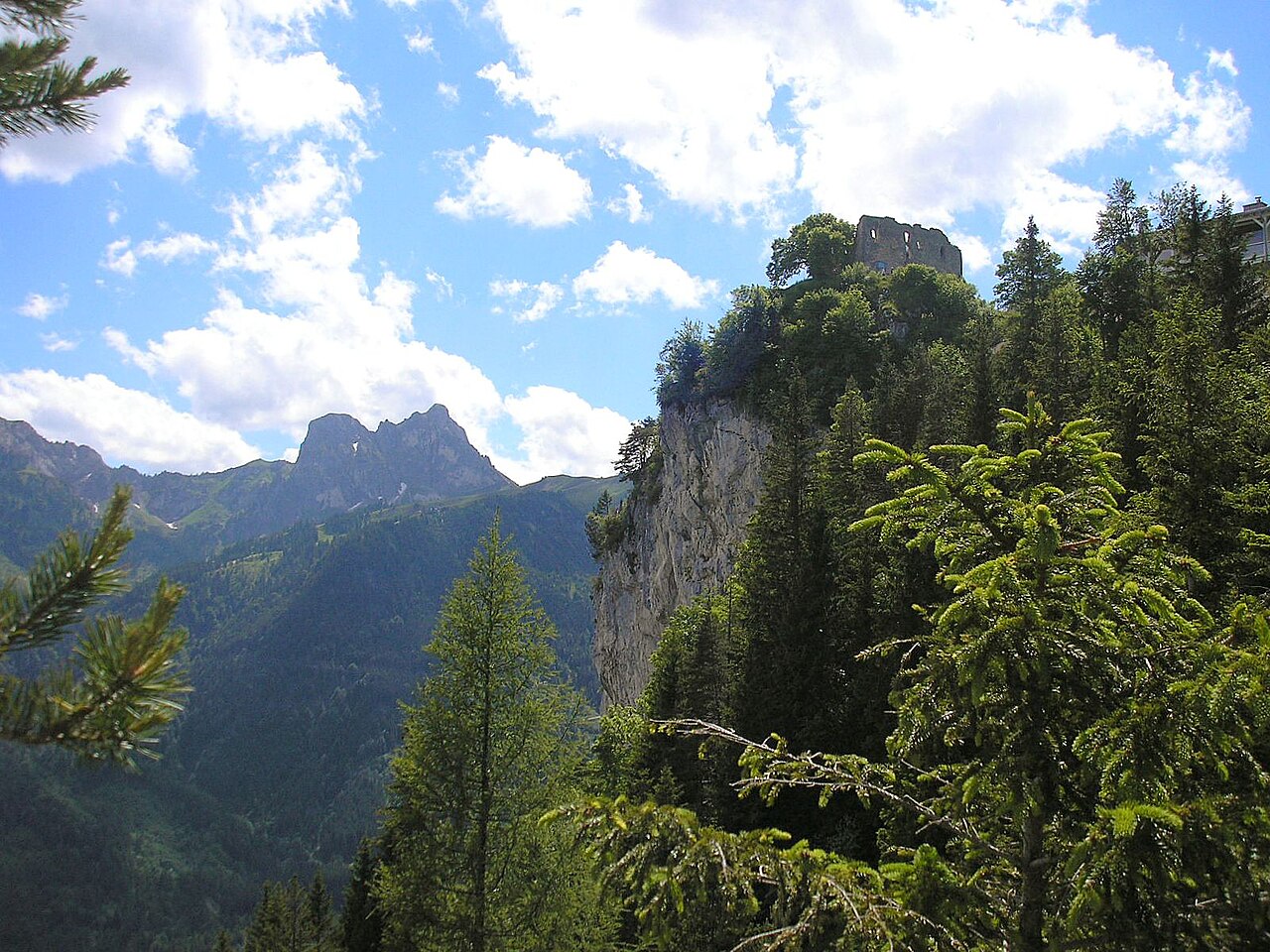
Burg Nesselburg
Burg Nesselburg stands as a significant medieval hill castle ruin located in the municipality of Nesselwang, Germany. Constructed in the late 13th century by the noble Rettenberg family, this fortress played a pivotal role in regional governance and defense through the High and Late Medieval periods. The castle's strategic hilltop position on the Kappelköpfel spur provided natural fortification and commanding views over the surrounding landscape, typical of hill castles designed for both defense and administration.
Early history and ownership transitions
The first documented mention of Burg Nesselburg dates back to 1302, shortly after its completion. Initially, the Rettenberg family maintained control but soon transferred the lordship to the Prince-Bishopric of Augsburg as collateral, retaining the castle as a fief. This arrangement illustrates the common medieval practice of pledging castles to ecclesiastical authorities while preserving noble influence. By the mid-14th century, the extinction of the Rettenberg lineage without heirs led to the castle becoming the administrative center of a Pflegamt, a local government district under the Prince-Bishopric's jurisdiction.
During this period, claims to the castle's inheritance were made by relatives such as Peter von Hohenegg, who ultimately received compensation instead of possession, reflecting the complex feudal and familial negotiations surrounding castle ownership in medieval Germany.
Role during the peasants' war and subsequent use
Burg Nesselburg endured significant turmoil in 1525 during the Peasants’ War, when rebel forces attacked, looted, and set fire to the castle. This event underscores the castle's involvement in wider social and political upheavals of the time. Following repairs, the castle resumed its function as the official residence for Augsburg's administrators until another devastating fire in 1595 rendered it uninhabitable.
At the dawn of the 17th century, administrative functions were relocated to a town house in Nesselwang, which itself succumbed to fire in 1635. Subsequently, a new administrative building was constructed on the castle site, maintaining the location's governmental importance until its demolition in 1976.
Architectural features and defensive structures
The ruins of Burg Nesselburg occupy a rectangular plateau approximately 30 by 23 meters in size, situated about 1038 meters above sea level and rising roughly 170 meters above the town below. The castle's location on the Kappelköpfel hill spur provided natural defense with steep slopes on the east and west flanks, complemented by a man-made defensive ditch cutting across the approach on the mountain side.
The surviving masonry walls are robust, with some sections reaching up to seven meters in height and nearly three meters thick. A prominent feature is the large shield wall on the southern side, built to absorb direct attacks and protect the castle's interior. The remains of the northern palas, the main residential building, are still visible, although its northern wall has mostly vanished. The eastern connecting wall has disappeared, while the western wall containing the original entrance gate remains intact adjacent to the living quarters.
Construction materials include a diverse range of local stones such as river cobbles, Nagelfluh conglomerate, sandstone, and tuff stone, a volcanic rock. Notably, some original quoins survive at the southeast corner, highlighting the precision of medieval masonry techniques. The original access path ascends from the northwest directly to the castle gate, evidencing the planned defensive layout.
Defensive design and terrain modifications
Beyond the walls, traces of former defensive ditches and terrain modifications remain discernible, indicating the castle's layered defense system. These earthworks would have served to hinder attackers and control access, a typical feature of medieval hill castles designed to maximize natural topography for protection.
Modern history and preservation efforts
In 1996, the castle ruins were acquired by a private owner who initiated stabilization efforts to secure the remaining stonework. However, these efforts ceased after a year. More than two decades later, in early 2025, the local market town of Nesselwang purchased the site and surrounding natural area with plans to continue restoration and preservation work.
Since stabilization began in 1997, parts of the masonry have been reinforced to prevent further deterioration, preserving the castle's imposing silhouette on the landscape. The ongoing preservation initiatives aim to maintain this historic site as a cultural landmark and attract visitors interested in medieval architecture and regional history.
Cultural significance and visitor experience
Burg Nesselburg offers visitors a tangible connection to medieval German history, showcasing architectural elements typical of 13th-century hill castles. Its ruins provide insight into feudal administration, military defense strategies, and the impact of regional conflicts such as the Peasants' War.
The castle's elevated position affords panoramic views of Nesselwang and the surrounding Bavarian landscape, enhancing its appeal as a historical and natural attraction. Visitors can explore the remains of the shield wall, palas, and entrance gateway, while interpreting the site's strategic importance through visible earthworks and terrain features.
Frequently asked questions (FAQ)
- When was Burg Nesselburg built and by whom?
- Burg Nesselburg was built in the late 13th century by the noble Rettenberg family, who were responsible for its construction and early administration.
- What happened to Burg Nesselburg during the Peasants' War?
- In 1525, Burg Nesselburg was attacked, looted, and burned by rebels during the Peasants' War, significantly damaging the castle.
- What architectural features remain at Burg Nesselburg?
- The ruins include a large southern shield wall, remains of the northern palas, a western entrance gateway, and robust masonry walls up to seven meters high and three meters thick.
- Who currently owns Burg Nesselburg?
- Since early 2025, Burg Nesselburg has been owned by the municipality of Nesselwang, which plans to continue restoration and preservation efforts.
- Is Burg Nesselburg accessible to visitors?
- While specific visiting hours are not established, the castle ruins are accessible to the public, offering views of the historic structures and surrounding landscape.
Information
Current owner
Municipality of Nesselwang
Loading map...
Visitor reviews
No reviews yet. Been here? Write the first review and help other travelers!
Write the first reviewVisited this castle? Share your experience
Your review helps other travelers and adds first-hand knowledge to our encyclopedia.