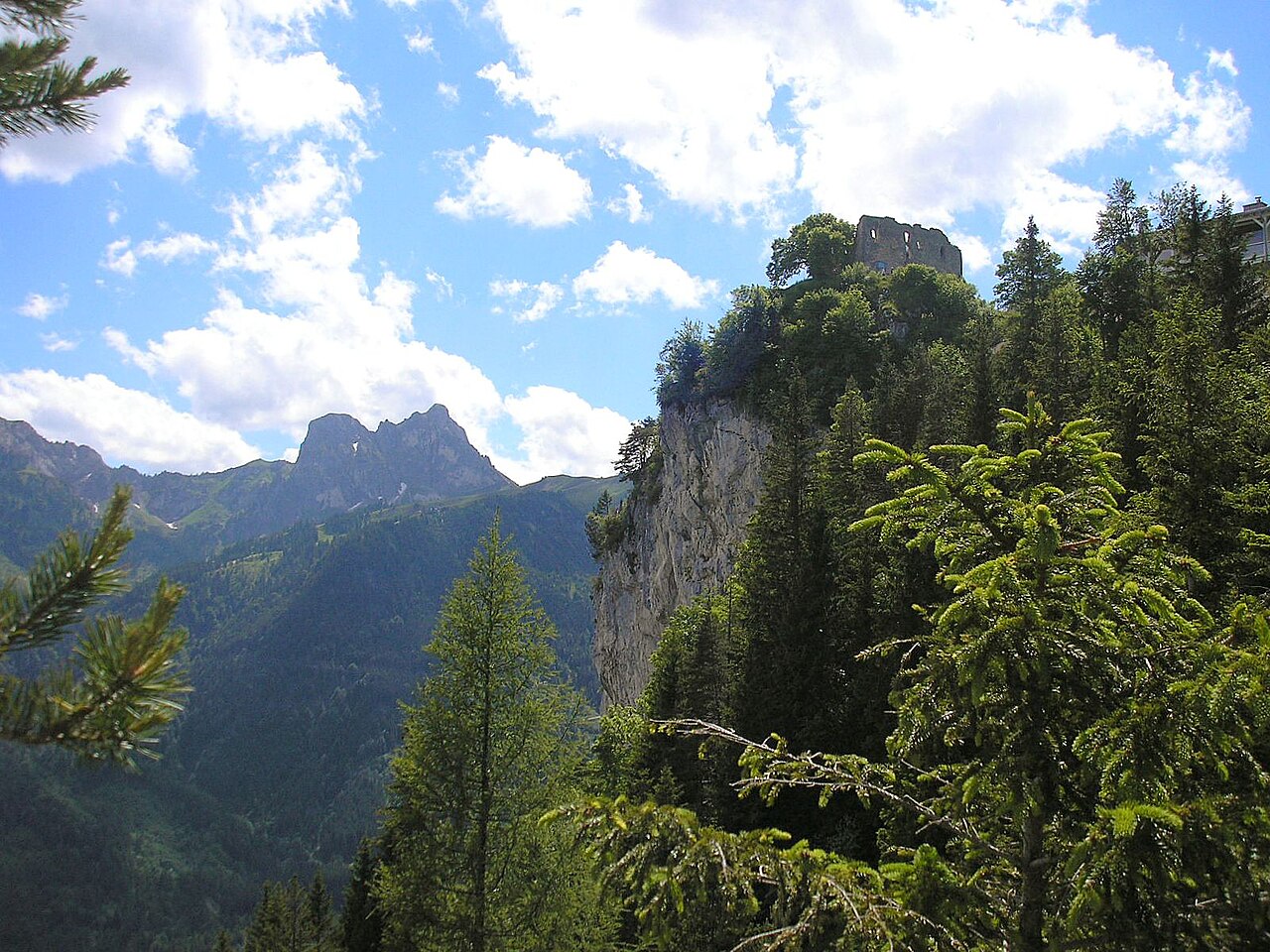
Hohenfreyberg Castle
Hohenfreyberg Castle, locally known as Burgruine Hohenfreyberg, is a significant late medieval hill castle located north of the town of Pfronten in the Bavaria region of Germany. Constructed between 1418 and 1432 by Friedrich von Freyberg zu Eisenberg, the castle stands as an architectural statement deliberately echoing the style of castles from two centuries earlier. Friedrich, the eldest son of the Lord of Eisenberg Castle nearby, intended to manifest enduring aristocratic power during a period marked by the decline of knightly dominance and the rise of the bourgeoisie.
Architectural design and construction phases
The castle was built mainly in three major phases, with the original structure comprising two angled residential buildings within the courtyard, a bergfried-like main tower to the east, and a chapel tower. This inner bailey was enclosed by a short enceinte, while the outer bailey was protected by a crenellated wall, originally lower than what survives today. Wooden domestic and residential buildings likely occupied the plateau of the outer ward. The original entrance to the outer ward was slightly wider but located in the same position as the current gate.
The castle's design intentionally mimicked high medieval hill castles, featuring an impressive bergfried and two palas buildings, symbolizing unbroken aristocratic tradition. The castle track originally circled the north and east sides, meeting the gate of the outer bailey. The inner ward's gate was initially in the south wall, and the outer wall guarded the main entrance in a gateway zwinger arrangement.
Fortification enhancements and artillery adaptations
In 1456, the castle's two gateways were reinforced, and a low artillery hut was added on the west side of the inner bailey to allow defenders to fire light firearms on attackers. The main gate was expanded into a massive gateway structure. Between 1486 and 1502, the castle underwent fundamental remodeling and strengthening. A large artillery roundel was constructed at the southwest corner of the outer ward, and the enceinte's height was increased with embrasures designed for arquebuses. The battery tower guarded a new southern approach, and the inner bailey gate was relocated to the west side with a new gate tower, necessitating demolition of part of the great west palas. The smaller palas was also remodeled, and a complex zwinger system with a semi-circular flanking tower was added to the north and east.
Historical context and ownership
Friedrich von Freyberg's vision of a castle embodying medieval aristocratic power was challenged by the high costs of construction and maintenance. His sons and cousin, lacking a male heir and burdened financially, sold the castle in 1484 to Sigismund, Archduke of Austria. In 1499, the castle was enfeoffed to Georg Gossembrot, a merchant from Augsburg and Pfleger of Ehrenberg Castle, who modernized its defenses significantly.
During the German Peasants' War of 1525, the upgraded fortifications proved effective as the castle successfully resisted an insurgent attack with reinforcements from Innsbruck. However, in 1646, near the end of the Thirty Years' War, the Tyrolean government ordered the castle to be abandoned and set on fire to prevent its capture by the advancing Protestant Swedish army. The destruction was ultimately unnecessary as the Swedish forces changed their route and never reached the area.
Following the Battle of Austerlitz in 1805, Austria ceded its Allgäu possessions to Bavaria. The Kingdom of Bavaria sold Hohenfreyberg back to the Barons of Freyberg in 1841, who remain the owners today. Extensive renovations began in 1995 to preserve the ruins.
Location and strategic importance
Hohenfreyberg Castle is situated on a twin-topped rocky ridge opposite Eisenberg Castle, overlooking the Tannheim Mountains. Its position on a high ridge exemplifies the strategic choice typical of hill castles, providing commanding views and defensive advantages. The castle's location near the border of Tyrol and Bavaria made it a significant military and administrative site during its active use.
Relationship with neighboring castles
The proximity to Eisenberg Castle, only about 200 meters away, reflects a historical connection between the two estates, both owned by branches of the Freyberg family. Along with the nearby Falkenstein Castle, these fortresses formed a defensive network in the region. The coordinated destruction of all three castles in 1646 illustrates their collective military importance.
Current condition and visitor experience
Today, Hohenfreyberg Castle exists as a well-preserved ruin open to the public without charge. The extensive renovation efforts since the 1990s have stabilized the remaining structures, allowing visitors to explore the inner and outer baileys, the bergfried remains, and the artillery fortifications. The castle offers a tangible glimpse into late medieval military architecture and the social history of the aristocracy during a period of significant transition in Europe.
Visitors can appreciate the castle's robust defensive features, including the massive gateway structures, artillery roundel, and the intricate zwinger system. The scenic views of the Allgäu Alps and surrounding landscapes add to the site's appeal, making it a worthwhile destination for history enthusiasts and hikers alike.
Access and amenities
The castle is accessible via a hiking trail from the nearby town of Pfronten, with signage guiding visitors to the site. There are no entrance fees, and the ruins can be explored year-round, although weather conditions in winter may affect accessibility. Informational panels provide historical context on-site, enhancing the visitor experience.
Frequently asked questions (FAQ)
- What is the historical significance of Hohenfreyberg Castle?
- Hohenfreyberg Castle, built in the 13th century, served as a strategic fortress in the region. It played a crucial role in the power struggles of the Bavarian nobility and offers visitors a glimpse into medieval history.
- When was Hohenfreyberg Castle constructed?
- Hohenfreyberg Castle was constructed around the year 1260. It was one of the two castles built by the Counts of Flandern, serving as a defensive stronghold for centuries.
- Can I visit Hohenfreyberg Castle year-round?
- Yes, Hohenfreyberg Castle is open to visitors throughout the year. However, it's advisable to check specific opening hours during the winter months as they may vary.
- What are the opening hours for Hohenfreyberg Castle?
- The castle is typically open from 9 AM to 5 PM during the summer months and from 10 AM to 4 PM in the winter. It's best to verify the hours before your visit, especially during holidays.
- Is Hohenfreyberg Castle accessible for visitors with disabilities?
- While efforts have been made to make Hohenfreyberg Castle accessible, some areas may still pose challenges due to its historical architecture. Visitors with mobility concerns should contact the castle administration for detailed accessibility information.
- When is the best time to visit Hohenfreyberg Castle?
- The best time to visit Hohenfreyberg Castle is during the late spring and early autumn when the weather is pleasant and the surrounding landscapes are at their most beautiful. This timing also allows for various outdoor activities in the nearby area.
- What are the ticket prices for Hohenfreyberg Castle?
- Ticket prices for Hohenfreyberg Castle are generally affordable, with discounts available for children, students, and seniors. It's advisable to check the official website for the most current pricing and any special promotions.
- Are there any nearby attractions to Hohenfreyberg Castle?
- Yes, several attractions are located near Hohenfreyberg Castle, including the picturesque Pfronten village and the stunning Alps. Visitors can also explore other nearby castles for a full day of historical sightseeing.
Information
Address
Next to Burgweg 50, Germany
Loading map...
Visitor reviews
No reviews yet. Been here? Write the first review and help other travelers!
Write the first reviewVisited this castle? Share your experience
Your review helps other travelers and adds first-hand knowledge to our encyclopedia.