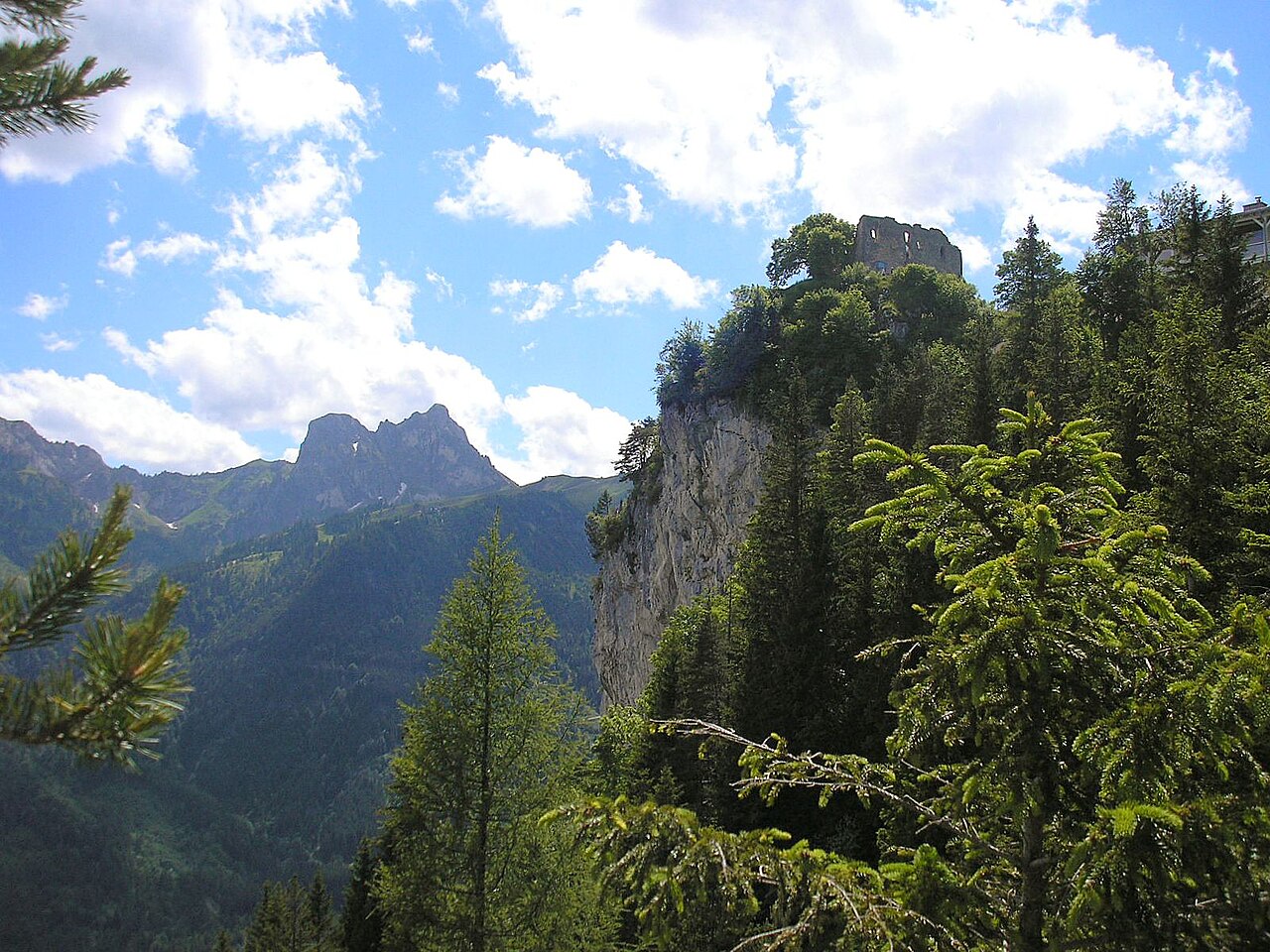
Eisenberg Castle
Eisenberg Castle, also known locally as Burgruine Eisenberg, is a remarkable medieval hilltop fortress located north of the town of Pfronten in the Bavaria region of southern Germany. Constructed in the early 14th century, around 1313 to 1315, by the noble Hohenegg family, the castle was established as a new stronghold after the family lost their previous seats, Loch and Vilsegg, to Tyrolean expansion. Its strategic position atop the Isenberch hill in the foothills of the Tannheimer Mountains provided commanding views and defensive advantages, making it a significant regional power center during the Late Medieval period.
The castle was first documented in 1340 under the name "uf den Isenberch," reflecting its elevated location. In 1382, the Hohenegg family sold Eisenberg Castle to Duke Leopold III of Austria, who granted it as a fief to Friedrich von Freyberg, connected to the Hoheneggs by marriage. The Freyberg family maintained control of Eisenberg for several centuries, overseeing its development and defense.
Architectural design and defensive features
Eisenberg Castle is a classic example of a hill castle designed as a mantelmauerburg, characterized by a continuous, high curtain wall that envelops the entire main castle. This architectural choice eliminated the need for a central keep, as the curtain wall itself served as the primary defensive structure. In the late 15th century, the curtain wall was heightened and topped with battlements to enhance defense against attackers.
The main castle features an oval-shaped layout approximately 38.5 by 25 meters in size. Within the curtain walls, several key structures were built directly against the inner side, including two residential palaces, a chapel, a bakery, a bathhouse, and storage rooms. The castle also housed a cistern to collect and store water, essential for sustaining inhabitants during sieges. Vaulted cellars beneath some of these buildings have partially survived, offering valuable insight into the castle’s internal organization.
Surrounding the main castle is a strong outer ward or zwinger, added to improve defensive capabilities. The outer bailey was fortified with four half-round shell towers reaching the height of the walls, with an additional similar tower reinforcing the zwinger wall near the main gate. Originally, the main entrance was located on the east side but was blocked in the 16th century, with the current main gate positioned on the west side. This gate is connected to the outer bailey by a large earth-filled bastion, enhancing access and defense.
Within the outer bailey stands a low, square tower that likely functioned as a lookout or artillery platform. Today, it contains a wooden viewing platform offering panoramic views of Pfronten and the surrounding Allgäu and Tyrolean mountains.
Historical significance and ownership
The castle’s history is closely tied to the shifting political landscape of the region. The Hohenegg family built Eisenberg Castle after losing their previous castles to the Tyrolean under Count Meinhard II. The new fortress symbolized their power and served as a defensive stronghold against Tyrolean and Austrian interests.
In 1382, the castle was sold to the Habsburg Duke Leopold III of Austria, who entrusted it to Friedrich von Freyberg. The Freyberg family, through marriage alliances and loyal service, held Eisenberg for centuries. In 1418-1432, the eldest son of Friedrich von Freyberg built the neighboring Hohenfreyberg Castle, creating a local network of fortifications.
During the German Peasants' War of 1525, Eisenberg Castle was seized and damaged by rebellious peasants. The Freyberg family received compensation around 1535 and undertook extensive rebuilding and modernization. This included the construction of a new stair tower, a bakery, a bathhouse, and several toilets integrated into the curtain wall, reflecting advances in comfort and hygiene for the time. The main gate was also relocated to the west.
The castle’s demise came during the Thirty Years' War. In September 1646, Austrian forces deliberately abandoned and set fire to Eisenberg Castle to prevent its capture by the advancing Swedish army. This scorched earth tactic was also applied to nearby fortresses Hohenfreyberg and Falkenstein. Ironically, the Swedish forces soon changed course and never reached the area, rendering the destruction strategically unnecessary.
Following its destruction, Eisenberg Castle remained a ruin. The Freyberg-Eisenberg family retained ownership until 1952. In 1980, the municipality of Eisenberg acquired the site and initiated restoration efforts in partnership with a local preservation society. These efforts focused on stabilizing the ruins and preserving the castle’s historical fabric, culminating in the establishment of a small museum in the nearby village of Zell.
Archaeological discoveries and preservation
Extensive archaeological excavations conducted in the late 20th century uncovered the castle’s foundational walls, earthworks, and water defenses, providing detailed insight into the castle’s layout and evolution. The preservation work was carried out using traditional methods to maintain structural stability without extensive reconstruction, allowing visitors to experience the authentic medieval atmosphere.
Besides the main castle, the site includes remnants of two other nearby fortifications, known by names such as Fürstenstuhl, Königsburg, or Goldenberg. These sites, dated between the 13th and 15th centuries, likely formed part of the broader defensive network controlling the surrounding territory. Features such as neck ditches, ring walls, and ramparts remain visible, enhancing understanding of medieval military architecture in the region.
Today, Eisenberg Castle is freely accessible to visitors who can explore the well-preserved ruins and enjoy spectacular views from the castle’s vantage points. The site is complemented by a nearby radio transmission facility, which operates on 106.3 MHz, demonstrating the blend of historical heritage and modern use.
Visitor information and cultural significance
Visitors to Eisenberg Castle can explore the extensive ruins, including the impressive curtain walls, residential buildings, chapel, and defensive towers. The wooden viewing platform in the outer bailey offers breathtaking vistas of the Allgäu landscape and the Tyrolean Alps, making the site a popular destination for history enthusiasts and hikers alike.
The castle’s rich history, architectural uniqueness as a mantelmauerburg, and its role in regional conflicts contribute to its cultural significance. Restoration efforts and the establishment of a museum in Zell help preserve and communicate the castle’s legacy, ensuring that Eisenberg remains an important landmark in Bavaria’s medieval heritage.
Frequently asked questions (FAQ)
- How do I get to Eisenberg Castle from Pfronten?
- Eisenberg Castle is located just north of Pfronten and can be reached by a short hike from the town center. Follow local hiking trails or signs leading to the castle ruins near Burgweg 50.
- What is the best time to visit Eisenberg Castle?
- The best time to visit Eisenberg Castle is during the late spring through early autumn months when the weather is favorable for hiking and outdoor exploration. The castle grounds are open year-round but may be less accessible in winter due to snow.
- Can I explore the ruins freely?
- Yes, Eisenberg Castle ruins are freely accessible to the public. Visitors can walk around the site, explore the curtain walls, towers, and enjoy panoramic views from the viewing platform in the outer bailey.
- Is there a museum related to Eisenberg Castle?
- Yes, a small museum dedicated to Eisenberg Castle's history is located in the nearby village of Zell. It offers exhibits on the castle's construction, historical events, and archaeological findings.
- Why was Eisenberg Castle destroyed?
- Eisenberg Castle was deliberately set on fire and abandoned by Austrian forces in 1646 during the Thirty Years' War to prevent its capture by the advancing Swedish army. This scorched earth tactic was common to deny strategic use to enemies.
Information
Current owner
Municipality of Eisenberg
Website
Visit websiteAddress
Next to Burgweg 50, Pfronten, Bavaria, Germany
Sources & official resources
Verify the information above using these authoritative references.
Loading map...
Visitor reviews
No reviews yet. Been here? Write the first review and help other travelers!
Write the first reviewVisited this castle? Share your experience
Your review helps other travelers and adds first-hand knowledge to our encyclopedia.