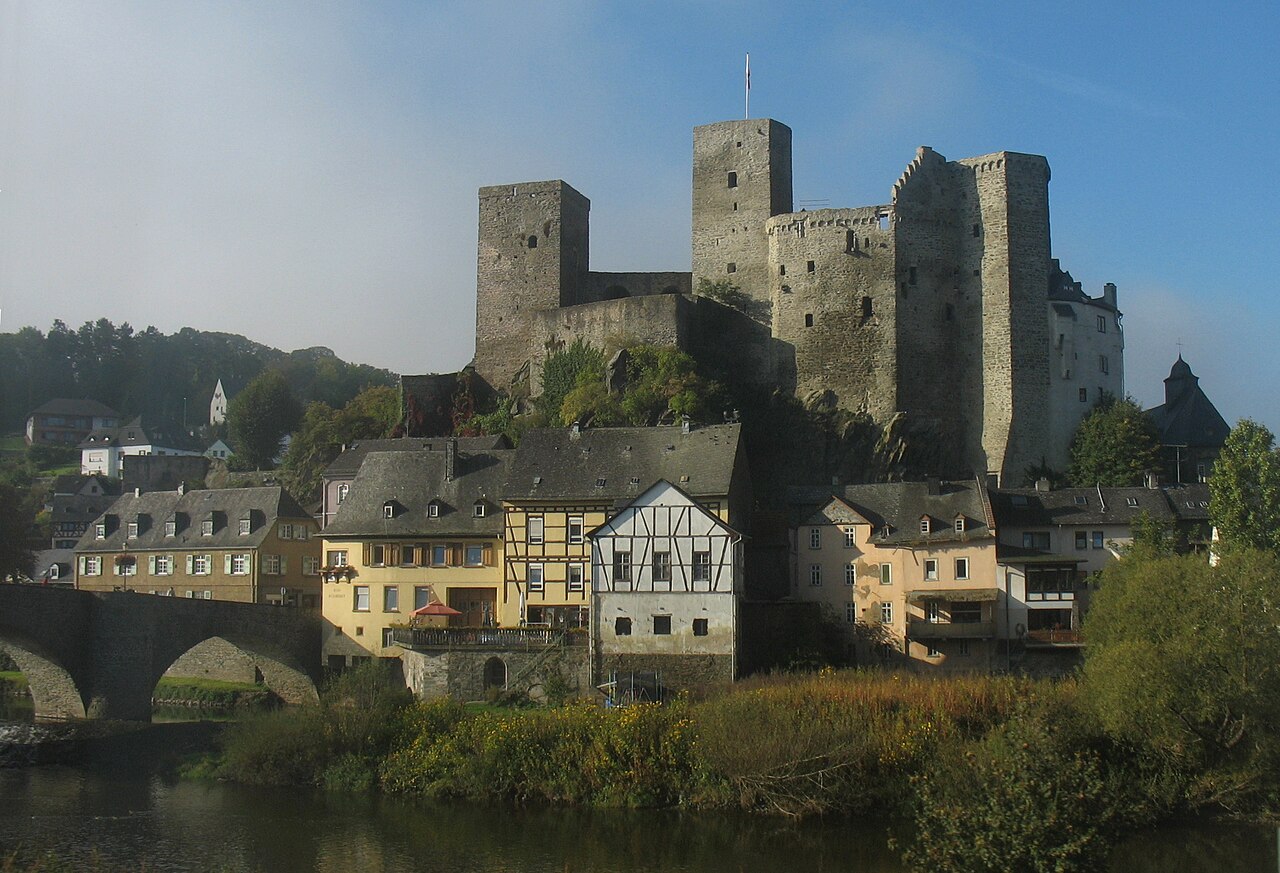
Burg Merenberg
Burg Merenberg stands as a significant medieval hill castle ruin located in the municipality of Merenberg, Germany. Perched atop the prominent Schlossberg basaltic hill at an elevation of approximately 337 meters, the castle occupies a naturally defensible position that was strategically chosen by its medieval builders. The castle's origins trace back to the early 12th century, with the first documented mention dating to 1129. This early record marks Burg Merenberg as an important stronghold in the region during the High Middle Ages.
The castle was initially constructed by German settlers during a period of territorial consolidation and feudal expansion. Its location on a volcanic hill provided both natural defense and commanding views of the surrounding landscape, which was essential for surveillance and military advantage. The castle's architectural design reflects typical medieval fortification principles, including a robust stone construction and a layout adapted to the hilltop terrain.
Historical development and feudal significance
Throughout its history, Burg Merenberg played a vital role within the feudal hierarchy of the region. From 1163 onward, the castle came under the control of the Gleiberg lordship, a notable territorial power during the 12th century. Despite this, the local noble family of Merenberg retained specific judicial rights and comital authority, indicating a complex division of power and a layered governance structure.
By 1333, the castle passed through marriage into the hands of the Nassau-Weilburg family, an influential noble house in the German territories. This transition marked a shift in the castle's function, as it increasingly served as a summer residence for the Nassau-Weilburg counts rather than solely a military fortress. This change reflects broader trends in castle use during the Late Middle Ages, where comfort and status began to complement defensive needs.
Castle occupants and administrative roles
During the late medieval period, from the 13th or 14th century onward, Burg Merenberg was occupied by a class of lower nobility known as Burgmannen. These individuals were responsible for the castle's defense and day-to-day administration. Among them were members of the Schütz family from nearby Holzhausen, illustrating the castle’s integration into regional noble networks.
In the 16th and 17th centuries, the castle also housed an Amtmann, an official appointed to oversee local administration and governance. This role underscores the castle's continued importance as a center of regional authority well into the early modern period.
Destruction and decline during the thirty years’ war
Burg Merenberg met its decline during the tumultuous period of the Thirty Years’ War (1618–1648), which devastated many German territories. In 1646, the castle was destroyed amid widespread military conflicts and was subsequently abandoned as a defensive stronghold. The war's destructive impact left the castle in ruins, marking the end of its active use.
Architectural features and surviving remains
The castle's remains today offer valuable insights into medieval fortification architecture and noble residence design. The most prominent surviving structure is the 22-meter-high round bergfried, a type of keep that served as a last refuge during attacks and as a watchtower. Its robust stone construction exemplifies medieval defensive architecture, and it remains accessible as a viewing platform, providing panoramic views of the surrounding landscape.
Fragments of the palas, the main residential building, survive at one corner of the castle. Originally a three-story structure, the palas housed the lord and his household, combining residential comfort with defensive considerations. The remains of outer walls and underlying cellars further illustrate the castle's layout, including storage and support areas essential for sustaining the inhabitants during sieges.
The castle’s position on a volcanic hill influenced its design, with defensive towers and living quarters arranged to maximize protection while accommodating noble residence needs. The surviving masonry and foundation remains allow historians and visitors to reconstruct the castle’s historical footprint and understand its architectural evolution despite the destruction it suffered in the 17th century.
Cultural significance and tourism today
Today, Burg Merenberg is valued as a cultural heritage site, attracting visitors interested in medieval history and architecture. Its ruins provide a tangible connection to the region’s feudal past and the complex socio-political dynamics of medieval Germany. The castle's elevated location and preserved bergfried offer unique opportunities for sightseeing and historical education.
Efforts to preserve the ruins focus on maintaining structural stability and facilitating public access, allowing visitors to explore the site safely. Interpretive signage and guided tours help contextualize the castle’s historical importance and architectural features, enhancing the visitor experience.
Overall, Burg Merenberg exemplifies a medieval hill castle adapted to its volcanic hilltop setting, reflecting centuries of noble residence, military significance, and regional governance. Its ruins stand as a testament to the architectural ingenuity and historical complexity of medieval German castles.
Frequently asked questions (FAQ)
- How do I get to Burg Merenberg?
- Burg Merenberg is located in Merenberg, Germany, easily accessible by car or public transport. If you're traveling by train, the nearest station is in Wetzlar, from where you can take a bus or taxi to the castle.
- What is the historical significance of Burg Merenberg?
- Burg Merenberg is a well-preserved medieval castle that dates back to the 13th century, showcasing the architectural style and defensive needs of that era. It played a crucial role in the region's history, serving as a residence for the noble family of Merenberg and later becoming a symbol of local heritage.
- When was Burg Merenberg built?
- Construction of Burg Merenberg began in 1250, making it one of the oldest castles in the area. Over the centuries, it has undergone various renovations and restorations, helping to preserve its historical character.
- Can I visit Burg Merenberg year-round?
- Yes, Burg Merenberg is open to visitors throughout the year, although specific opening hours may vary by season. It’s advisable to check the castle's official website for the most up-to-date information regarding visitor access.
- Why is Burg Merenberg a popular tourist attraction?
- Burg Merenberg attracts visitors due to its stunning medieval architecture, picturesque setting, and rich history. The castle offers guided tours, beautiful views of the surrounding landscape, and events that bring its history to life.
- Is it possible to take guided tours of Burg Merenberg?
- Yes, guided tours are available at Burg Merenberg, providing visitors with in-depth knowledge about the castle's history and architecture. These tours are typically offered in multiple languages and can enhance your overall experience.
- What are the ticket prices for visiting Burg Merenberg?
- Ticket prices for Burg Merenberg are generally affordable, with discounts available for students and seniors. Children under a certain age may enter for free, so it’s best to check the official website for specific pricing details.
- What are the opening hours of Burg Merenberg?
- Burg Merenberg usually opens at 10 AM and closes at 6 PM, but these hours can vary based on the season or special events. Always check the official website for the latest information on opening hours before your visit.
- What nearby attractions can I visit while in Merenberg?
- While visiting Burg Merenberg, you can also explore the charming town of Merenberg, known for its scenic walking trails and local shops. Additionally, nearby attractions include the historic town of Wetzlar and the beautiful Lahn River, perfect for outdoor activities.
Information
Website
Visit websiteSources & official resources
Verify the information above using these authoritative references.
Loading map...
Visitor reviews
No reviews yet. Been here? Write the first review and help other travelers!
Write the first reviewVisited this castle? Share your experience
Your review helps other travelers and adds first-hand knowledge to our encyclopedia.