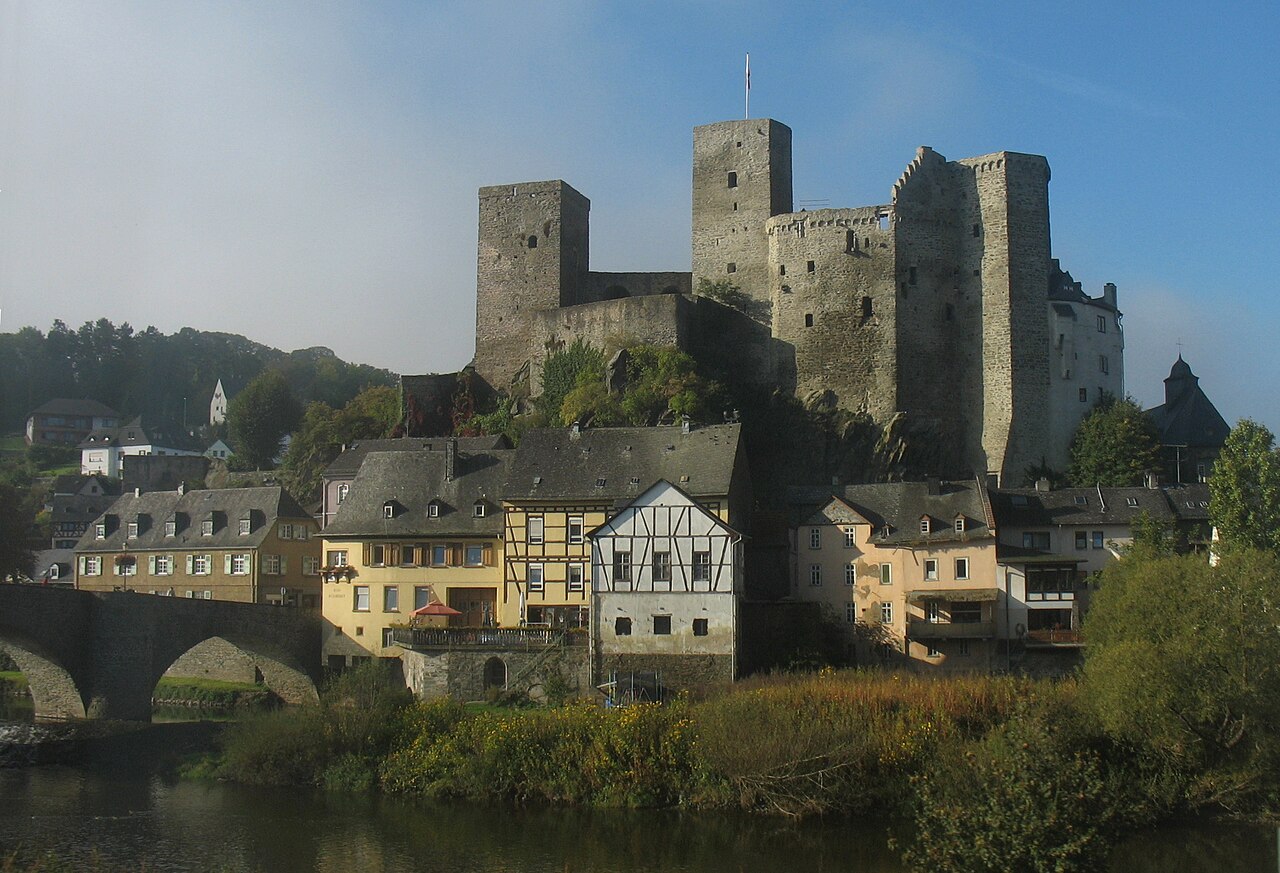
Burg Ellar
Burg Ellar is a notable medieval hill castle located in the municipality of Waldbrunn, Germany. Constructed in the late 13th century, it was established by the Counts of Diez to secure vital imperial roads near the toll station known as Gadelheimer Mühle. This strategic positioning highlights its importance in controlling trade and movement in the region during the High to Late Medieval period.
The earliest documented reference to Burg Ellar dates back to 1323, mentioning Heinricus, who served as the burgrave or castle governor under Count Emicho I of Nassau-Hadamar. Throughout the 14th century, officials associated with the castle often adopted the name Ellar, reflecting their close ties to the fortress. Between 1337 and 1362, the castle was pledged to the Counts of Nassau-Hadamar, and following its redemption, underwent necessary repairs to maintain its defensive capabilities.
In 1367 and 1368, Burg Ellar transferred ownership to the County of Katzenelnbogen as part of a dowry agreement. Significantly, Emperor Charles IV confirmed Burg Ellar as an immediate imperial fief, meaning it owed allegiance directly to the emperor rather than to regional lords. Around the year 1400, the castle is linked to Johann I of Nassau-Dillenburg. A key historical moment occurred in 1408 when a peace treaty was signed at Burg Ellar between the Counts of Katzenelnbogen and Nassau-Siegen, resolving a protracted dispute over succession rights.
Medieval conflicts and ownership changes
During the mid-15th century Mainz Diocesan Feud, Burg Ellar played a strategic role for the Counts of Katzenelnbogen in their conflict with the County of Sayn. The extinction of the Katzenelnbogen family line in 1479 led to the castle's partial transfer to the Landgraviate of Hesse. The long-standing inheritance dispute was finally resolved by the 1557 Treaty of Frankfurt, which granted full ownership to Count William I of Nassau-Siegen.
Following these events, Burg Ellar's military and political significance declined, transitioning into a more administrative role during the 15th and 16th centuries. It housed an Amtmann (local official) and a steward, maintaining a small permanent staff including a watchman and cooks. Notably, the castle featured a donjon or strong tower that doubled as a dovecote for raising pigeons, illustrating a blend of defensive and practical functions.
Architectural features and structural remains
The surviving structure of Burg Ellar forms an almost rectangular footprint measuring approximately 21 by 27 meters. The foundation walls are constructed from robust basalt stones about two meters thick, indicating a strong emphasis on defense. Interestingly, these walls lack typical openings such as windows or arrow slits, which were commonly incorporated in medieval fortifications for surveillance and archery.
One corner of the castle features a prominent donjon tower, historically used as a lookout and signal post. This tower's dual function as a dovecote is unusual and highlights the castle's multifunctional use. Although the interior courtyard today contains a modern covered pavilion for events, this is a recent addition and does not reflect the castle's original medieval layout.
Historical records mention a bridge associated with the tower, likely serving to connect different parts of the castle or provide access to the donjon, though no detailed descriptions have survived. The castle was originally surrounded by various outbuildings, which have since disappeared without trace. The remaining ruins offer a fragmentary yet evocative glimpse into a medieval stronghold adapted over centuries for diverse defensive and administrative purposes.
Role during the thirty years' war and preservation efforts
During the Thirty Years' War in the 17th century, Burg Ellar's ruins were restored to provide refuge for local villagers amidst widespread conflict and instability. This temporary revival underscores the castle's enduring strategic value even after its peak period.
Modern preservation initiatives began in 1969 to secure and maintain the castle ruins. These efforts have aimed to stabilize the remaining structures and promote Burg Ellar as a cultural heritage site, allowing visitors to appreciate its historical and architectural significance.
Historical significance and cultural heritage
Burg Ellar stands as a testament to the complex feudal and territorial dynamics of medieval Germany. Its connections to prominent noble families such as the Counts of Diez, Nassau-Hadamar, Katzenelnbogen, and Nassau-Siegen reflect the shifting allegiances and inheritance disputes characteristic of the era.
The castle's designation as an immediate imperial fief highlights its importance within the Holy Roman Empire's political structure. Architecturally, Burg Ellar exemplifies the defensive priorities of hill castles built during the late 13th century, with massive basalt walls designed to withstand siege warfare.
Today, the ruins of Burg Ellar invite exploration and study, offering valuable insights into medieval castle construction, feudal governance, and regional history. Its preservation ensures that this heritage site continues to educate and inspire future generations.
Frequently asked questions (FAQ)
- How do I get to Burg Ellar?
- Burg Ellar is located in the municipality of Waldbrunn, Germany. Visitors can reach the site by local roads, and it is advisable to check local maps or GPS for the best route.
- What is the historical significance of Burg Ellar?
- Burg Ellar was a strategic medieval hill castle built in the late 13th century, serving as a military and administrative center for various noble families and playing a role in regional conflicts.
- Can I visit the ruins of Burg Ellar?
- Yes, the ruins of Burg Ellar are accessible to the public. While the site is in ruins, it offers a fascinating glimpse into medieval castle architecture and history.
- When was Burg Ellar built?
- Burg Ellar was constructed in the late 13th century, likely by the Counts of Diez to secure important imperial roads.
- Why does Burg Ellar have such thick basalt walls without windows or arrow slits?
- The castle's walls are built from thick basalt stones for strong defense. The absence of windows or arrow slits is unusual and may reflect specific defensive strategies or later modifications.
Information
Website
Visit websiteSources & official resources
Verify the information above using these authoritative references.
Loading map...
Visitor reviews
No reviews yet. Been here? Write the first review and help other travelers!
Write the first reviewVisited this castle? Share your experience
Your review helps other travelers and adds first-hand knowledge to our encyclopedia.