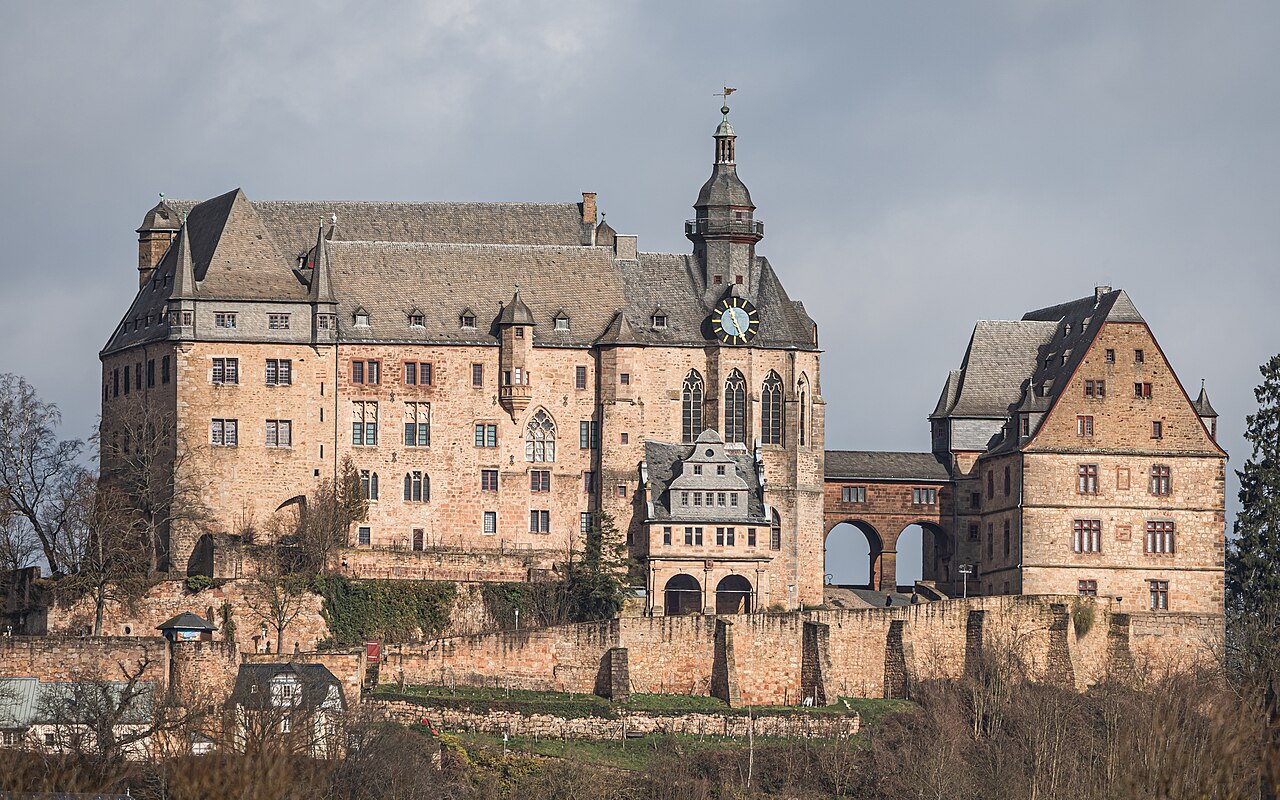
Burg Mellnau
Burg Mellnau is a notable medieval hilltop castle located above the village of Mellnau in the municipality of Wetter, Germany. Constructed in the mid-13th century, it served as a strategic fortification for controlling the surrounding region and protecting the important religious foundation known as the Stift Wetter. The castle's origins trace back to around 1248, when Archbishop Siegfried III of Eppstein from Mainz likely commissioned its construction to replace the earlier Burg Hollende, which had been destroyed. This initiative reflects the medieval Germanic practice of building castles to assert territorial control and safeguard ecclesiastical interests.
The castle first appears in historical records in 1263 under the name "Elenhouch," later evolving to "Elnhoch." It was not until around 1500 that the name "Mellnau" was adopted for both the castle and the surrounding village. Early agreements, such as the one in 1263 between the regional leaders of Hesse and Archbishop Werner von Eppstein, confirmed that Burg Mellnau remained under the control of the Archbishopric of Mainz, underscoring its importance as a religious and military stronghold.
Historical significance and military role
Throughout its history, Burg Mellnau played a pivotal role in regional conflicts and power struggles. During the 1301 Rheinischer Zollkrieg (Rhenish Customs War), the castle was captured by Ulrich I of Hanau, the Imperial Vogt, highlighting its strategic value. Ownership fluctuated in the following decades, with Archbishop Heinrich III of Virneburg reclaiming it in 1342. The castle endured a siege in 1381 by Landgrave Hermann II of Hesse, which ultimately failed, demonstrating the castle's robust defenses.
Later, the Mainz Stiftsfehde, a conflict within the Archbishopric of Mainz, led to a shift in control when the castle and the Stift Wetter were pledged to the Landgraves of Hesse in 1464. This transition marked the beginning of the castle's decline in military importance. Subsequently, the castle was granted as a fiefdom to the Milchling family from nearby Schönstadt. By 1510, the Hessian bailiff's seat moved to the town of Wetter, and Burg Mellnau was no longer staffed with guards, leading to gradual disrepair over the centuries.
Architectural features and layout
The surviving ruins of Burg Mellnau provide valuable insight into medieval fortification architecture. The castle's core is nearly oval-shaped, surrounded by a largely intact ring wall that formed a continuous defensive barrier. The southwestern section of this wall exhibits evidence of a later entrance, interrupting the original fortification line.
The bergfried, a prominent feature constructed circa 1329, is a round, freestanding tower approximately 9.5 meters in diameter with walls up to three meters thick. Positioned in the eastern part of the castle, the bergfried served as the strongest point of defense and a lookout tower, a role it continues to fulfill today.
On the northern side, the ring wall is reinforced into a shield wall, a thicker and stronger section designed to absorb attacks on the castle's most vulnerable side. The southeastern part of the ring wall encloses the remains of the palas, the main residential building where the lord and household lived, illustrating the blend of defensive and domestic functions within the castle.
Defensive structures
- The ring wall encircles the castle's core, providing a formidable barrier.
- The shield wall on the northern side strengthens the defense against assaults.
- The bergfried stands as a central tower with a high entrance, typical of medieval military architecture.
- The original gate east of the bergfried, now sealed, indicates the castle's controlled access points.
Residential and functional spaces
The palas ruins reveal the castle's residential quarters, highlighting the coexistence of living spaces and military fortifications. The castle's design reflects the medieval need to combine habitation with defense.
Decline and preservation
After the castle lost its military significance in the 16th century, it gradually fell into ruin. The relocation of the Hessian bailiff's seat to Wetter in 1510 marked the end of Burg Mellnau as an active administrative center. Over the following centuries, the castle was neglected, and its structures deteriorated.
In the 19th century, the process of allodification transformed feudal fiefs into private property, and ownership of Burg Mellnau passed definitively to the Milchling family. Today, the castle remains in a partially preserved state, with significant portions of the ring wall and bergfried still standing. The bergfried, in particular, serves as a lookout tower, offering visitors panoramic views of the surrounding landscape.
Archaeological and photographic documentation
Extensive archaeological studies and photographic records have documented key features of Burg Mellnau. The southwestern ring wall with its later gate area, the elevated entrance to the bergfried on its western side, the northern shield wall, and the eastern palas ruins collectively illustrate the castle's complex construction history and strategic adaptations over time.
The castle's ruins provide valuable educational and cultural heritage opportunities, allowing visitors and scholars to explore medieval fortification techniques and the historical context of the region. Its location atop a hill offers strategic visibility, which was crucial for defense and control during the Middle Ages.
Visiting burg mellnau
Visitors to Burg Mellnau can explore the castle ruins and climb the bergfried, which functions as a lookout tower. The site offers a glimpse into medieval military architecture and the historical power struggles of the region. Due to the castle's hilltop location, visitors should be prepared for a moderate hike to reach the site.
The castle is an important cultural landmark in the Wetter municipality and contributes to the understanding of medieval Germanic fortifications. Its preservation allows for continued study and appreciation of the architectural and historical heritage of the area.
Frequently asked questions (FAQ)
- How do I get to Burg Mellnau?
- Burg Mellnau is located above the village of Mellnau in Wetter, Hesse, Germany. Visitors can reach the castle by hiking up from the village, which involves a moderate uphill walk suitable for most visitors.
- What is the historical significance of Burg Mellnau?
- Burg Mellnau was a strategic medieval hilltop castle built around 1248 to protect the Stift Wetter and assert control in the region. It played a role in regional conflicts such as the Rheinischer Zollkrieg and was involved in power struggles between the Archbishopric of Mainz and the Landgraves of Hesse.
- Can I climb the bergfried at Burg Mellnau?
- Yes, the bergfried at Burg Mellnau is still standing and functions as a lookout tower. Visitors can climb it to enjoy panoramic views of the surrounding landscape and gain insight into medieval defensive architecture.
- When was Burg Mellnau built?
- Burg Mellnau was likely constructed around 1248 under the direction of Archbishop Siegfried III of Eppstein, replacing the earlier Burg Hollende.
- Is Burg Mellnau open year-round for visits?
- The castle ruins are accessible year-round as an outdoor site. However, visitors should check local tourism information for any seasonal access restrictions or guided tour availability.
Information
Sources & official resources
Verify the information above using these authoritative references.
Loading map...
Visitor reviews
No reviews yet. Been here? Write the first review and help other travelers!
Write the first reviewVisited this castle? Share your experience
Your review helps other travelers and adds first-hand knowledge to our encyclopedia.