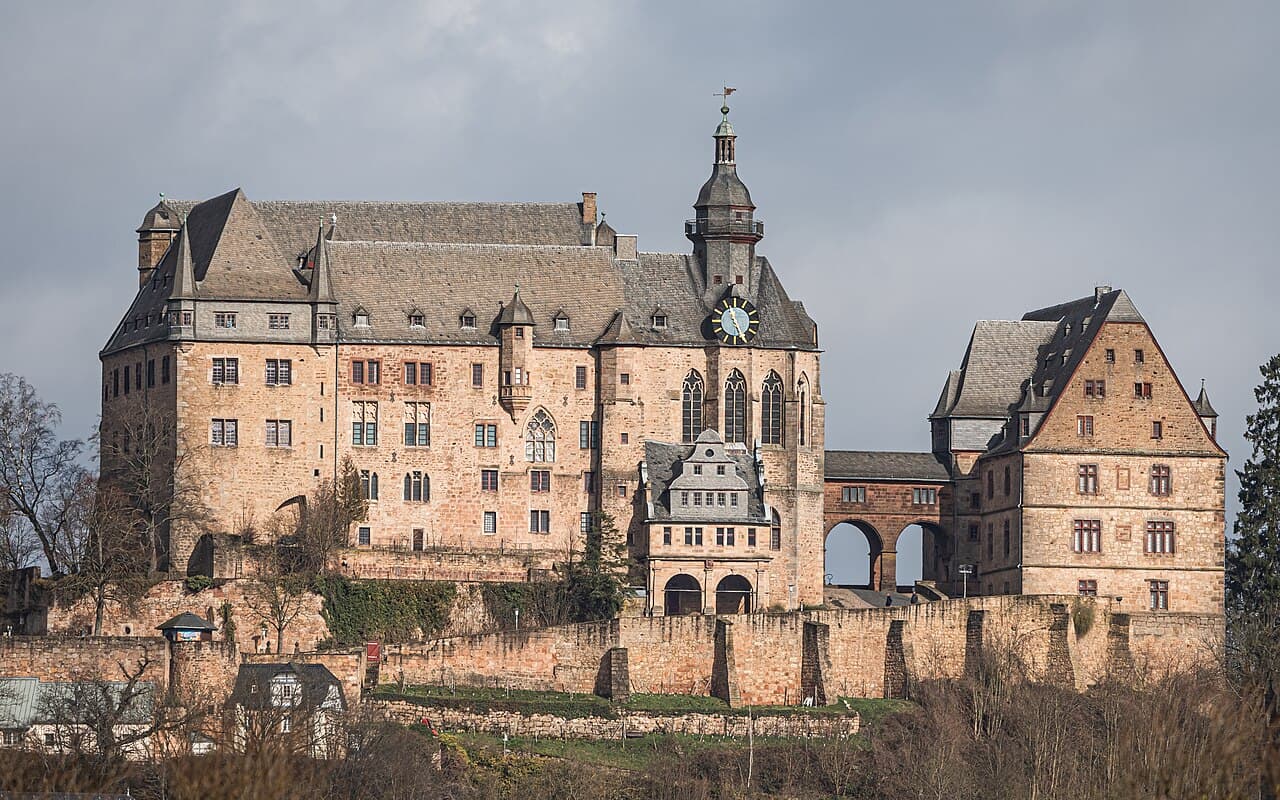
Marburg Castle
Marburg Castle, also known as Landgrafenschloss Marburg, is a prominent hill castle located in the city of Marburg in the Hesse region of Germany. Perched atop the Schlossberg hill at an elevation of approximately 287 meters above sea level, this castle has a rich history dating back to the 12th century. Originally constructed as a fortification in the early High Medieval period, Marburg Castle became the first residence of the Landgraviate of Hesse, an important principality within the Holy Roman Empire.
Early history and strategic significance
The castle's origins trace back to the 11th century when it was initially established as a defensive stronghold. Its commanding position on the Schlossberg provided a strategic vantage point overseeing the surrounding valley and trade routes. This location was crucial for controlling regional power and protecting the developing town of Marburg. By the 12th century, the castle had evolved into a substantial fortified residence, reflecting the growing importance of the Landgraviate of Hesse.
Architectural development and features
Marburg Castle exhibits typical characteristics of a High Medieval hill castle. The fortifications include thick stone walls, towers, and a gatehouse designed to repel attackers. Over the centuries, the castle underwent various expansions and modifications to adapt to changing military technologies and residential needs. The castle complex includes a keep or donjon, which served as the last line of defense and the lord's residence.
The castle's layout is adapted to the natural topography of the hill, with terraced courtyards and defensive walls following the contours of the terrain. The Schlossberg location also allowed for the inclusion of a moat and other defensive features, although these were limited by the hilltop setting.
Historical events and cultural importance
One of the most notable historical events associated with Marburg Castle is the Marburg Colloquy of 1529. This was a significant religious conference held within the castle walls, where leading Protestant reformers attempted to resolve doctrinal disputes during the Reformation. The colloquy brought together figures such as Philipp Melanchthon and Ulrich Zwingli, marking the castle as a site of major religious and political importance in early modern Europe.
Throughout its history, the castle served not only as a military fortress but also as a residence for the Landgraves of Hesse, reflecting the region's political and cultural development. It witnessed various conflicts and sieges, particularly during the Thirty Years' War and other regional disputes.
Modern use and preservation
Today, Marburg Castle is well preserved and functions as a museum and cultural venue. Since 1981, it has housed the Marburger Universitätsmuseum für Kulturgeschichte in the Wilhelmsbau wing, showcasing the cultural history of the region through extensive collections. The castle also hosts events, exhibitions, and educational programs that attract visitors interested in medieval history and architecture.
The castle's preservation efforts have maintained its medieval character while allowing for modern accessibility and visitor amenities. It remains a key landmark in Marburg, offering panoramic views of the city and surrounding landscape.
Architectural style and classification
Marburg Castle is primarily classified as a hill castle built during the High Medieval period. Its architectural style reflects the functional and defensive requirements of medieval fortifications, with elements typical of Romanesque and early Gothic military architecture. The castle's robust stone construction, battlements, and towers exemplify the transitional styles of the 12th century, blending fortress and residential features.
Key architectural elements
- Keep (donjon): The central tower serving as the main defensive stronghold and residence.
- Gatehouse: Fortified entrance controlling access to the castle.
- Curtain walls: Thick defensive walls surrounding the castle perimeter.
- Towers: Positioned for surveillance and defense along the walls.
- Terraced courtyards: Adapted to the hill's natural slope for functional space.
Visiting marburg castle
Visitors to Marburg Castle can explore the museum's extensive collections, which include artifacts related to the castle's history and the broader cultural heritage of Hesse. The castle grounds offer walking paths and viewpoints that highlight its strategic hilltop position.
The castle is accessible from the city of Marburg, which itself is known for its medieval old town and university. Guided tours provide insights into the castle's architectural features and historical significance. Seasonal events and exhibitions further enrich the visitor experience.
Frequently asked questions (FAQ)
- When was Marburg Castle originally built?
- Marburg Castle was originally built in the 11th century as a fortification and developed into a substantial castle by the 12th century.
- What is the significance of the Marburg Colloquy held at the castle?
- The Marburg Colloquy in 1529 was a key religious conference where Protestant reformers discussed doctrinal differences during the Reformation, making the castle historically important.
- Can visitors tour Marburg Castle today?
- Yes, Marburg Castle is open to the public as a museum and event venue, offering guided tours and exhibitions about its history and architecture.
- What architectural style characterizes Marburg Castle?
- Marburg Castle features elements of Romanesque and early Gothic military architecture typical of the High Medieval period.
- Where is Marburg Castle located within Germany?
- Marburg Castle is located on Schlossberg hill in the city of Marburg, in the Hesse region of Germany.

Information
Loading map...
Visitor reviews
No reviews yet. Been here? Write the first review and help other travelers!
Write the first reviewVisited this castle? Share your experience
Your review helps other travelers and adds first-hand knowledge to our encyclopedia.

