Burg Kreuzenstein
Burg Kreuzenstein is a remarkable hill castle located near Leobendorf in Lower Austria, perched on a ridge overlooking the Rohrwald forest and the Danube River. Originally constructed in the 12th century by the Counts of Formbach, it stands today as a fascinating blend of authentic medieval ruins and a 19th-century romantic reconstruction. The castle's unique character arises from its reconstruction, which incorporated genuine medieval architectural elements sourced from various parts of Europe, creating a historically evocative yet somewhat eclectic medieval fortress.
Historical background and significance
The origins of Burg Kreuzenstein trace back to the high medieval period when it was established by the Counts of Formbach. Through strategic marriages, ownership passed to the Counts of Wasserburg, and by 1278, the castle became part of the extensive Habsburg domains under the rule of Ottokar II of Bohemia. This integration marked the castle's importance within the shifting political landscape of Central Europe during the Middle Ages.
In the early 16th century, the castle gained notoriety as a site of religious imprisonment during the Reformation. The Anabaptist preacher Balthasar Hubmaier was detained and interrogated here in 1527. His steadfast refusal to renounce his beliefs led to his execution in Vienna the following year, highlighting the castle's role in the religious conflicts of the era.
For centuries, Burg Kreuzenstein remained a formidable fortress, never conquered until the Thirty Years' War. In 1645, Swedish forces under Field Marshal Lennart Torstensson captured the castle without resistance and ordered partial demolition, leaving it in ruins. The castle's military significance thus declined, and it entered a long period of decay.
19th-century reconstruction and architectural revival
The castle's revival began in the 18th century when the Wilczek family acquired the ruined fortress. Wealth from their extensive Silesian coal mining ventures financed a grand reconstruction starting in 1874, led by Count Johann Nepomuk Wilczek. Over three decades, the castle was rebuilt as a "show castle" intended to evoke the romantic spirit of the medieval period rather than replicate the original fortress exactly.
The reconstruction was guided initially by architect Carl Gangolf Kayser until 1895, followed by Humbert Walcher von Molthein and artist Egon Rheinberger. The project involved incorporating genuine medieval architectural fragments purchased from across Europe, including stonework, windows, and staircases, to create an authentic medieval atmosphere. This approach makes Burg Kreuzenstein a unique example of a neo-medieval castle that blends original ruins with carefully integrated historical elements.
A family crypt was constructed beneath the chapel to serve as the Wilczek family vault, where Count Wilczek himself was later interred. The castle was also furnished with medieval artifacts, notably including one of the oldest surviving catapults, acquired from the fortress of Hohensalzburg.
The restored castle was officially reopened on 6 June 1906, an event attended by German Emperor Wilhelm II, underscoring its cultural significance at the time.
Architectural features and layout
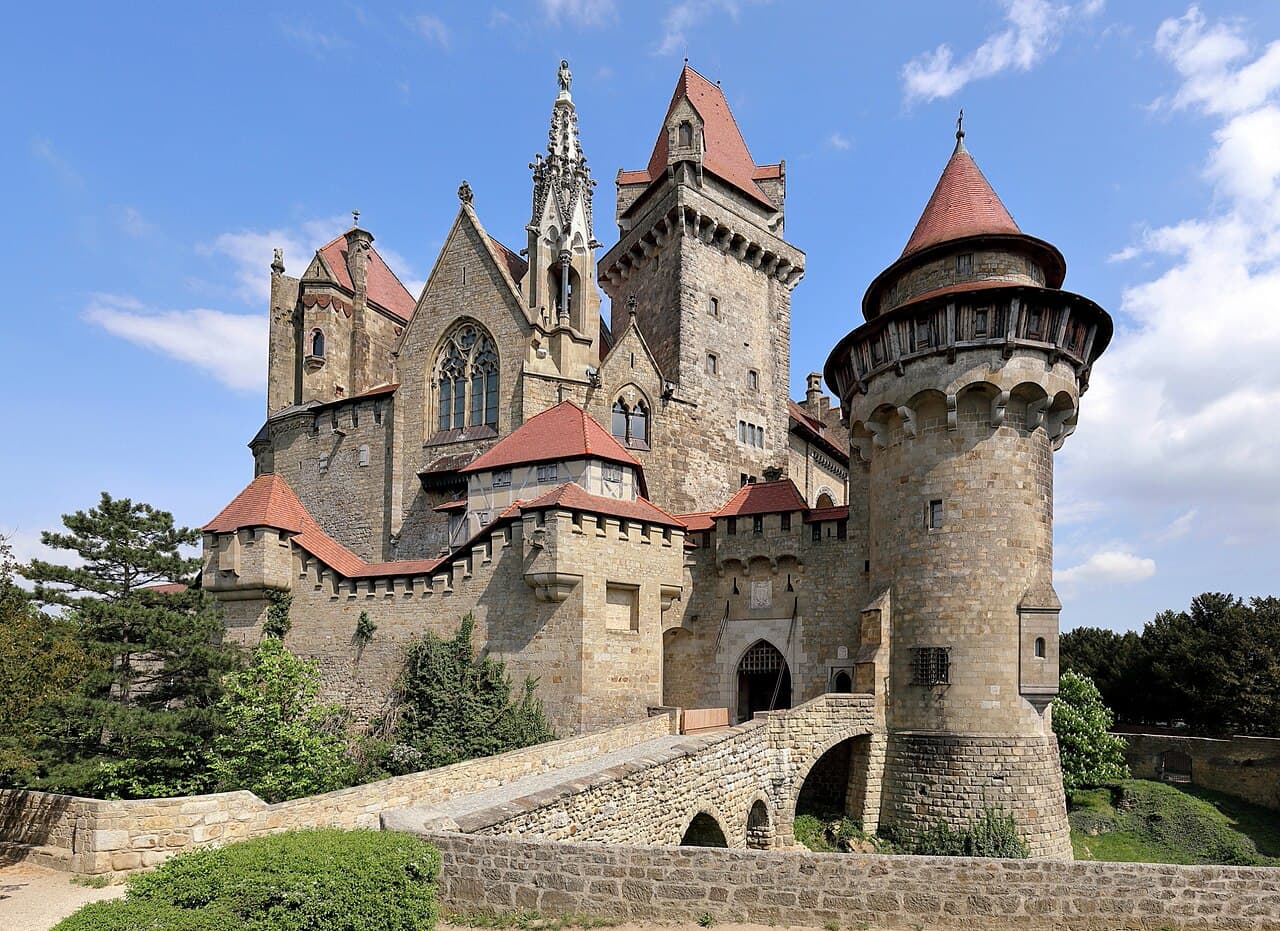
Burg Kreuzenstein is characterized by its ring-shaped layout encircling a central courtyard, typical of medieval hill castles designed for defense and residence. The castle complex includes multiple towers, residential buildings, a defensive wall, and a moat, combining original medieval construction with 19th-century neo-romantic additions.
The castle's construction prominently features exposed stone masonry. The medieval masonry is distinguishable from the 19th-century reconstruction by its weathered appearance and construction techniques. Surviving medieval elements include portions of the ring wall, the remains of the east tower, and parts of the chapel.
The west façade is narrow and includes a polygonal northwest tower adjacent to the chapel’s gable front. The chapel itself is notable for its tracery windows and a crucifix dating from around 1520. Next to the chapel stands a polygonal bell tower adorned with crockets and finials. Atop this tower is a 16th-century bronze statue of Saint Michael, enhanced with wings, sword, and shield added during the 19th-century restoration.
The main entrance on the west side is approached via a high masonry arch bridge and a drawbridge leading to the gatehouse. The gatehouse features a projecting turret known as a pecherker, a defensive structure for archers. Beyond the gatehouse lies the zwinger, an outer ward enclosed for additional defense.
Inside the castle, the Kaschau Gallery stands out as a significant architectural treasure. This large Gothic tracery arcade was originally part of the west gallery of St. Elisabeth Cathedral in Košice (formerly Kaschau) and dates to about 1450. It was acquired and installed during the 19th-century rebuilding, adding to the castle's authentic medieval ambiance.
A Renaissance spiral staircase from 1555, taken from the castle of Göllersdorf, connects the courtyard to the upper floors and roof, showcasing the blend of architectural periods present within the castle.
Beneath the chapel lies the Wilczek family crypt, a solemn space dedicated to the family's legacy.
Damage, preservation, and current status
The castle has endured various damages over the centuries. A lightning strike in 1915 caused a fire that damaged the archive and library wing. During World War II in 1945, combat between German and Soviet forces inflicted heavy damage on parts of the castle, and many valuable collection items were stolen. Some manuscripts from the Wilczek collection have since been preserved in the Austrian National Library.
Despite these setbacks, Burg Kreuzenstein has been repaired and maintained in a well-preserved condition. The distinction between the original medieval ruins and the 19th-century neo-romantic additions remains clear, offering visitors a unique glimpse into both medieval and romantic historicist architecture.
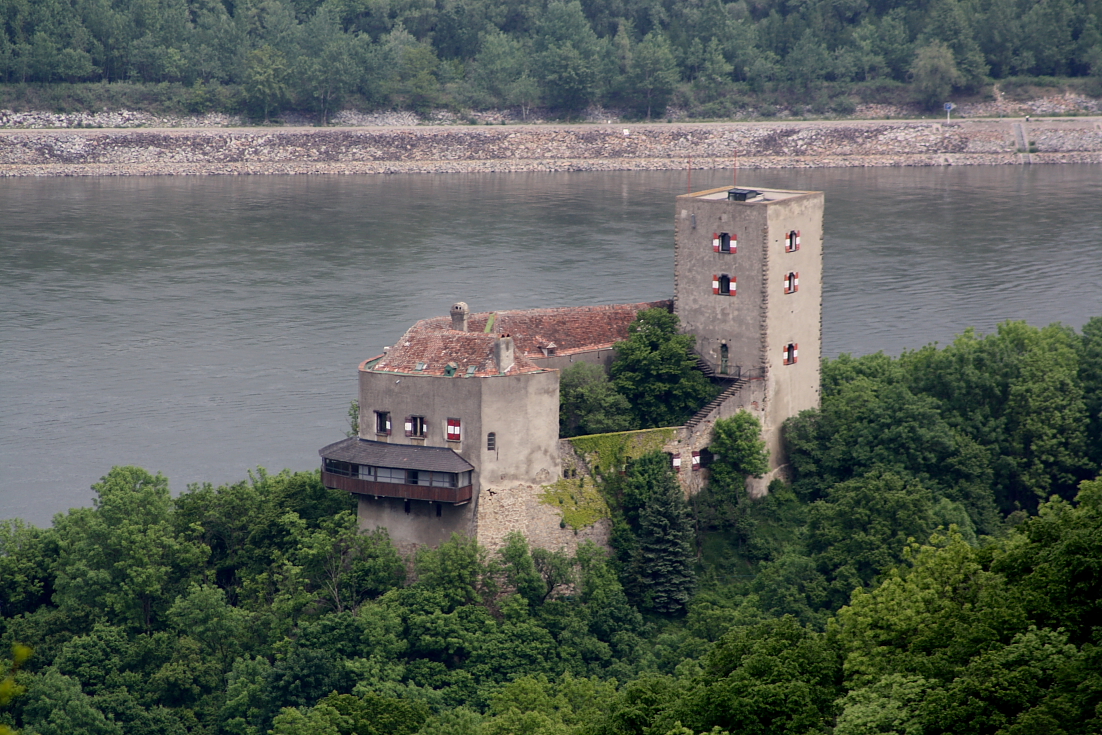
The castle's elevated position near the Wiener Pforte water gap on the Danube provides commanding views over the river and the Korneuburg basin. Across the Danube lies Burg Greifenstein, another historic fortress, highlighting the strategic importance of this region throughout history.
Cultural significance and tourism
Today, Burg Kreuzenstein remains under the ownership of the Wilczek family, who continue to preserve its historical and cultural heritage. The castle is open to the public and serves as a popular destination for tourists interested in medieval architecture, history, and romantic revivalism.
Its distinctive character as a castle reconstructed with authentic medieval elements makes it a favored location for film productions, although it is sometimes confused with Burg Liechtenstein, another Austrian castle used in cinema.
Visitors can explore the castle’s extensive grounds, including its towers, galleries, chapel, and crypt, while enjoying panoramic views of the Danube valley. The castle offers a vivid experience of medieval fortification combined with 19th-century romantic ideals, making it a unique cultural landmark in Austria.
Frequently asked questions (FAQ)
- How do I get to Burg Kreuzenstein?
- Burg Kreuzenstein is located near Leobendorf in Lower Austria. It is accessible by car and public transport from Vienna, with local buses and taxis available for the short journey from Leobendorf town.
- What is the historical significance of Burg Kreuzenstein?
- Burg Kreuzenstein dates back to the 12th century and played roles in medieval politics, religious conflicts during the Reformation, and military history during the Thirty Years' War. Its 19th-century reconstruction also reflects romantic historicism.
- Can I visit the interior of Burg Kreuzenstein?
- Yes, the castle is open to visitors who can explore its medieval halls, the chapel, the Kaschau Gallery, and the Wilczek family crypt. Guided tours provide insights into its history and architecture.
- What architectural styles are represented at Burg Kreuzenstein?
- The castle features a mix of medieval Gothic elements and 19th-century neo-romantic additions. Authentic medieval architectural fragments from various European regions were integrated during its reconstruction.
- When is the best time to visit Burg Kreuzenstein?
- The castle is best visited during the warmer months from spring to early autumn when the weather is favorable for exploring the hilltop grounds and enjoying panoramic views.
Photo gallery

Information
Sources & official resources
Verify the information above using these authoritative references.
Loading map...
Visitor reviews
No reviews yet. Been here? Write the first review and help other travelers!
Write the first reviewVisited this castle? Share your experience
Your review helps other travelers and adds first-hand knowledge to our encyclopedia.