Burg Jesberg
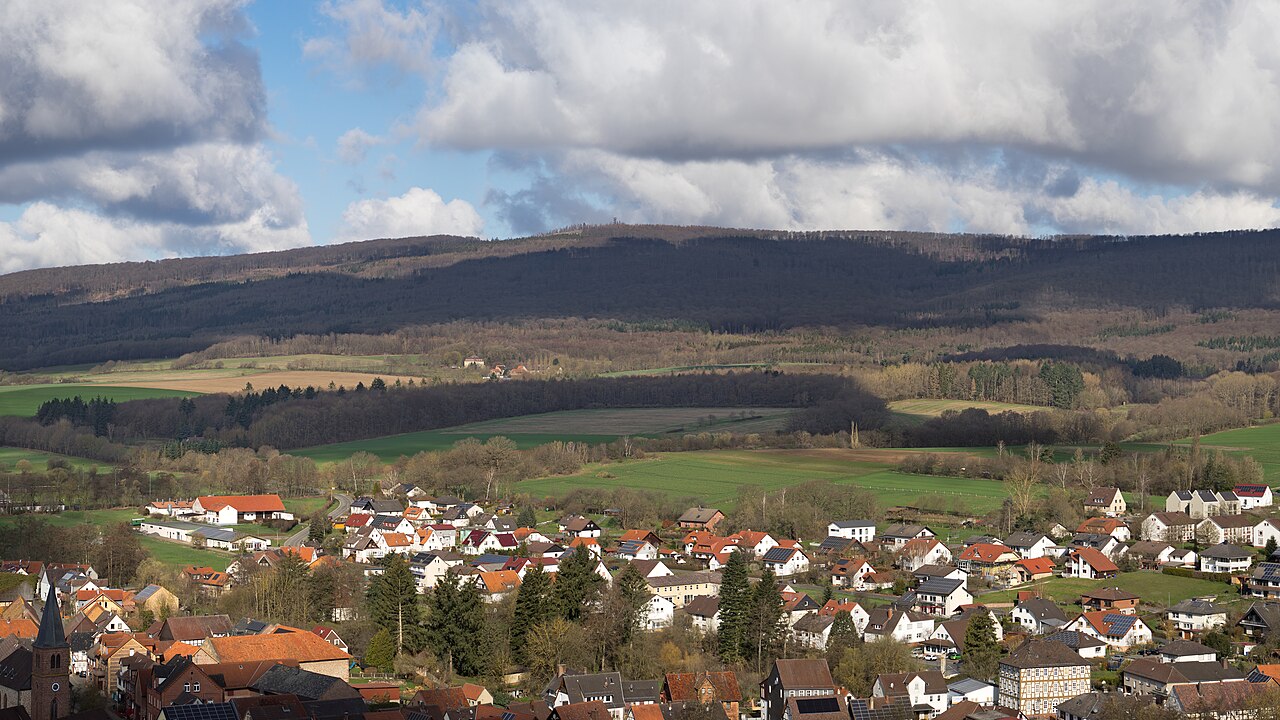
Burg Jesberg stands as a significant medieval hill castle ruin nestled near the town of Jesberg in northern Hesse, Germany. Constructed in the late 12th or early 13th century, this fortress was strategically positioned to oversee and protect an important historic trade route known as the Fritzlarer Straße. Its elevated location at approximately 280 meters above sea level provided commanding views of the surrounding landscape, including the nearby Kellerwald forest, making it a vital stronghold in the region.
The castle's origins trace back to Germanic builders who employed the Romanesque architectural style, characterized by thick stone walls, narrow windows, and a compact, sturdy layout adapted to the hilltop terrain. The castle's design reflects the military and residential needs of the period, combining defensive features with living quarters suitable for noble families and their retainers.
Historical development and ownership
The earliest documented mention of Burg Jesberg dates to 1241, when the brothers Ludwig and Wortwin von Linsingen sold the castle and its jurisdiction, then called "Lenswideshusen," to Archbishop Siegfried III of Mainz. Despite this sale, the von Linsingen family retained the castle as a fief under Mainz, indicating a feudal relationship where local noble authority was balanced with submission to ecclesiastical overlords.
Over the next two centuries, Burg Jesberg remained a crucial stronghold for the Archbishopric of Mainz in the region of Lower Hesse. It served as a counterbalance to other Mainz-controlled castles such as those at Fritzlar, Naumburg, and Heiligenberg near Felsberg. The castle was managed by various ministerial families, including the von Falkenberg, von Linsingen, von Gilsa, and von Grifte, who acted as pledge holders and castellans, reflecting the fluid noble stewardship typical of the medieval period.
Conflicts and sieges
By the mid-14th century, around 1350, Burg Jesberg suffered significant damage, likely due to ongoing conflicts between the Archbishopric of Mainz and the expanding Landgraves of Hesse. These tensions culminated in 1400, when the von Linsingen family shifted allegiance to the Hessian Landgrave, prompting Mainz forces to besiege and capture the castle.
The castle underwent extensive rebuilding from 1425 to 1426 under the direction of Happel Katzmann, a ministerial figure from Fritzlar. This reconstruction preserved the original Romanesque bergfried but added substantial fortifications, including a newly excavated defensive moat. These enhancements reflected evolving military architecture and the castle's ongoing strategic importance.
In 1427, Burg Jesberg played a pivotal role during a decisive conflict between Landgrave Ludwig I of Hesse and Archbishop Konrad of Mainz. After Mainz troops were defeated near Fritzlar, survivors sought refuge within the castle, underscoring its continued military value.
The castle's most dramatic siege occurred in 1469 during the Hessian Brother War. Defended by von Linsingen castellans loyal to Mainz, Burg Jesberg was attacked by forces led by Landgrave Ludwig II, who employed 500 Bohemian mercenaries and 300 horsemen. The fortress was stormed after a prolonged siege, resulting in the death of all defenders and near-total destruction of the castle.
Decline and preservation
Although rebuilt again in 1524, Burg Jesberg gradually lost its military and administrative significance after 1586, when control definitively passed to the Landgraviate of Hesse. Over subsequent centuries, the castle fell into disuse and decay. Many stones were removed and repurposed for local construction, a common fate for abandoned medieval fortifications.
The von Linsingen family's Hesse branch became extinct in 1721, marking the castle's final transition to Hessian control. By around 1820, a merchant named Appell acquired the ruins and prevented their complete destruction. Eventually, in 1964, the municipality of Jesberg assumed ownership of Burg Jesberg and the surrounding Schlossberg area.
Between 1980 and 1987, restoration efforts focused on stabilizing the remaining structures, preserving the Romanesque bergfried, parts of the palas, cellars, and curtain walls. These works ensured that the castle's historical and architectural legacy would endure for future generations.
Architectural features and remains
The bergfried: central defensive tower
The most prominent surviving feature of Burg Jesberg is its bergfried, a tall, robust Romanesque keep that served as the castle's primary defensive tower and last refuge during attacks. This tower was deliberately preserved during the 15th-century reconstruction, highlighting its enduring strategic importance. Constructed of thick stone masonry, the bergfried remains largely intact and was stabilized during late 20th-century restoration efforts.
Today, visitors can ascend a modern staircase to an observation platform atop the bergfried, which offers expansive views over Jesberg and the surrounding Kellerwald forest. This vantage point underscores the castle's original purpose as a lookout and stronghold overseeing key trade routes and territories.
Palas and residential quarters
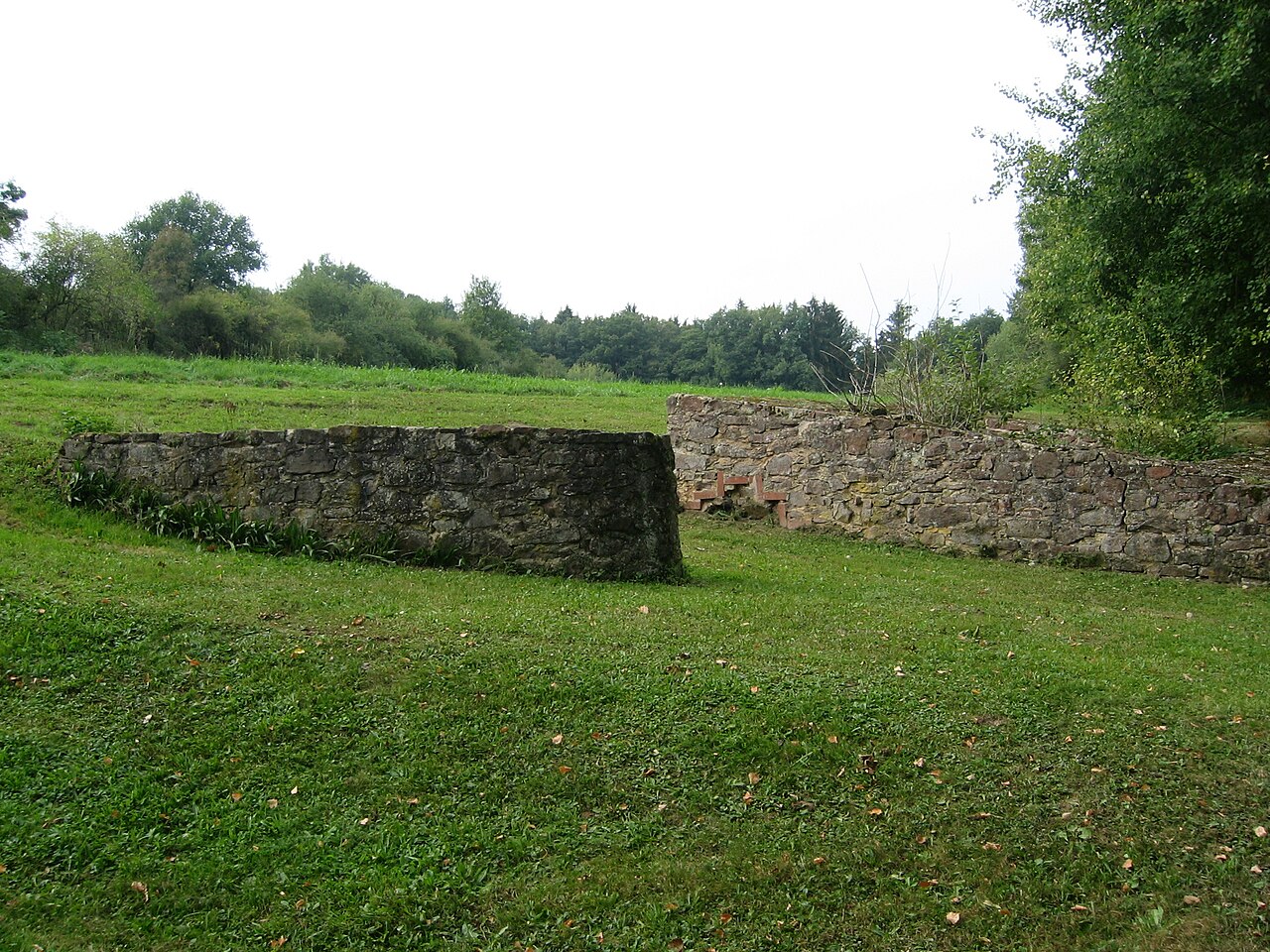
Adjacent to the bergfried lie the remains of the palas, the castle's main residential building. While only fragments of its walls survive, these remnants provide insight into the living spaces occupied by the noble families and their retainers. Archaeological traces also reveal cellars used for storage and service functions essential to daily castle life.
Fortifications and defensive structures
Significant modifications in the 15th century included the excavation of a defensive moat, or wall ditch, carved directly into the hill to encircle and protect the castle. This moat enhanced the fortress's defenses against siege and assault, reflecting advances in military architecture of the period.
Remnants of the curtain walls, which enclosed the castle grounds, still stand today. These fortified outer walls were integral to the castle's defense system and were a focus of the restoration efforts in the 1980s. Together with the bergfried and moat, they illustrate the castle's layered defensive design.
Burg jesberg today and visitor experience
Today, Burg Jesberg is a well-preserved ruin that offers visitors a tangible connection to medieval German history and architecture. The site features a circular hiking trail around the ruins, providing scenic views and educational opportunities. Modern amenities such as sanitary facilities and a nearby music pavilion enhance the visitor experience, although these lie outside the core archaeological area.
The castle's location near Jesberg and its historical significance as a strategic stronghold of the Archbishopric of Mainz and later Hesse make it a valuable cultural heritage site. The restored bergfried stands as a landmark, inviting exploration and reflection on the turbulent history of the region.
Visitors interested in medieval military architecture, feudal history, and the evolution of castle fortifications will find Burg Jesberg a compelling destination. Its combination of Romanesque origins and later medieval modifications offers a vivid illustration of castle development over several centuries.
Frequently asked questions (FAQ)
- How do I get to Burg Jesberg?
- Burg Jesberg is located near the town of Jesberg in northern Hesse, Germany. It is accessible by local roads and hiking trails from Jesberg, with parking available nearby.
- What is the best time to visit Burg Jesberg?
- The best time to visit Burg Jesberg is during the spring, summer, and early autumn months when the weather is mild and the hiking trails are most enjoyable.
- Is Burg Jesberg suitable for families and children?
- Yes, Burg Jesberg is suitable for families and children. The site features safe walking paths and an observation platform on the bergfried that provides panoramic views, making it an educational and enjoyable outing.
- Are there guided tours available at Burg Jesberg?
- Currently, Burg Jesberg does not offer regular guided tours. Visitors can explore the ruins independently using informational signage available on-site.
- Can I climb the bergfried at Burg Jesberg?
- Yes, visitors can climb the bergfried via a modern staircase to reach the observation platform, which offers expansive views of Jesberg and the surrounding Kellerwald forest.
Information
Opening hours
Daily during daylight hours
Ticket prices
Free
Current owner
Municipality of Jesberg
Website
Visit websiteSources & official resources
Verify the information above using these authoritative references.
Loading map...
Visitor reviews
No reviews yet. Been here? Write the first review and help other travelers!
Write the first reviewVisited this castle? Share your experience
Your review helps other travelers and adds first-hand knowledge to our encyclopedia.