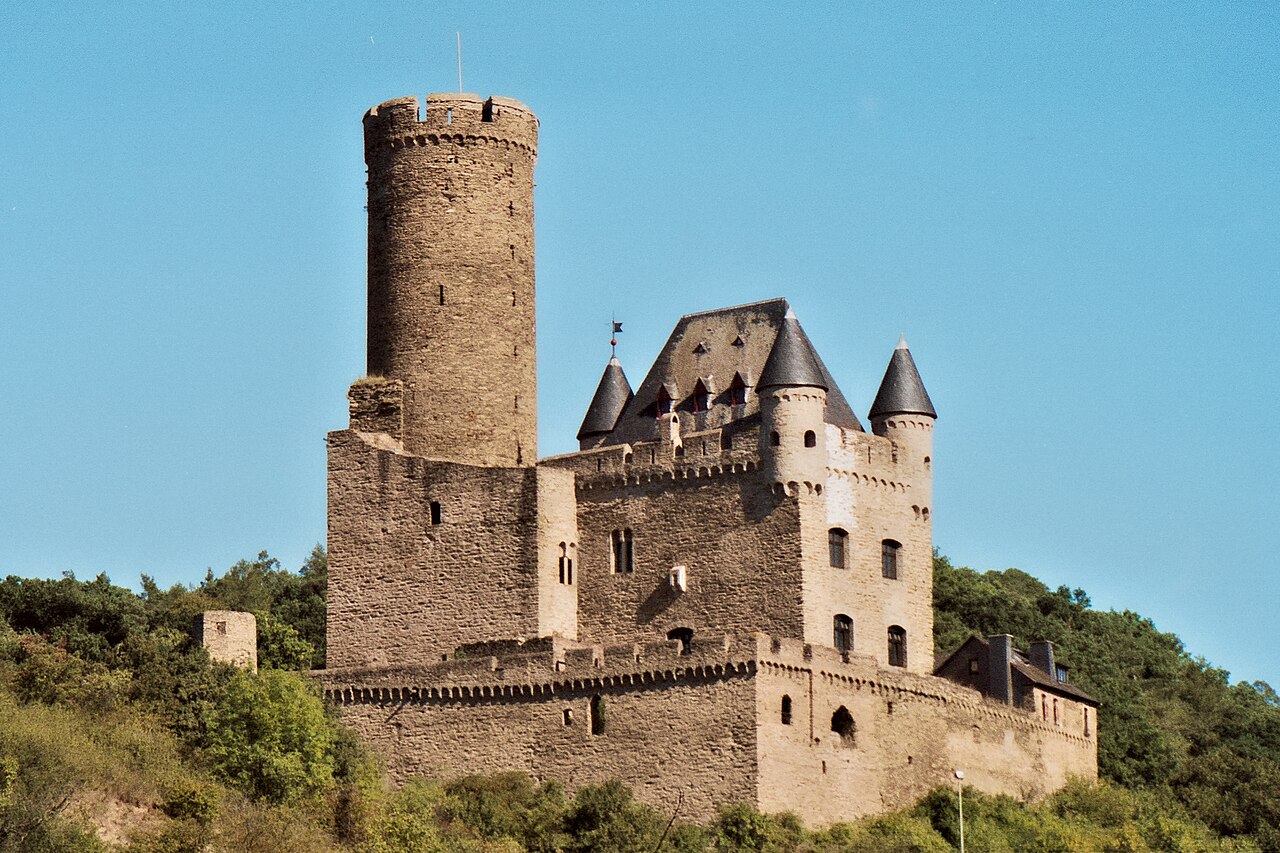
Burg Hohenstein
Burg Hohenstein is a prominent medieval hill castle ruin located near the town of Hohenstein in the state of Hesse, Germany. Constructed primarily during the High Middle Ages, this fortress exemplifies the strategic military architecture of the late 12th and early 13th centuries. Its origins trace back to the influential noble family of the Counts of Katzenelnbogen, who built the castle to control and defend the surrounding territory within the Taunus region.
The origins and early history of Burg Hohenstein
The castle was likely constructed between 1190 and 1230, a period marked by territorial consolidation and frequent conflicts among regional nobility in what is now central Germany. The Counts of Katzenelnbogen chose the rocky elevation for its natural defensive advantages, typical of hill castles of the era. From around 1260, Burg Hohenstein became the seat of the younger branch of the Katzenelnbogen family, underscoring its importance as a noble residence and military stronghold.
During the early 15th century, significant enhancements were made under Count Johann III of Katzenelnbogen (1402–1444). These expansions improved both the defensive capabilities and the residential comfort of the castle, reflecting the evolving needs of medieval fortifications transitioning into more complex noble estates. However, the castle's fortunes fluctuated due to regional conflicts, particularly with the neighboring Counts of Nassau, which led to damage or partial destruction during this turbulent period.
The transition of ownership and later history
The Katzenelnbogen male line ended in 1479 with the death of Philipp of Katzenelnbogen. The castle passed through marriage to the Landgraviate of Hesse when the heiress Anna married Landgrave Heinrich III of Hesse-Marburg. This transfer marked a significant shift in regional power dynamics, integrating Burg Hohenstein into the expanding Hessian territories.
By the early 17th century, the castle had fallen into disrepair but was restored under the direction of Landgrave Moritz of Hesse-Kassel around 1604. Moritz frequently resided at the castle from approximately 1616, revitalizing its status as a noble residence. However, the Thirty Years’ War brought further devastation. In 1647, during internal conflicts between Hessian factions, troops from Hesse-Kassel deliberately set fire to the castle, inflicting significant damage.
Despite this, parts of Burg Hohenstein remained in use until about 1778, after which the site gradually fell into ruin. Ownership eventually transferred to the state of Hesse in 1949, which has since overseen preservation efforts. Recent restoration initiatives, beginning in 2020, have focused on stabilizing the medieval gate tower and surrounding defensive walls, utilizing modern surveying techniques such as drone-mounted laser scanning to guide conservation.
Architectural features and remaining structures
The castle's layout reveals a typical medieval fortification built on a rocky outcrop, with robust stone construction designed for defense and control. The most notable surviving elements include two substantial shield walls. The outer shield wall dates from the late Gothic period, while the inner shield wall originates from the 13th century. Each wall is fortified with two defensive towers, which provided vantage points for surveillance and protection against attackers.
Dominating the site is the bergfried, a tall, slender main tower characteristic of German medieval castles. The bergfried served primarily as a lookout and final refuge rather than living quarters. Access to the bergfried is via narrow spiral staircases, which also connect to walkways along the tops of the shield walls, allowing defenders to move efficiently while remaining protected.
The residential buildings within the castle, including the palas (the main hall), have not survived. The palas collapsed entirely in 1864, leaving little trace. Other structures, such as the gatehouse and sections of the ring wall, have been the focus of recent restoration efforts, including repointing of stone masonry to preserve the integrity of the walls.
Vegetation clearance around the castle has been an important part of conservation, removing trees and shrubs within a five-meter perimeter to prevent damage to the masonry and facilitate detailed digital surveys. These surveys have been instrumental in planning ongoing and future restoration work, which builds upon the earliest known building plans dating back to 1608.
Strategic importance and regional connections
Burg Hohenstein's location near the ruins of Burg Greifenstein suggests a coordinated defensive network in the region. Historical evidence indicates that the fortifications of these two castles were once linked, providing control over key routes and territories in the Taunus mountains. This network enhanced the military and administrative reach of the Counts of Katzenelnbogen and later the Landgraves of Hesse.
Despite its current state as a ruin, Burg Hohenstein remains a valuable example of medieval military architecture. Its surviving gate tower, bergfried, and shield walls offer insights into the design principles and defensive strategies employed during the High and Late Middle Ages. The castle's layered history reflects broader regional shifts in power, warfare, and noble residence development over several centuries.
Preservation and visitor experience
Today, Burg Hohenstein is managed by the State Palaces and Gardens Authority of Hesse, which has prioritized the stabilization and restoration of key structures. Visitors can explore the ruins, including the impressive bergfried and gate tower, and appreciate the castle's commanding position overlooking the surrounding landscape.
Interpretive signage and guided tours provide historical context, highlighting the castle's role in regional politics, architecture, and military history. The ongoing restoration efforts ensure that Burg Hohenstein will remain an important cultural heritage site, preserving its legacy for future generations interested in medieval fortifications and noble residences.
Frequently asked questions (FAQ)
- How do I get to Burg Hohenstein?
- Burg Hohenstein is located near the town of Hohenstein in Hesse, Germany. It is accessible by car and local public transport, with parking available nearby. Walking paths lead up to the castle ruins from the town center.
- What is the historical significance of Burg Hohenstein?
- Burg Hohenstein was a strategic medieval hill castle built by the Counts of Katzenelnbogen in the late 12th or early 13th century. It played a key role in regional defense and noble residence during the High and Late Middle Ages.
- Can I visit the bergfried and gate tower at Burg Hohenstein?
- Yes, visitors can explore the surviving bergfried and gate tower, which are among the best-preserved parts of the castle. These structures offer panoramic views and insight into medieval defensive architecture.
- When is the best time to visit Burg Hohenstein?
- The castle is open daily from 9:00 to 18:00. Spring through early autumn offers the best weather for exploring the ruins and enjoying the surrounding natural landscape.
- Is there an entrance fee for Burg Hohenstein?
- Admission to Burg Hohenstein is free of charge, making it accessible to all visitors interested in medieval history and architecture.
Information
Opening hours
Daily 9:00-18:00
Ticket prices
Free
Current owner
State Palaces and Gardens Authority of Hesse
Website
Visit websiteSources & official resources
Verify the information above using these authoritative references.
Loading map...
Visitor reviews
No reviews yet. Been here? Write the first review and help other travelers!
Write the first reviewVisited this castle? Share your experience
Your review helps other travelers and adds first-hand knowledge to our encyclopedia.