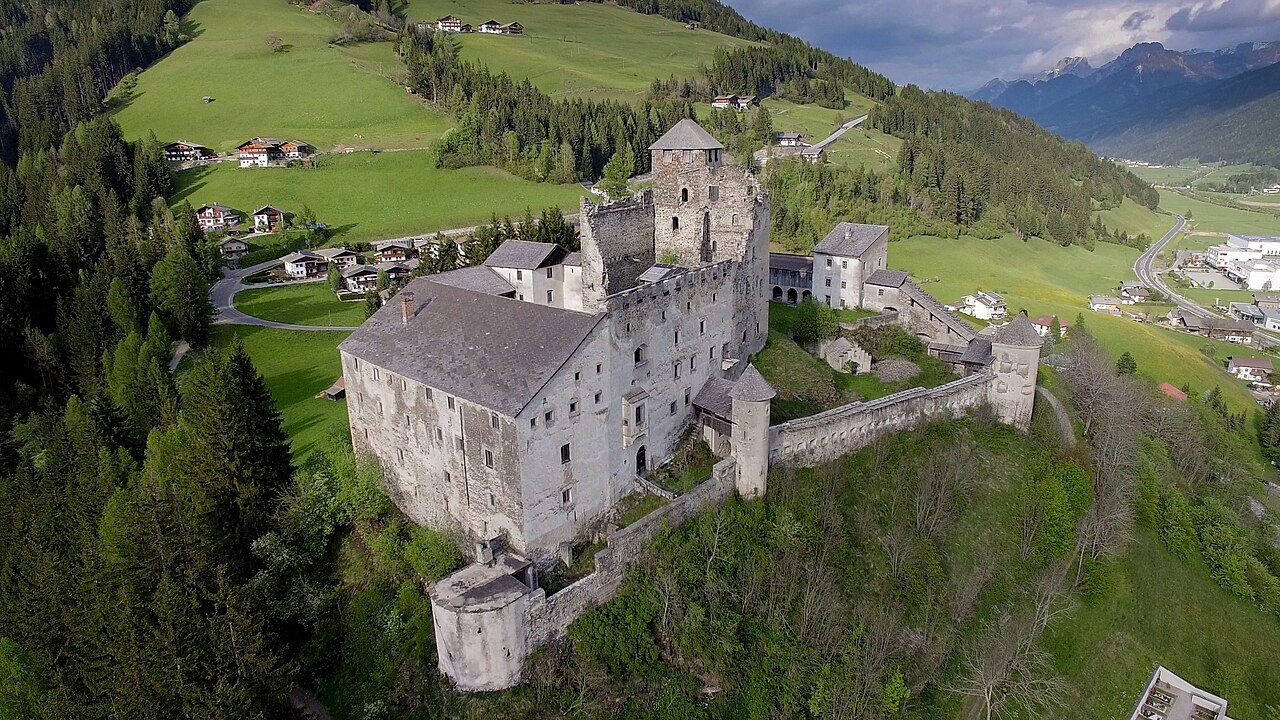
Burg Heinfels
Heinfels Castle, located in the scenic region of Tirol, Austria, stands as a remarkable example of medieval fortification perched at an elevation of 1,130 meters above sea level. This strategic height allowed the castle to dominate the surrounding upper Puster Valley, providing early warning against approaching enemies. The castle's commanding position reflects its historical role as a military stronghold designed to control and protect the region.
The origins of Heinfels Castle are shrouded in mystery and legend. Although the first documented mention dates to the early 13th century, archaeological and historical evidence suggests that the site may have been fortified much earlier. Local lore attributes the foundation of the settlement, originally known as Huonenfels until the 16th century, to the Huns or more plausibly the Avars during the 5th century. These early fortifications likely served as a refuge and defensive position during the turbulent Migration Period.
Historical development and legends
The castle's history is intertwined with numerous legends, the most famous of which speaks of a hidden underground passage connecting the fortress to the former Salcher house, now the Gasthaus Burg Heimfels in the village below. According to the tale, those brave enough to traverse this passage under the full moon at midnight might encounter two spectral dogs with fiery eyes carrying the keys to a hidden treasure. While sightings of these ghostly guardians have been reported, the elusive keys have never been found, adding a layer of mystique to the castle's history.
Throughout the centuries, Heinfels Castle underwent continuous renovations and fortifications, particularly in response to the threat posed by the advancing Ottoman Turks. These costly upgrades were often funded by the local peasantry, leading to social unrest and peasant rebellions in the 16th century. One notable uprising even resulted in the brief occupation of the castle by a peasant army, highlighting the complex socio-political dynamics of the period.
The castle's fortunes declined following an earthquake in 1714, which caused significant damage and led to a gradual neglect of maintenance. Over time, the fortress was repurposed to house the poor and homeless, further contributing to its deterioration. In the late 19th century, a company of Tyrolean hunters established barracks within the castle grounds, marking a shift from its original defensive function to a military outpost. Ownership changed hands multiple times in the 20th and 21st centuries, with notable proprietors including a local entrepreneur, the Jesuit college in Innsbruck, a Viennese lawyer, and eventually a prominent family of confectionery manufacturers from Heinfels who acquired the property in 2005.
Architectural features and structural evolution
The oldest surviving elements of Heinfels Castle date back to the 13th century and include the main fortress and the imposing keep, which rises to an impressive height of approximately 20 meters. This central tower served as both a defensive stronghold and a symbol of feudal power. Adjacent to the keep is the palace, parts of which have partially collapsed over time but still reveal the castle's former grandeur.
The castle courtyard features buildings from the transitional period between the 15th and 16th centuries, showcasing architectural developments of the late medieval era. Among these are the late Gothic chapel wing, which reflects the religious devotion of the castle's inhabitants, and a dilapidated stair tower that once facilitated access between different levels of the fortress.
Additional notable structures include the 16th-century arcades that surround parts of the courtyard, providing sheltered walkways, and the prison rooms where detainees were confined. The knights' hall stands out for its impressive 18th-century stucco decoration, a later addition that illustrates the castle's evolving aesthetic and functional roles over time.
Defensive elements and layout
The castle's design incorporates typical medieval defensive features such as thick stone walls, battlements, and strategically placed towers to maximize surveillance and protection. Its hilltop location naturally enhances its defensive capabilities by limiting access routes and providing clear sightlines across the valley. The presence of an underground passage, whether factual or legendary, suggests sophisticated planning for escape or secret communication during sieges.
Cultural significance and preservation efforts
Heinfels Castle holds a significant place in the cultural heritage of Tirol. Its rich history, architectural complexity, and the legends surrounding it continue to attract historians, tourists, and enthusiasts of medieval architecture. Although the castle is now in a state of partial ruin, efforts to preserve and maintain the site have been ongoing, especially since its acquisition by private owners committed to its restoration.
The castle's combination of military, residential, and religious structures provides valuable insights into the lifestyle and defensive strategies of medieval nobility in the region. Its enduring legends contribute to the local identity and tourism appeal, making it a focal point for cultural events and historical education.
Visiting heinfels castle
Visitors to Heinfels Castle can explore its ruins, including the towering keep, chapel wing, and courtyard buildings. The scenic views from the castle's elevated position offer breathtaking panoramas of the upper Puster Valley and surrounding mountains. While some areas may be unstable due to the castle's age and condition, guided tours and informational signage help visitors appreciate the site's historical and architectural significance.
The castle's location in the Tirol region makes it accessible for travelers interested in combining cultural heritage with outdoor activities such as hiking and sightseeing in the Austrian Alps.
Frequently asked questions (FAQ)
- When was Heinfels Castle first mentioned in historical documents?
- Heinfels Castle was first mentioned in documents in the early 13th century, although its origins likely date back earlier.
- What architectural styles are present at Heinfels Castle?
- The castle features primarily Gothic architectural elements, including a late Gothic chapel wing and 16th-century arcades.
- Is it possible to visit Heinfels Castle today?
- Yes, visitors can explore the ruins of Heinfels Castle, including the keep, chapel, and courtyard, though some areas may be unstable.
- What legends are associated with Heinfels Castle?
- A famous legend tells of an underground passage with two fiery-eyed dogs guarding keys to a hidden treasure, adding to the castle's mystique.
- Why was Heinfels Castle continuously renovated during the 16th century?
- The castle was renovated to defend against the threat of the Ottoman Turks, often funded by local peasants, which led to peasant rebellions.
Information
Loading map...
Visitor reviews
No reviews yet. Been here? Write the first review and help other travelers!
Write the first reviewVisited this castle? Share your experience
Your review helps other travelers and adds first-hand knowledge to our encyclopedia.