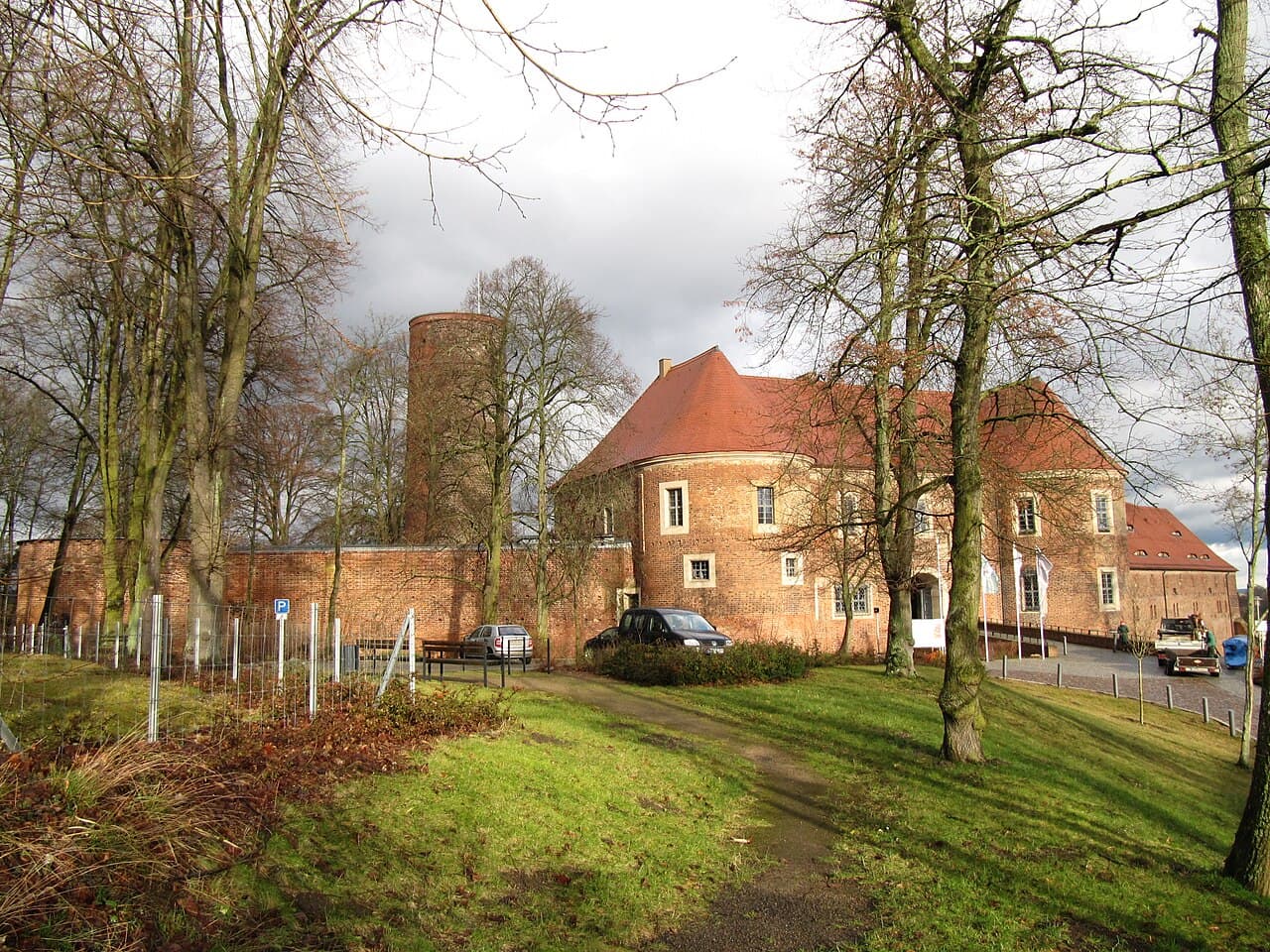
Burg Eisenhardt
Burg Eisenhardt is a remarkable medieval hill castle situated on the Bricciusberg hill at the southwestern edge of Bad Belzig, Germany. The castle's strategic location atop a hill provided natural defense advantages and oversight of the surrounding landscape, a typical characteristic of hill castles constructed during the High Medieval period. This fortress has a rich history spanning over a millennium, reflecting the complex political and military developments in the Brandenburg region.
The site originally belonged to the Slavic Heveller tribe, who established a stronghold here during the early medieval period. It first appears in historical records in the year 997 as burgwardium belizi, a term indicating a fortified settlement or castle district, mentioned in a document issued by Emperor Otto III. This document granted the territory to the Archbishopric of Magdeburg, illustrating the castle's early importance in regional power struggles between Slavic tribes and emerging Germanic authorities.
Archaeological evidence reveals that the area around Bricciusberg was inhabited since the late Bronze and Iron Ages, underscoring its long-standing strategic significance. After the Slavic uprising of 983, local Slavic groups retained control until 1157, when Albrecht the Bear, a pivotal figure in the German eastward expansion, reconquered the region. This conquest brought Burg Eisenhardt under the rule of the Ascanian dynasty, which shaped much of Brandenburg's medieval history.
Early construction and medieval expansions
The first stone castle on the site was erected in the mid-12th century by Count Siegfried of Belzig, a member of the Baderich family. This initial construction marked the transition from earlier wooden fortifications to a more durable stone stronghold, typical of the era's military architecture. Following the death of the last count after 1251, the castle passed to the Duchy of Saxony, reflecting the shifting feudal allegiances common in medieval Germany.
Significant expansion occurred around 1305 under Duke Rudolf I, who enhanced the castle's fortifications to meet evolving military needs. The nearby settlement of Belzig was granted town rights in 1358, signifying the area's growing economic and administrative importance linked to the castle.
The house of wettin and artillery modernization
By the mid-15th century, approximately between 1423 and 1425, Burg Eisenhardt came under the ownership of the House of Wettin, a powerful dynasty influential in Saxony and beyond. Starting around 1477, the Wettins undertook extensive renovations, transforming the fortress into a modern artillery fortress. This included the addition of distinctive rondelle bastions—rounded artillery towers designed to mount handguns and medium artillery pieces, a cutting-edge defense feature of the late medieval period.
The castle's gatehouse was converted into a princely residence during this time, possibly under the direction of the architect Arnold von Westfalen. This transformation reflected a broader trend in castle architecture where military fortifications were adapted to serve as stately homes, blending defensive and residential functions.
Destruction and restoration through the early modern period
The fortress suffered severe damage in 1636 during the Thirty Years’ War when it was attacked by Swedish troops. This conflict devastated much of central Europe, and Burg Eisenhardt's damage illustrates the widespread impact of the war on German castles. Restoration began in the 1680s under Elector Johann Georg III, culminating in the consecration of the rebuilt fortress in 1691. The restoration included Baroque style renovations, particularly in the interior residential spaces, aligning with contemporary tastes and the castle's evolving role from purely military fortress to noble residence.
Architectural features and fortifications
Burg Eisenhardt is enclosed by an irregular heptagonal outer wall featuring seven rondelle bastions at each corner. These bastions are reinforced with thick walls and contain chambers equipped with firing slits, allowing defenders to use handguns and artillery effectively. The two southernmost bastions integrate with the gatehouse, which was adapted into an elegant residential building during the late 15th century renovations.
The main entrance lies on the north side, situated between the north and northeast bastions. The largest bastion on the northeast corner houses a deep cistern measuring eight meters, which provided a vital water supply during sieges. Inside the courtyard stands the bergfried, a tall circular keep constructed from fieldstones in the early 13th century. This tower, rising 28 meters, served as both a defensive stronghold and a lookout point. Its northwest wall was partially rebuilt in 1859 using red bricks.
The bergfried features a round-arched entrance, a latrine niche, and a fireplace on its middle floor, with the basement historically functioning as a dungeon. The castle's gatehouse is a double-towered structure built of rubble stone with brick facing. After damage in the Thirty Years’ War, it was rebuilt between 1685 and 1691, with the towers shortened and unified under a single roof. The facade was remodeled in the Baroque style, characterized by rectangular windows with wrought-iron grilles.
Above the outer basket-handle arch of the gate passage rests a keystone bearing the coat of arms of the Electorate of Saxony. The vaulted passage replaced the original drawbridge with a fixed masonry bridge made of brick. East of the gatehouse is the former salt magazine, built in the early 16th century as part of the outer defensive wall. Originally a granary, it later stored salt, a valuable commodity. This brick building features diverse window and door arches and was converted to residential use in 1930.
Later history and modern uses
Following the Napoleonic Wars and the Congress of Vienna in 1815, Burg Eisenhardt and the town of Belzig were transferred from Saxon to Prussian control. Throughout the 19th century, the castle served administrative functions, including housing the local court and district administration offices.
In the 20th century, the castle’s role evolved with the political landscape. Between 1936 and 1945, it hosted the Reich School of Technical Assistance. During the German Democratic Republic era, the site accommodated various institutions such as vocational and special schools, a youth hostel, music school, youth club, registry office, local history museum, and a youth naturalist station.
Since German reunification, extensive restoration has preserved Burg Eisenhardt’s historical fabric. Today, it houses a local history museum, a branch of the registry office, and a library dedicated to the castle’s history. The castle courtyard has also become a cultural venue, hosting annual open-air concerts by the band Keimzeit from 1998 through 2021.
Notable historical events linked to Burg Eisenhardt include the stay of Tsar Peter the Great in 1712 during his journey to attend his son’s wedding. Additionally, the nearby Battle of Hagelberg in 1813, part of the German Wars of Liberation against Napoleon, took place west of Belzig, connecting the castle to broader European military history.
Archaeological findings and castle remains
Archaeological excavations in 1993 uncovered the foundations of a Romanesque chapel dating to the early 13th century within the inner courtyard. This three-part fieldstone structure highlights the castle’s religious functions in medieval times. Foundations of a former palas, the main residential hall, and remnants of an older inner ring wall reveal multiple construction phases and expansions.
The surviving architectural features illustrate Burg Eisenhardt’s evolution from a medieval hill fortress into a fortified residence adapting to changing military technologies and residential needs over centuries. Its heptagonal fortifications, artillery bastions, and baroque renovations represent a layered history of military architecture and noble habitation.
Today, visitors to Burg Eisenhardt can explore its well-preserved bergfried, the imposing gatehouse, and the extensive curtain walls with bastions. The castle’s museum offers insights into its multifaceted history, from Slavic origins through medieval feudalism, Renaissance artillery modernization, and modern cultural uses.
Frequently asked questions (FAQ)
- When was Burg Eisenhardt originally constructed?
- Burg Eisenhardt was originally constructed in the mid-12th century by Count Siegfried of Belzig as a stone castle replacing earlier fortifications.
- What architectural features make Burg Eisenhardt unique?
- Burg Eisenhardt features a distinctive heptagonal outer wall with rondelle artillery bastions, a tall circular bergfried, and a baroque-style gatehouse converted from a medieval fortress.
- Can visitors explore the interior of Burg Eisenhardt?
- Yes, visitors can explore the castle's courtyard, bergfried lookout tower, gatehouse, and local history museum, which provide insights into its medieval and early modern history.
- What notable historical events are connected to Burg Eisenhardt?
- The castle hosted Tsar Peter the Great in 1712 and is near the site of the Battle of Hagelberg in 1813, linking it to significant European historical events.
- Is Burg Eisenhardt accessible year-round?
- Visiting hours may vary seasonally; it is recommended to check local tourist information for current opening times and any special events held at the castle.
Photo gallery

Information
Sources & official resources
Verify the information above using these authoritative references.
Loading map...
Visitor reviews
No reviews yet. Been here? Write the first review and help other travelers!
Write the first reviewVisited this castle? Share your experience
Your review helps other travelers and adds first-hand knowledge to our encyclopedia.



