Burg Dreieichenhain
Burg Dreieichenhain stands as a remarkable example of a Salian dynasty hill castle in Germany with a history deeply intertwined with the Holy Roman Empire and the management of imperial hunting grounds. Located in the town of Dreieich, this medieval fortress was originally built in the first half of the 11th century as an administrative center overseeing the vast Wildbann Dreieich forest. Its strategic position on a small island in the Hengstbach stream provided natural defenses, enhanced by a broad, water-filled moat and a high curtain wall that enclosed the castle’s essential buildings.
The castle’s origins are linked to the imperial administration during the Salian period, with the earliest documented figure being Eberhard von Hagen, who served as imperial reeve in 1076. Around 1080, he constructed a substantial five-story residential tower on the island, which became the core of the fortress. This tower, measuring approximately 25 meters in height with walls nearly three meters thick at the base, was both a defensive stronghold and a noble residence. Although local legend attributes an earlier hunting lodge on the site to Charlemagne in the 9th century, no definitive historical evidence supports this claim.
Architectural evolution and expansions
During the late 12th century, under the influence of the Staufer dynasty, Burg Dreieichenhain underwent significant expansion. New stone structures were added, including a round bergfried serving as a fortified keep, a Romanesque palas or great hall, and a chapel dedicated to Saint Pancras. These additions reflected the castle’s growing importance as a noble seat and administrative hub. The castle became the ancestral home of the influential von Hagen-Münzenberg family, who played a key role in the region’s medieval history.
After the death of the last von Hagen-Münzenberg heir in 1255, the castle transitioned into a Ganerbenburg, a jointly owned castle shared by multiple noble families. By 1286, the von Falkenstein family had emerged as dominant owners. They enhanced the castle’s residential quarters, improved the church facilities, established a nearby school, and constructed a residence for the Burgmannen (castle guards), further solidifying the castle’s role as a local power center.
The settlement of Hayn and later ownership
The name Hayn appears in records from 1256 onwards, referring to the small community that developed around the castle. This settlement mainly housed officials responsible for managing the imperial hunting grounds. In 1460, a devastating fire destroyed the original Salian residential tower. Subsequently, the castle passed into the hands of the Counts of Isenburg, who completed their acquisition by 1701. They introduced late Gothic architectural features before the castle ceased to be used as a noble residence.
Decline, ruin, and preservation
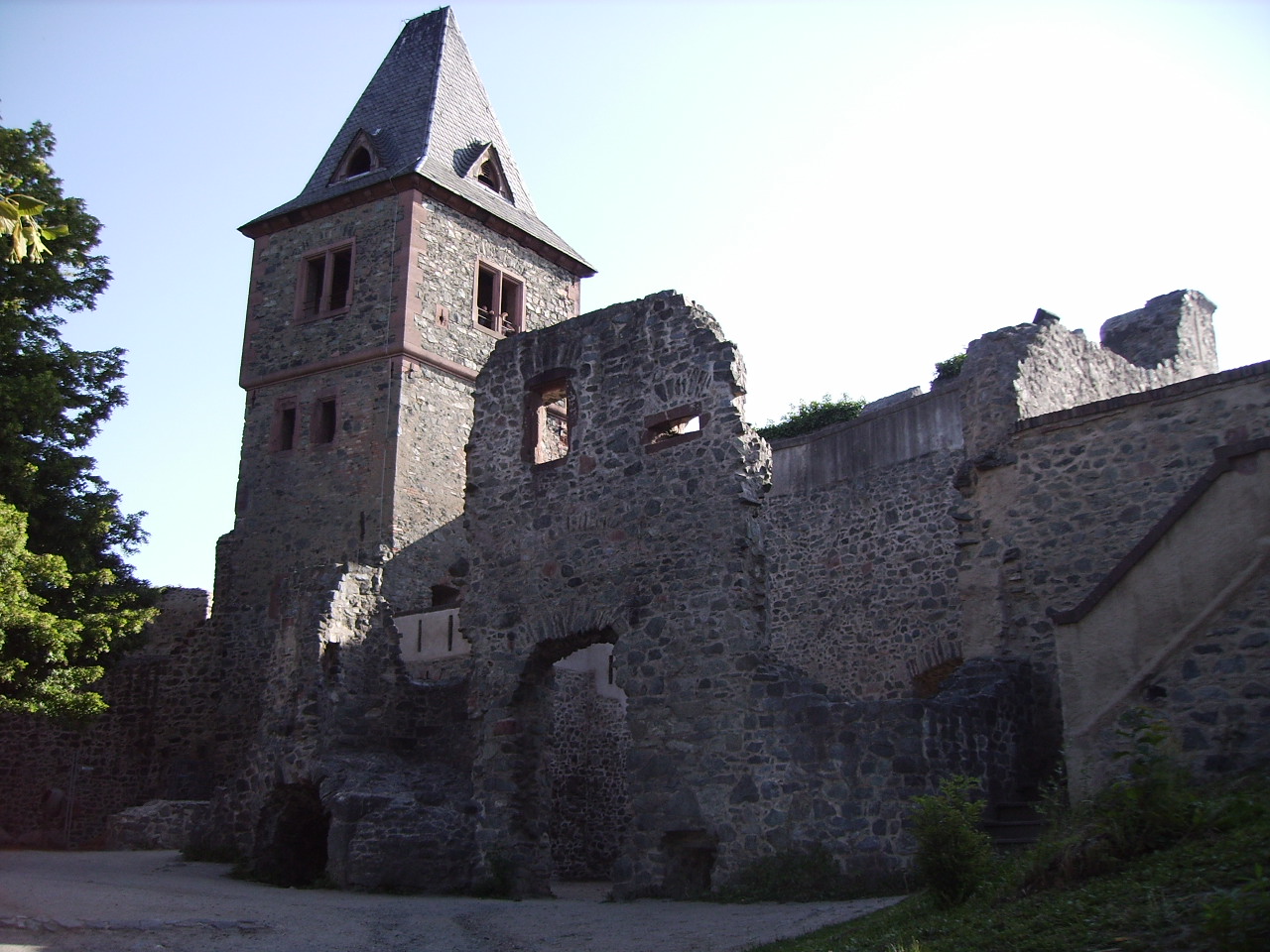
Throughout the 18th century, Burg Dreieichenhain fell into disuse and was partially dismantled. Stones from the castle were repurposed for local construction projects, including road building. The main residential tower collapsed in 1750, leaving only a 22-meter-long fragment of wall standing today. Despite this decline, the castle’s ruins remain significant for their historical and architectural value.
In the 20th century, ownership transferred to a local history association dedicated to preserving the site. Today, Burg Dreieichenhain is a protected heritage site and is considered one of the best-preserved secular castles from the Salian era in Germany. The ruins include the remains of the palas, the round bergfried, the western curtain wall, and the chapel with its successive architectural phases.
Architectural features and surviving structures
The residential tower and defensive elements
The original five-story residential tower was the centerpiece of the castle’s early design. Built around 1080, it stood on a 30 by 40-meter island within the Hengstbach stream. Its massive walls provided strong defense, while its height offered commanding views of the surrounding forest and settlement. After the 1460 fire and subsequent collapse in 1750, only a portion of the tower’s wall remains, allowing visitors to appreciate its original scale and construction techniques.
Romanesque and Gothic influences
The late 12th-century expansions introduced hallmark Romanesque architectural features such as the palas and the chapel dedicated to Saint Pancras. Around 1300, the chapel was replaced by an early Gothic hall church, reflecting evolving religious architectural styles. This church was destroyed by fire in 1669 and rebuilt by 1718, incorporating later renovations like a sacristy added for its 300th anniversary.
Supporting structures and castle life
Beyond the main fortifications, the castle complex included stables for horses, kennels for hunting dogs, and a Fronhof manor estate where officials and Burgmannen lived and worked. The Burgmannen’s house, expanded notably by the Bellersheim family, was integral to the castle’s defense and administration during the late medieval period.
Current use and cultural significance
Today, the ruins of Burg Dreieichenhain serve as a cultural venue and historical museum. The Dreieich-Museum housed on site preserves and presents the local history connected to the castle and its surroundings. The castle grounds, including the historic garden and preserved curtain walls, provide an atmospheric setting for cultural events, educational programs, and tourism.
As one of the best-preserved secular castles from the Salian era, Burg Dreieichenhain offers valuable insights into medieval castle architecture, feudal administration, and regional history. Its combination of Romanesque and Gothic elements, alongside its unique status as a Ganerbenburg, makes it a significant heritage site in Germany.
Frequently asked questions (FAQ)
- How do I get to Burg Dreieichenhain?
- Burg Dreieichenhain is located in Dreieich, Hesse, Germany. It can be reached by local public transport or car, with parking available nearby.
- What is the historical significance of Burg Dreieichenhain?
- Burg Dreieichenhain was an important administrative center for the Holy Roman Empire overseeing the Wildbann Dreieich forest. It also served as a noble residence and a Ganerbenburg shared by multiple families.
- Can I visit the Dreieich-Museum at the castle?
- Yes, the Dreieich-Museum is located on the castle grounds and offers exhibitions on local history and the castle's heritage. It is open during the castle's visiting hours.
- What architectural styles are visible at Burg Dreieichenhain?
- The castle features Romanesque architecture in its original structures, with later Gothic influences visible in the chapel and expansions made by the Counts of Isenburg.
- Is Burg Dreieichenhain accessible for visitors with mobility issues?
- The castle ruins have uneven terrain and some steep areas, which may pose challenges for visitors with mobility issues. It is advisable to check accessibility options before visiting.
Information
Current owner
Local history association
Loading map...
Visitor reviews
No reviews yet. Been here? Write the first review and help other travelers!
Write the first reviewVisited this castle? Share your experience
Your review helps other travelers and adds first-hand knowledge to our encyclopedia.