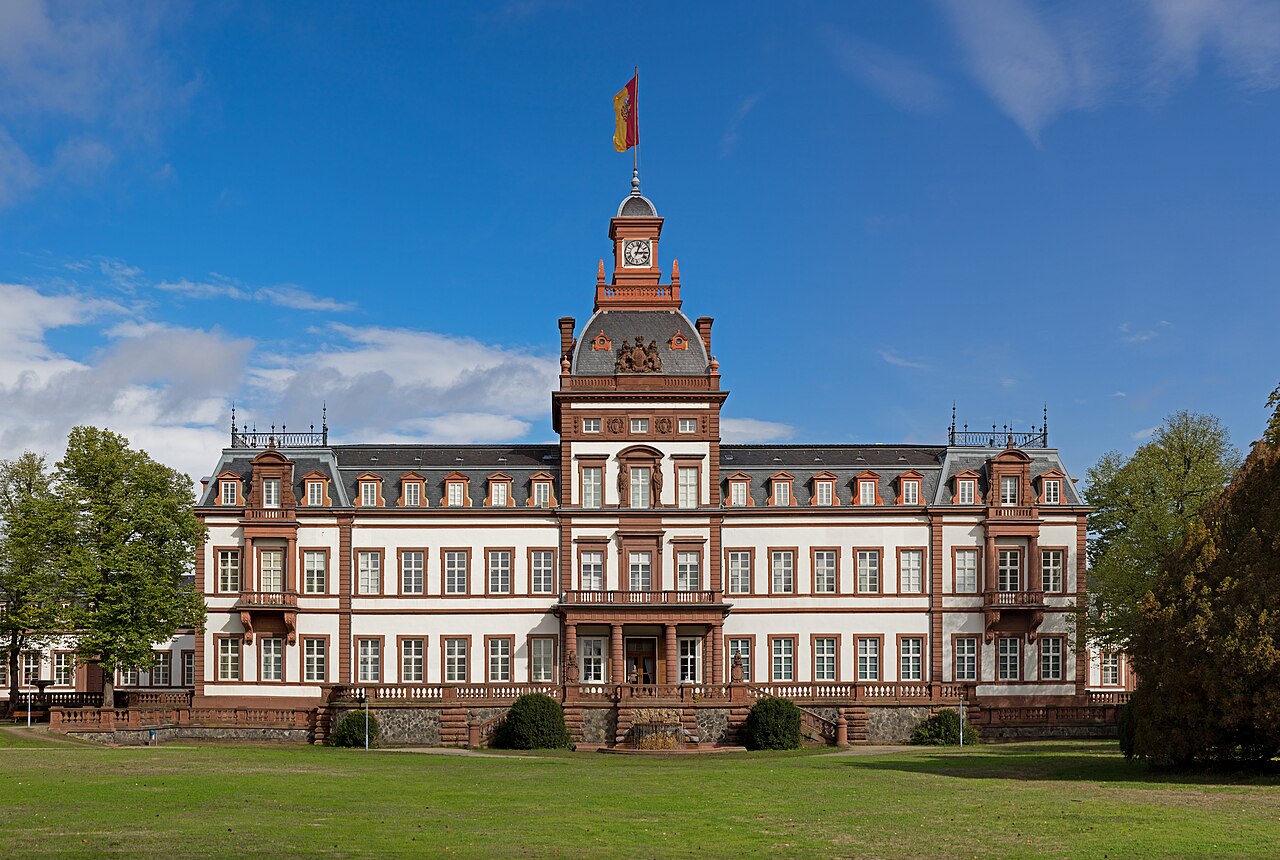
Schelmenburg
Schelmenburg castle stands as a remarkable example of a historic water castle nestled in the municipality of Frankfurt-Bergen-Enkheim, Germany. Its origins trace back to the medieval era, where it began as the seat of the noble Schelme von Bergen family. This castle embodies centuries of architectural evolution, noble lineage, and regional history, making it a significant heritage site in the region.
Medieval origins and early history
The earliest documentary evidence of Schelmenburg dates to 1194, referencing a member of the Schelm von Bergen family, which confirms the castle's existence by the late 12th century. Archaeological findings indicate that the original fortification was a wooden motte-and-bailey castle, typical of medieval defensive architecture during the reign of Emperor Frederick Barbarossa in the 12th or 13th century. This initial structure consisted of wooden buildings atop an earthwork mound, designed for defense and control of the surrounding territory.
Despite local legends suggesting a Roman or Frankish fortress previously occupied the site, no archaeological evidence supports these claims. The Roman bricks found at Schelmenburg were repurposed from nearby Roman agricultural estates rather than from a Roman fortification on the castle grounds.
Architectural transformation and political history
During the High Middle Ages, the Schelme von Bergen family held the castle as imperial vassals. However, from 1269 onward, their allegiance shifted increasingly toward the Lords and Counts of Hanau. By 1354, under the rule of Ulrich III of Hanau, the castle underwent a significant transformation from a wooden stronghold into a fortified stone residence described as a "fortified house." This transition involved the construction of stone walls and expansions that enhanced both defensive capabilities and residential comfort.
The Schelme von Bergen family's decline led them to engage in banditry, targeting merchants traveling nearby. This hostile behavior prompted military responses from the city of Frankfurt, which occupied Schelmenburg twice, in 1381/82 and again in 1389. Following these occupations, the Schelme swore allegiance to Frankfurt and entered into service for the city, marking a pivotal shift in the castle’s political status.
Early modern renovations and baroque reconstruction
Between 1500 and 1520, Adam Schelm von Bergen initiated renovations that included the addition of an outer moat to protect service buildings and the reinforcement of outer walls with shooting openings. Despite these improvements, the castle's military significance diminished as warfare evolved.
By the early modern period, Schelmenburg ceased functioning as a fortress and became a manor estate. Around 1700, Friedrich Adolph Schelm von Bergen, connected to the Electoral Palatinate court, demolished the medieval main residential building and erected a new Baroque-style water castle on the original foundations. This reconstruction preserved key features such as the moat and bridge, blending historical continuity with contemporary architectural trends.
Architectural features of the baroque water castle
Today, Schelmenburg is a three-story Baroque water castle measuring approximately 16 meters along its front and rear façades and 18 meters along its sides. The building is crowned with a mansard roof clad in slate, featuring dormer windows that illuminate the attic space.
The northern part of the castle, about one-third of the structure, corresponds to the location of the original motte and notably lacks a cellar. Within the cellar, a Romanesque round-arch doorway remains visible, serving as a tangible link to the castle's medieval past.
Access is gained via a bridge spanning the surrounding moat. The medieval bridge originally had a removable wooden section near the castle for defensive purposes. The current bridge consists of two stone arches, providing stable access.
The main entrance showcases a Renaissance-style portal crafted from red sandstone, possibly salvaged from earlier structures. Above this portal is a Baroque broken gable bearing an inscribed cartouche and flanked by coats of arms representing the Schelme von Bergen family and the Lords of Venningen.
Castle grounds and water defenses
The outer courtyard historically contained essential economic buildings, including stables, barns, gardens, and a brewhouse. Although the brewhouse was dismantled around 1820, brewing rights persisted, and beer production continued under later owners until World War I.
The castle's water defenses consist of moats fed by powerful springs to the north, with water draining south through a covered channel. The moat water was unsuitable for drinking due to marshy conditions and contamination, so fresh water was supplied by a well inside the castle cellar and two wells in the outer courtyard.
Renovations in the 1960s involved dredging and partially filling the moat with gravel and lining its banks with basalt stones. Archaeological excavations during these works uncovered medieval weapons and riding equipment, now preserved in the local museum.
Modern history and preservation
The Schelme family line ended in the 19th century, with ownership passing to various individuals, including Johann Georg Kalbhenn in 1830. The municipality of Bergen-Enkheim acquired the castle in 1942. Agricultural use continued until 1962, after which restoration efforts repurposed the site for communal and cultural activities.
Post-World War II development transformed much of the castle's gardens and grounds into residential housing for refugees and civic buildings such as the Bergen town hall and a savings bank, integrating the historic site into the modern urban fabric.
Archaeological excavations in 2001 and earlier renovation projects revealed artifacts like a dagger, crossbow bolt, and spur, shedding light on the castle's layered history and daily life during its medieval period.
Frequently asked questions (FAQ)
- How do I get to Schelmenburg castle?
- Schelmenburg castle is located in the municipality of Frankfurt-Bergen-Enkheim in Hesse, Germany. It is accessible by local roads and public transport connections from Frankfurt city center.
- What is the historical significance of Schelmenburg castle?
- Schelmenburg castle is significant for its medieval origins as a motte-and-bailey fortress and its transformation into a Baroque water castle, reflecting regional noble history and architectural evolution.
- Can I visit the interior of Schelmenburg castle?
- Visiting access to the interior of Schelmenburg castle may be limited as it serves communal and cultural functions. It is best to check with the local municipality for current visiting arrangements and events.
- When was Schelmenburg castle built?
- The original castle was constructed in the 12th century as a wooden motte-and-bailey fortress, with major stone renovations occurring in the 14th century and a Baroque reconstruction around 1700.
- What architectural styles are present at Schelmenburg castle?
- Schelmenburg castle features a blend of architectural styles including medieval Romanesque elements, Renaissance portals, and a prominent Baroque-style water castle built around 1700.
Information
Loading map...
Visitor reviews
No reviews yet. Been here? Write the first review and help other travelers!
Write the first reviewVisited this castle? Share your experience
Your review helps other travelers and adds first-hand knowledge to our encyclopedia.