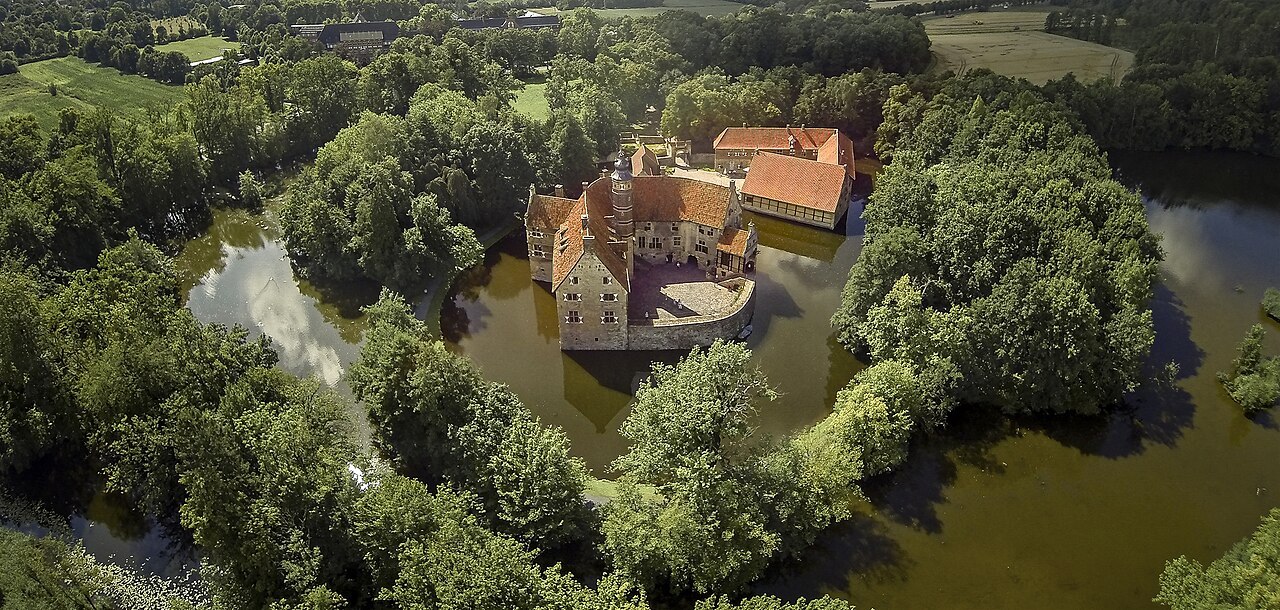
Burg Botzlar
Burg Botzlar is a historic hill castle located in the town of Selm, Germany. Established in the High Middle Ages, the castle played a significant role as a defensive and administrative center over several centuries. Its origins trace back to the local nobility, notably the lords of Meinhövel, who adopted the name “von Botzlar” around 1250, indicating their close association with the site. The first clear written record of the castle dates to 1282, when ownership passed to the Bishop of Münster. Under episcopal oversight, Burg Botzlar was expanded to serve as a fortified border fortress guarding against the neighboring Counts of the Mark, reflecting its strategic importance in regional conflicts.
Medieval origins and turbulent history
The castle's early history was marked by violent disputes and military actions. In 1305, during a feud involving Wulf zu Wulfsberg and the Count of the Mark, Burg Botzlar was destroyed. It was rebuilt but faced further conflict when it was captured and demolished by the Counts of the Mark in 1369. These events underscore the castle's role as a contested stronghold in a volatile border region. By 1315, the castle was pledged to the Münster-Meinhövel family, who maintained control for nearly three centuries, illustrating the continuity of noble ownership despite regional turmoil.
Ownership transitions and administrative role
In 1597, the estate passed by inheritance to the Ascheberg family, continuing its status as a noble residence. Around the mid-18th century, ownership transferred to the Counts of Landsberg-Velen zu Gemmen. Beyond its military function, Burg Botzlar served as a local center of justice, maintaining its own manorial court. During the 15th century, this court merged with the episcopal court in Werne, highlighting the castle's integration into regional governance and legal affairs.
Architectural features and castle layout
The present-day structure is a two-story building with six window axes, constructed primarily of rubble stone with prominent quoins at the corners, dating from the early 19th century. This building incorporates parts of earlier medieval construction. Notably, remnants of a bergfried—a tall fortified tower typical of medieval castles—are believed to be integrated into the southwest corner. The bergfried's historical presence is confirmed by an 1834 cadastral map.
The castle's original layout featured a main island surrounded by water, a common defensive feature in medieval fortifications. To the west lies a forecastle island, which once held two rows of buildings. The entire complex was enclosed by a broad earthwork hedge, providing an additional defensive barrier.
Notable buildings and medieval elements
Documents from 1587 describe several castle components, including a stone house, an adjoining house with a hall and parlor above cellars, a workshop, a summer house, as well as bridges, moats, and gates. Two stone houses are particularly documented: one built in 1469 attributed to Lubbert von Morrien, likely serving as a residence for a castle official or vassal; and another called the “lapideum,” granted in 1300 by the Bishop of Münster to the Burgmann family von Krampe. The lapideum probably formed the core of the main castle island, serving both residential and military functions.
Water defenses and fortifications
Burg Botzlar was well-fortified with multiple moats encircling the castle. The innermost moat remained until the 1960s, demonstrating the longevity of its medieval defensive features. These moats, combined with the surrounding earthworks, emphasized the castle's role as a fortified stronghold in a contested border zone.
20th-century use and preservation efforts
During the Nazi period, Burg Botzlar was repurposed as a district school for the National Socialist Women’s League in Westphalia-North. In October 2013, a citizens’ foundation acquired the castle from the city of Selm, reflecting ongoing local interest in preserving its heritage. Before the municipal merger in 1975, there was consideration to name the new municipality after the castle, but the name Selm was chosen instead.
Today, Burg Botzlar stands as a valuable historic site illustrating medieval defensive architecture and noble residence evolution. Its combination of medieval remnants, 19th-century construction, and water defenses offers insights into the complex history of border fortifications in the Münsterland region.
Frequently asked questions (FAQ)
- When was Burg Botzlar originally built?
- Burg Botzlar was originally established in the 13th century, with the first clear written record dating to 1282.
- What architectural features define Burg Botzlar?
- The castle features a two-story rubble stone building with quoins, remnants of a bergfried tower, multiple moats, and earthwork defenses.
- Who were the original owners of Burg Botzlar?
- The lords of Meinhövel, who adopted the name von Botzlar around 1250, were the original noble owners associated with the castle.
- What role did Burg Botzlar play in regional conflicts?
- Burg Botzlar served as a border fortress guarding against the Counts of the Mark and was destroyed and rebuilt multiple times during feuds in the 14th century.
- Is Burg Botzlar open to the public?
- The castle is currently owned by a citizens’ foundation focused on preservation. Visitors should check local sources for current access and opening hours.
Information
Current owner
Citizens’ foundation
Loading map...
Visitor reviews
No reviews yet. Been here? Write the first review and help other travelers!
Write the first reviewVisited this castle? Share your experience
Your review helps other travelers and adds first-hand knowledge to our encyclopedia.