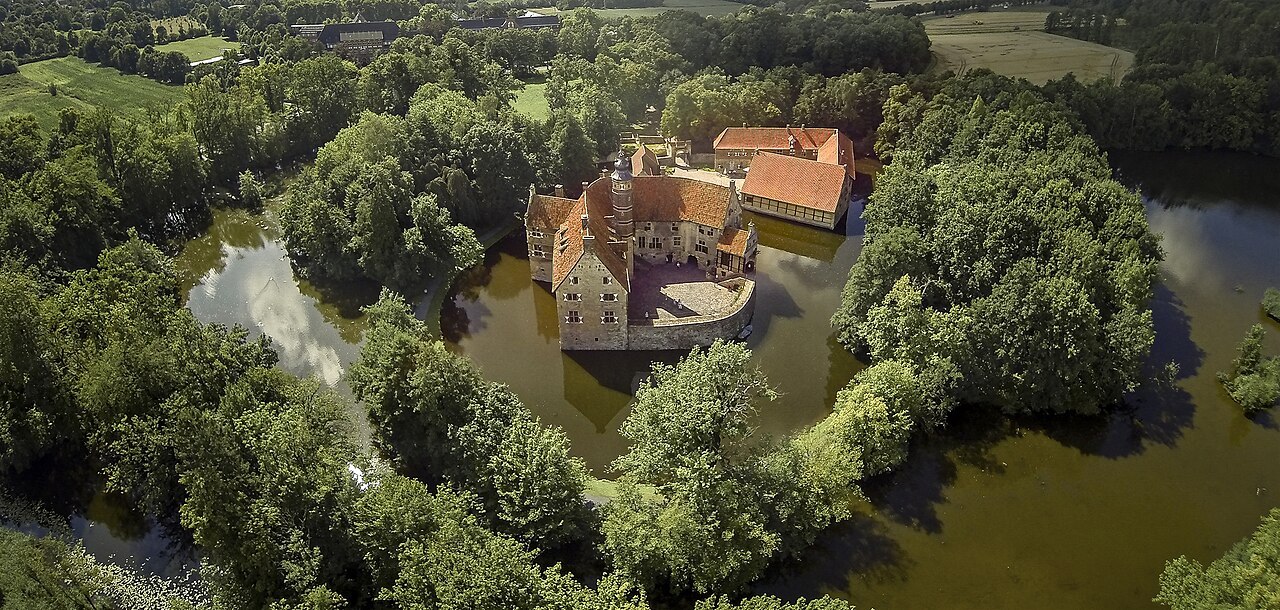
Lüdinghausen Castle
Lüdinghausen Castle, located in the heart of Lüdinghausen, Germany, stands as a remarkable example of medieval fortification transformed through Renaissance architectural innovation. Originally constructed in the 12th century by the noble von Lüdinghausen family, the castle's strategic position and robust design reflect its initial purpose as a fortified residence and stronghold during the High Medieval period. Over centuries, the castle evolved significantly, mirroring the shifting tides of political power, architectural styles, and social functions within the region.
The castle's early history is deeply intertwined with the feudal and ecclesiastical structures of medieval Germany. First documented in 1271, it served as the seat of the knights of Lüdinghausen, who were ministeriales under the Bishop of Münster. These knights held the castle as a fief from the Abbey of Werden, highlighting the complex religious and feudal allegiances that shaped its governance. The castle was a focal point in regional conflicts, notably when Bishop Gerhard von der Mark led a military campaign in 1271 to curb the knights' attempts at asserting independence. Despite the conflict, Burg Lüdinghausen was spared destruction but was declared an open house to the bishop, signaling a reduction in the knights' autonomy.
Medieval architecture and expansions
Throughout the 14th and 15th centuries, Burg Lüdinghausen expanded its defensive and residential capabilities. Key architectural features from this period include a gatehouse, multiple stone residential buildings equipped with kitchens, a bergfried (a tall, central tower or keep), and a chapel attached to the gatehouse. These structures exemplify typical medieval castle design, emphasizing both defense and domestic functionality. The castle remained under the Lüdinghausen family's control until their lineage ended in 1443, after which ownership transferred to the Bishop of Münster.
Renaissance transformation under canon gottfried von raesfeld
Between 1569 and 1573, the castle underwent a significant transformation under the direction of Canon Gottfried von Raesfeld, who rebuilt it into a quintessential Renaissance castle. This renovation introduced elaborate decorative elements such as intricately carved window gables and a prominent coat of arms plaque in the inner courtyard. The south wing, constructed during this period, remains a defining feature of the castle's current appearance. The Renaissance rebuilding not only restored the castle's structural integrity but also reflected contemporary tastes and the social status of its owners.
Historical events and uses
The castle's history includes darker chapters, notably in 1624 when it was the site of witch trials resulting in the execution of at least twenty individuals. This grim episode reflects the broader context of witch persecutions in early modern Germany. During the Thirty Years' War (1618–1648), the castle was occupied by Hessian troops for three years, who enhanced its fortifications, underscoring its ongoing military significance.
In the 19th century, the castle experienced further changes: the medieval bergfried was dismantled in 1829, with its former location marked today by a courtyard pavement feature. The castle passed into private ownership in 1802 and was repurposed as an agricultural school from 1869 to 1972. Renovations during this era included rebuilding the west wing and refurbishing the gatehouse and south wing facades, blending preservation with adaptation.
Architectural layout and defensive features
Burg Lüdinghausen is classified as a water castle (Wasserburg), uniquely situated on an island surrounded by multiple concentric moats and ring ditches. Originally, the fortifications comprised six to seven rings of ditches, topped by a semicircular earthwork, all fed by water channels from the nearby Stever River and the mill channel connected to Burg Vischering. This elaborate water defense system linked the castle's protection with that of the town of Lüdinghausen, creating an integrated defensive network.
The main castle complex today prominently features the south wing from the Renaissance period and a west wing dating from the late 19th century. The masonry of these buildings likely incorporates remnants of an older residential tower, indicating continuous occupation and rebuilding. The former site of the bergfried, a round tower approximately 11 meters in diameter, is commemorated in the courtyard pavement, preserving the memory of this key medieval structure.
To the east lies a moated outer bailey (vorburg) containing a gatehouse and the Bauhaus building. While only the north wall of the Bauhaus dates back to 1569, the rest was reconstructed in the 19th century. This outer bailey served as an additional fortified enclosure before the main castle. Adjacent to this is a second moated outer bailey, still surrounded by water but apparently never developed with permanent structures.
The castle's water defenses extend westward, where the moat forms a concentric ring around the central island. This feature remains visible today as a shallow depression retaining some water, illustrating the castle's sophisticated defensive design.
Interior features and cultural significance
The castle interior combines traditional construction with modern adaptations. The upper rooms serve as conference spaces, while the large hall is richly decorated with numerous heraldic emblems that reflect the noble heritage of its historic occupants. This hall currently hosts concerts and cultural events organized by the city, making the castle a vibrant center of community life.
Architectural details from the Renaissance period include a carved stone list documenting food prices from 1573/74, various coats of arms adorning the facade, and an inscription commemorating a city fire in 1569. These elements provide valuable insight into the administrative and daily life of the castle's residents during that era.
Today, Lüdinghausen Castle stands as a testament to the region's rich history, architectural evolution, and cultural heritage. Its preservation and adaptive reuse as a cultural venue ensure that the castle remains a significant landmark within the landscape of Lüdinghausen, attracting visitors interested in medieval and Renaissance architecture, regional history, and cultural events.
Frequently asked questions (FAQ)
- How do I visit Lüdinghausen Castle?
- Lüdinghausen Castle is open to visitors primarily during cultural events and concerts. Visiting hours vary depending on the schedule of events organized by the municipality. It is recommended to check the official website or local tourist information for current visiting times and ticket availability.
- What is the historical significance of Lüdinghausen Castle?
- Lüdinghausen Castle has played a crucial role since the 12th century as a fortified residence for noble families and a seat of ecclesiastical power under the Bishop of Münster. Its evolution from a medieval stronghold to a Renaissance residence reflects the region's political and architectural history.
- Can I see the castle's original medieval fortifications?
- Yes, the castle's complex water defenses, including multiple concentric moats and ring ditches, remain visible today. These features illustrate the sophisticated medieval defensive system that protected the castle and the town.
- Is Lüdinghausen Castle accessible for cultural events?
- Yes, the castle is currently used as a cultural and event center hosting concerts, conferences, and community programs. Facilities have been adapted to accommodate visitors while preserving historical features.
- When was the castle rebuilt in the Renaissance style?
- The castle was rebuilt in the Renaissance style between 1569 and 1573 under Canon Gottfried von Raesfeld, introducing elaborate decorative elements and restoring its structural integrity.
- Are there any notable architectural features inside the castle?
- Inside, the castle boasts a large hall decorated with heraldic emblems, a carved stone list of food prices from the 1570s, and various coats of arms on the facade, reflecting its noble heritage and Renaissance renovations.
Information
Opening hours
Varies by event
Ticket prices
Varies by event
Current owner
Municipality
Website
Visit websiteSources & official resources
Verify the information above using these authoritative references.
Loading map...
Visitor reviews
No reviews yet. Been here? Write the first review and help other travelers!
Write the first reviewVisited this castle? Share your experience
Your review helps other travelers and adds first-hand knowledge to our encyclopedia.