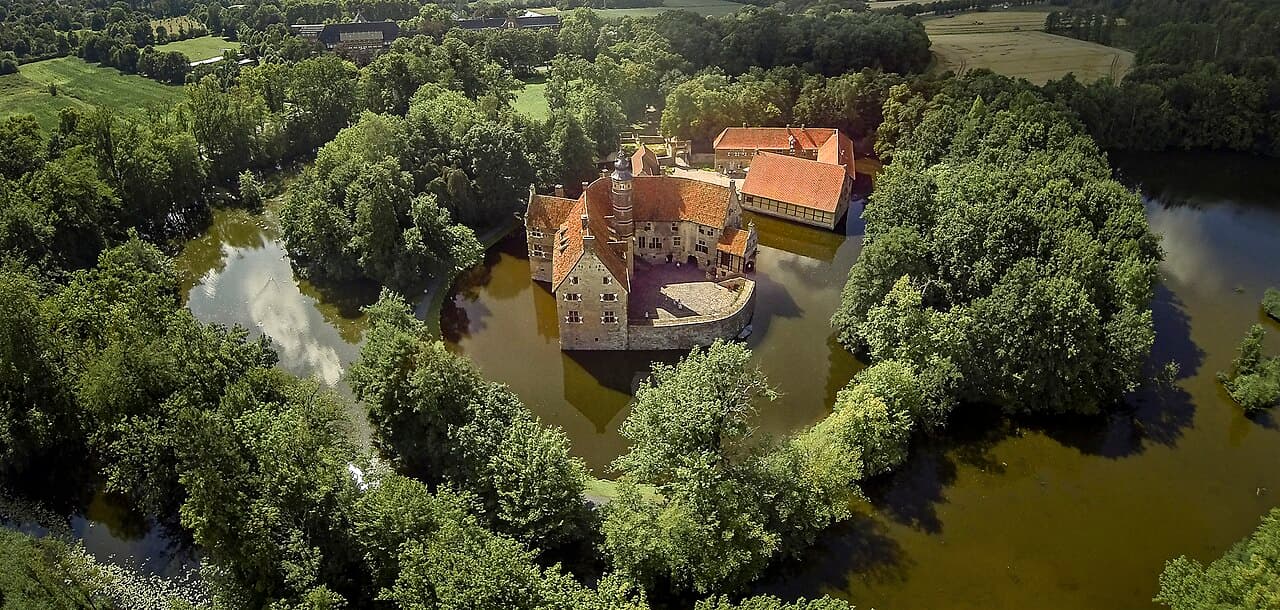
Vischering Castle
Vischering Castle stands as one of the most iconic and well-preserved examples of a moated castle in the Münsterland region of Germany. Located in the municipality of Lüdinghausen, this castle embodies the architectural and historical legacy of the High Medieval period with significant Renaissance modifications. Its strategic placement on a sandy island within a branch of the Stever River allowed it to serve as a formidable defensive fortress and a symbol of ecclesiastical and noble power in the region.
The castle was originally established in the latter half of the 13th century under the direction of Bishop Gerhard von der Mark of Münster. Its construction was motivated by the need to counterbalance rebellious local knights who had built an unauthorized fortress nearby. The earliest documentary evidence dates to 1271, when the castle was granted as a hereditary fief to Albert III von Wulfheim, a ministerial serving the bishop. Over time, the castle became the hereditary seat of the Droste zu Vischering family, whose name evolved alongside the castle's identity.
Medieval origins and strategic design
Vischering Castle was conceived as a water castle with a unique circular ground plan, uncommon in the Münsterland. It is composed of two islands: the western forecastle (Vorburg) and the eastern core castle (Kernburg), surrounded by a large moat system fed by the Stever River. The defensive walls, constructed from a combination of dark ironstone and Baumberger sandstone, reach up to ten meters in height and are notably thick, measuring approximately 1.6 to 1.7 meters at the base. The walls feature narrow arrow slits designed for archery defense but lack external windows, emphasizing the fortress's military purpose.
The castle's original layout included a central keep or bergfried in the eastern courtyard, which no longer survives above ground. Access to the inner castle is via a stone bridge built in 1719, complemented by a wooden drawbridge segment, leading into the trapezoidal forecourt island guarded by a gatehouse dating from 1519. This gatehouse remarkably survived the devastating fire of 1521 and still retains its original drawbridge fittings and a late Gothic coat of arms carved in stone.
Renaissance rebuilding and architectural evolution
The castle suffered significant damage from a fire in 1521, which destroyed much of the core buildings. Reconstruction was overseen by Johann von Droste zu Vischering and completed by his son Heidenreich by 1580. This rebuilding introduced Renaissance architectural elements, including the addition of a stair tower and larger windows, which enhanced the castle's residential comfort but reduced its purely defensive character.
Between 1617 and 1622, the castle was further expanded with the construction of the Auslucht, a three-story waterside annex featuring brick walls with light quoins and decorated oriel windows with geometric strapwork and family coats of arms. This annex included a secure Renaissance-era safe room accessible via a round trapdoor, reflecting the evolving needs for security and comfort.
Historical significance and noble heritage
Throughout its history, Vischering Castle played a significant role in regional power dynamics. It was occupied by Hessian forces during the Thirty Years' War from 1633 to 1634 but survived the conflict relatively intact. The Droste family, elevated to barons in 1670 and counts in 1826, moved their main residence to Schloss Darfeld by 1690, leaving Vischering under stewardship.
In the late 19th century, the castle was reoccupied by Maximilian Graf Droste zu Vischering and his wife, who commissioned interior renovations incorporating historicist wood paneling, blending contemporary tastes with the castle's medieval heritage. Structural challenges in the early 20th century due to lowered water tables prompted extensive foundation stabilization efforts led by engineer Georg Rüth between 1927 and 1929.
Preservation, restoration, and cultural role
Damage sustained during World War II was limited but included destruction to mill buildings, the bridge, gatehouse, and parts of the knights' hall ceiling. Post-war restoration from 1948 to 1952, with further repairs in the 1960s, restored the castle's structural integrity and historical appearance.
Archaeological investigations in the 1970s uncovered 16th-century frescoes and medieval foundations dated to around 1270, confirming the castle's age and providing insights into its construction techniques. The castle was transformed into a cultural center and museum, opening the Münsterlandmuseum in 1972, with expansions completed by 1984.
A major renovation completed in 2018 modernized exhibition spaces with a €9.6 million investment, ensuring the castle's role as a vibrant cultural hub. Today, Burg Vischering is a protected historic monument showcasing centuries of noble heritage, medieval architecture, and regional history.
Architectural features and layout
Defensive structures and moats
The castle’s double-moat system, fed by the Stever River, creates a formidable water defense surrounding the two islands. The thick ring wall with arrow slits and the surviving gatehouse provide insight into medieval defensive strategies. The stone and wooden drawbridge system allowed controlled access, critical for security.
Residential and ceremonial spaces
The main residential buildings form a horseshoe-shaped, three-story complex with heavy outer walls. The south wing contains one of the largest knights’ halls in the Münsterland, notable for its vaulted cellar, open floor plan, and 16th-century painted ceiling beams with rare secco frescoes depicting human and animal figures. Sandstone decorations on the facade include Renaissance medallions and family coats of arms, adding artistic and heraldic significance.
Stair tower and annexes
The octagonal stair tower with a spiral staircase features decorative German bands, cornices, and glazed bricks arranged in geometric patterns. Its pitched slate roof is crowned by a wooden crown and weather vane added in later centuries. The Auslucht annex extends into the moat, highlighting Renaissance-era residential expansion and security features.
Economic buildings and chapel
The western forecastle island hosts the economic courtyard with timber-framed and brick buildings, including a historic brewhouse, bakehouse with functioning stone oven, and stables. The nearby Georgskapelle chapel, consecrated in 1495, retains original Renaissance altar plates and a Flemish chandelier, enriching the site's spiritual heritage.
Visitor experience and cultural significance
Today, visitors to Vischering Castle can explore its well-preserved medieval and Renaissance architecture, walk the scenic lime-lined avenue, and enjoy the cultural exhibitions housed within the Münsterlandmuseum. The castle also features a children’s exhibit on knighthood and a cafe-restaurant, making it a vibrant cultural center for the Kreis Coesfeld region.
The castle's harmonious blend of natural surroundings, historic architecture, and cultural programming offers a comprehensive experience of feudal life, noble heritage, and regional history. Its preservation as a protected historic monument ensures that future generations can continue to appreciate this exceptional example of a High Medieval moated castle in Germany.
Frequently asked questions (FAQ)
- How do I visit Vischering Castle and what are the opening hours?
- Vischering Castle is open to visitors daily during the warmer months, typically from 10:00 to 17:00. It is advisable to check the official website for seasonal variations and special event closures before planning your visit.
- What is the historical significance of Vischering Castle?
- Built in the 13th century by Bishop Gerhard von der Mark, Vischering Castle served as a strategic fortress and noble residence. It reflects medieval defensive architecture and Renaissance modifications, illustrating the region's feudal history.
- Can I tour the interior of the castle and what exhibits are available?
- Yes, the castle houses the Münsterlandmuseum with exhibits on regional history, knighthood for children, and noble life. Visitors can explore the knights' hall, chapel, and various restored rooms showcasing frescoes and period furnishings.
- Is Vischering Castle accessible for visitors with mobility issues?
- While the castle has some uneven surfaces and staircases, efforts have been made to improve accessibility. Visitors with mobility concerns should contact the castle administration in advance to arrange accommodations.
- What architectural styles are represented at Vischering Castle?
- The castle features primarily High Medieval defensive architecture with significant Renaissance-era renovations, including a stair tower and decorative elements that enhance its residential character.
Photo gallery

Information
Sources & official resources
Verify the information above using these authoritative references.
Loading map...
Visitor reviews
No reviews yet. Been here? Write the first review and help other travelers!
Write the first reviewVisited this castle? Share your experience
Your review helps other travelers and adds first-hand knowledge to our encyclopedia.


