Bukovina Castle
Bukovina Castle stands as a significant medieval fortress located near the village of Jiřice u Moravských Budějovic in the Czech Republic. Established in the early 14th century, this hill castle was built to protect the important trade route known as the Haberner Steig, which linked the historical regions of Bohemia and Moravia. The castle's strategic position on a plateau approximately 393 meters above sea level allowed for commanding views over the Nedveka valley, making it a formidable defensive site in the medieval landscape.
The earliest historical references to the site date back to 1173, when it served as the seat of a local nobleman named Hrut von Bukovina. This early mention indicates the area's longstanding importance before the castle's formal construction. Between 1320 and 1325, the main construction phase of Bukovina Castle took place, culminating in 1337 with the completion of its central structures. The fortress was initially the residence of the Bukovina noble family for nearly a century until their lineage ended in 1417.
Architectural design and defensive features
The castle's layout reflects advanced medieval architectural principles, combining residential comfort with robust defense. The fortress was enclosed by thick defensive walls approximately 2.5 meters wide, designed to withstand siege weaponry of the period. One of the castle's most distinctive architectural elements is its round bergfried located on the northern wall. This tower, with an external diameter of 10 meters and an internal diameter of just 3 meters, served both as a keep and as the main gate, integrating defense and access control in a single structure. The circular shape of the bergfried is unusual for the region and demonstrates a sophisticated approach to fortification.
The southern section of Bukovina Castle houses a large palace completed by 1337, measuring approximately 11 to 13 meters in width and 40 meters in length. This two-story building featured vaulted rooms connected by an enclosed passageway, showcasing the advanced construction techniques of the time and the importance of residential quarters within the castle complex. Further expansion included a larger palace built down the slope outside the main castle core, which contained a basement with two vaulted rooms linked by a portal.
Additionally, a third residential building in the form of a square donjon with reinforced corners was situated on the southwestern promontory of the castle. The coexistence of a rectangular residential tower alongside a round bergfried reveals a unique architectural combination that was not commonly seen in castles of the region.
Historical context and ownership
Following the end of the Bukovina family line in 1417, ownership of the castle passed to Johann von Weitmühl of Žerotice. The castle played a role during the Hussite Wars in the early 15th century, a period marked by religious and political upheaval in Bohemia. During these conflicts, Bukovina Castle and the surrounding settlements suffered significant damage by fire, which led to the abandonment of the adjacent village of Bukovina.
In the mid-15th century, the estate came under the control of the Lords of Lichtenburg. In 1463, Hynek Bítovský von Lichtenburg led a rebellion against King George of Poděbrady. This insurrection resulted in the royal army besieging and capturing Bukovina Castle in 1465. The castle did not recover from this conflict; by 1481 it was recorded as deserted and fell into ruin. Administrative functions were transferred to the nearby village of Hostim, marking the end of Bukovina Castle's active use.
Fortifications and landscape features
The castle's defensive system included a broad, curved moat separating it from the village of Bukovina. This moat ranged from 16 to 30 meters in width, providing a substantial obstacle to attackers. On the northeast side, where the moat narrowed, additional defenses included a 10-meter-wide ditch and an earthen rampart, enhancing the fortress's protection on its most vulnerable side.
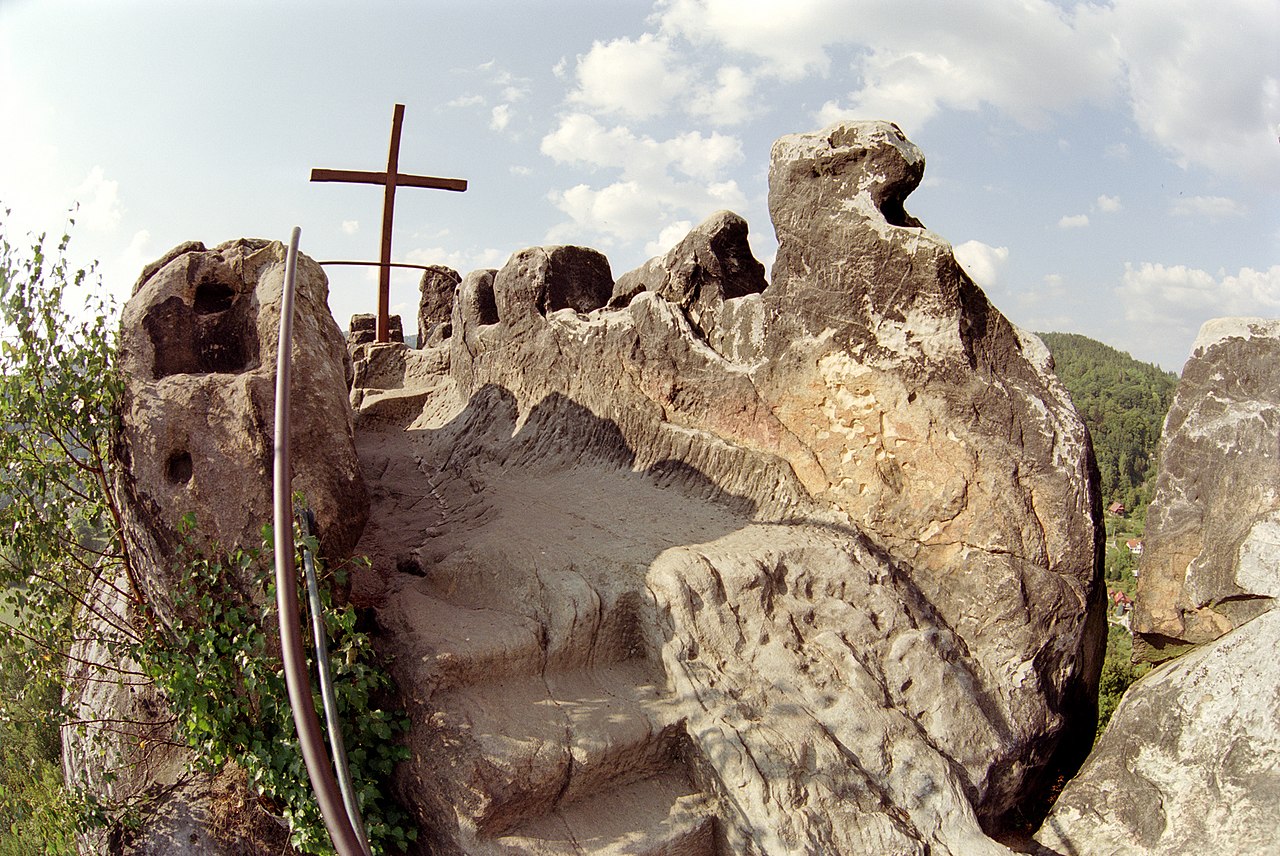
Today, the ruins of Bukovina Castle include partial sections of the southern palace, the vaulted passageway, fragments of the surrounding castle walls, and the remains of the bergfried. The castle embankment and outlines of the moats are also visible, offering visitors a tangible connection to the medieval past. Historical drawings and photographs, including a depiction from 1787, document the former presence of the square donjon. These remains have been protected as a cultural monument since 1958, preserving the site as an important heritage landmark in Czechia.
Archaeological significance and preservation
Archaeological studies confirm that Bukovina Castle was abandoned after the 15th century and saw no further habitation. The castle's name gradually faded from common use, with locals in the 19th century referring to it simply as the "deserted castle." Excavations and research have provided valuable insights into medieval fortification techniques and noble residence design in the Bohemian-Moravian border region.
The preservation of Bukovina Castle's ruins allows scholars and visitors to explore the evolution of medieval military architecture and the socio-political history of the region. The site serves as a testament to the turbulent history of Bohemia and Moravia during the Middle Ages, reflecting the impact of regional conflicts and noble power struggles on castle construction and decline.
Frequently asked questions (FAQ)
- How do I get to Bukovina Castle?
- Bukovina Castle is located near the village of Jiřice u Moravských Budějovic in the Vysočina Region of Czechia. It is accessible by local roads, and visitors can reach the site by car or on foot from nearby villages.
- What is the historical significance of Bukovina Castle?
- Bukovina Castle was a strategic fortress built in the early 14th century to protect a major trade route between Bohemia and Moravia. It played a role in regional conflicts such as the Hussite Wars and the rebellion against King George of Poděbrady.
- Can I visit the ruins of Bukovina Castle?
- Yes, the ruins of Bukovina Castle are open to the public. Visitors can explore the remaining walls, the bergfried ruins, and the outlines of the moats. There are no entrance fees, but facilities are limited due to the site's ruinous condition.
- When was Bukovina Castle built?
- The castle was constructed primarily between 1320 and 1337, with earlier historical mentions of the site dating back to 1173.
- What architectural style is Bukovina Castle?
- Bukovina Castle features Gothic architectural elements typical of the High Medieval period, including vaulted rooms and robust defensive walls.
Information
Current owner
State monument authority
Loading map...
Visitor reviews
No reviews yet. Been here? Write the first review and help other travelers!
Write the first reviewVisited this castle? Share your experience
Your review helps other travelers and adds first-hand knowledge to our encyclopedia.