Buckenham Castle
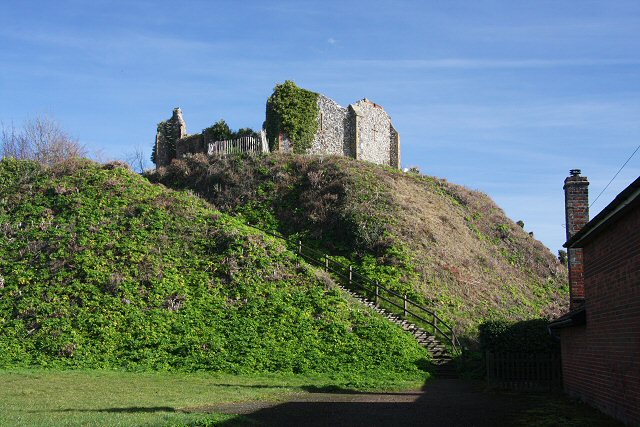
Buckenham Castle is a historic Norman fortress located west of the village of New Buckenham in Norfolk, England. This hill castle occupies a strategic position approximately 50 meters above sea level on relatively flat terrain, leveraging natural and man-made earthworks to enhance its defenses. The castle is renowned for its early circular stone keep, one of the earliest of its kind in England, and its well-preserved medieval earthworks, including moats and ramparts that outline the former fortifications.
The origins of Buckenham Castle date back to around 1140, during the early reign of King Stephen (1135–1154), when the Anglo-Norman Aubigny family constructed the fortress. This second castle, known as New Buckenham Castle, replaced an earlier Norman stronghold built approximately two miles northwest, known as Old Buckenham Castle. The original site was subsequently repurposed for the founding of Old Buckenham Priory around 1146, which led to the destruction of many early castle structures.
The foundation and early history
The Aubigny family, supporters of William the Conqueror, initially established Old Buckenham Castle as part of Norman consolidation efforts in the region. However, strategic considerations prompted the relocation to the New Buckenham site, where a planned settlement was established alongside the castle. This settlement evolved into the modern village of New Buckenham, whose layout still largely reflects its medieval origins, emphasizing the close relationship between the community and the fortress.
Architectural significance of the circular keep
The castle's most notable architectural feature is its circular stone keep, which measures approximately 18 meters (60 feet) in diameter with walls about 3 meters (11 feet) thick at the base. The keep may have stood up to 12 meters (40 feet) high, providing a formidable defensive tower and a symbol of feudal authority. This keep is considered one of the earliest examples of circular keeps in England, marking an important development in medieval military architecture that offered advantages in deflecting projectiles and resisting undermining compared to square keeps.
Medieval developments and ownership
During the 13th century, New Buckenham Castle was involved in significant historical events, including a siege during the Barons' War in 1263, a conflict between rebellious barons and royal forces. Ownership of the castle changed hands several times, passing to Adam de Clifton in 1316 before transferring to the Knyvett family through marriage alliances. By 1465, the castle was the residence of Sir John Knyvett, who maintained its role as a noble stronghold.
Castle layout and defensive structures
The castle complex consisted of an inner bailey surrounded by two outer baileys, all enclosed by earthen walls and ramparts. These baileys served multiple defensive and functional purposes, providing space for garrisons, storage, and domestic buildings. The entire site was further protected by a circular moat, which remains visible today along with the earth ramparts that trace the outline of the former curtain walls.
The castle's decline and demolition
The defensive importance of Buckenham Castle diminished over time, particularly during the 17th century. Following the English Civil War, in 1649, Sir Philip Knyvett, the castle's owner and 1st Baronet, ordered its demolition, likely under instructions from Parliament to prevent its use as a military stronghold. This demolition reduced the castle to ruins, leaving only the moat, earthworks, and the flint foundations of the circular keep.
Current condition and preservation
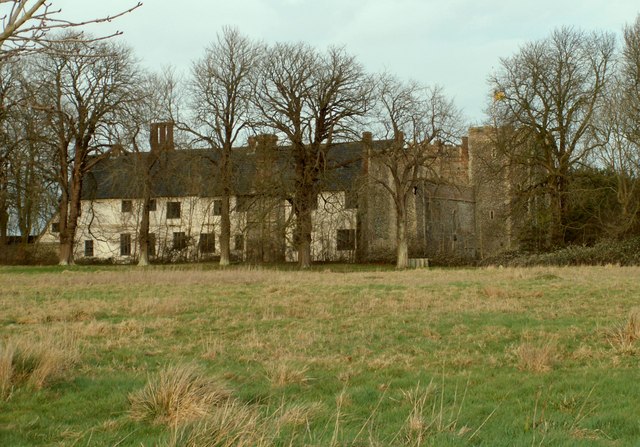
Today, Buckenham Castle is classified as a late medieval hill castle in ruins. The site is private property and generally not open to public visitation, although access may be arranged via the local village shop. The surviving earthworks, moat, and keep foundations provide valuable insight into Norman military architecture and medieval fortification strategies in Norfolk. The castle's remains, along with associated structures like St Mary's chapel (later converted to a barn), are protected as a Grade I Listed building and a Scheduled Monument, reflecting their cultural and historical significance.
Legacy and historical importance
Buckenham Castle stands as a testament to the Norman conquest and feudal era in England. Its strategic relocation, architectural innovations such as the circular keep, and its role in regional conflicts illustrate the evolution of castle design and medieval society. The preserved earthworks and ruins continue to attract interest from historians, archaeologists, and enthusiasts of medieval military architecture, despite limited public access.
Frequently asked questions (FAQ)
- How do I get to Buckenham Castle?
- Buckenham Castle is located in New Buckenham, United Kingdom, easily accessible by car or public transport. If you are traveling by train, the nearest station is Attleborough, from where you can take a taxi or local bus to reach the castle.
- What is the historical significance of Buckenham Castle?
- Buckenham Castle dates back to the 11th century and is a notable example of Norman architecture in the region. It played a crucial role in local history, serving as a defensive structure and a residence for influential families throughout the centuries.
- When was Buckenham Castle built?
- Construction of Buckenham Castle began in 1066 shortly after the Norman Conquest of England. Over the years, it underwent various renovations and expansions, reflecting different architectural styles and historical periods.
- Can I visit Buckenham Castle year-round?
- Yes, Buckenham Castle is open to visitors throughout the year, but it is advisable to check specific opening hours before your visit. Seasonal events and tours may also be available, enhancing the visitor experience.
- Why is Buckenham Castle a popular tourist attraction?
- Buckenham Castle attracts visitors due to its rich history, architectural beauty, and scenic surroundings. The castle offers a glimpse into medieval life and serves as a picturesque backdrop for photography and exploration.
- Is it possible to access the castle grounds with a wheelchair?
- Yes, Buckenham Castle is committed to accessibility and provides facilities for wheelchair users. However, some areas may have limited access due to the castle's historical design, so it's recommended to inquire about specific accommodations before your visit.
- What are the ticket prices for visiting Buckenham Castle?
- Ticket prices for Buckenham Castle vary depending on age and group size, with discounts available for children and seniors. It's best to check the official website for the most current pricing and any special offers available during your visit.
- What is the best time to visit Buckenham Castle?
- The best time to visit Buckenham Castle is during the spring and summer months when the weather is pleasant and outdoor events are often held. This period also allows visitors to enjoy the lush gardens and surrounding landscapes at their finest.
- What nearby attractions can I explore after visiting Buckenham Castle?
- After visiting Buckenham Castle, you can explore the charming village of New Buckenham, which features quaint shops and local eateries. Additionally, nearby attractions include the picturesque Thetford Forest and the historic town of Bury St Edmunds, both offering unique experiences.
Information
Loading map...
Visitor reviews
No reviews yet. Been here? Write the first review and help other travelers!
Write the first reviewVisited this castle? Share your experience
Your review helps other travelers and adds first-hand knowledge to our encyclopedia.