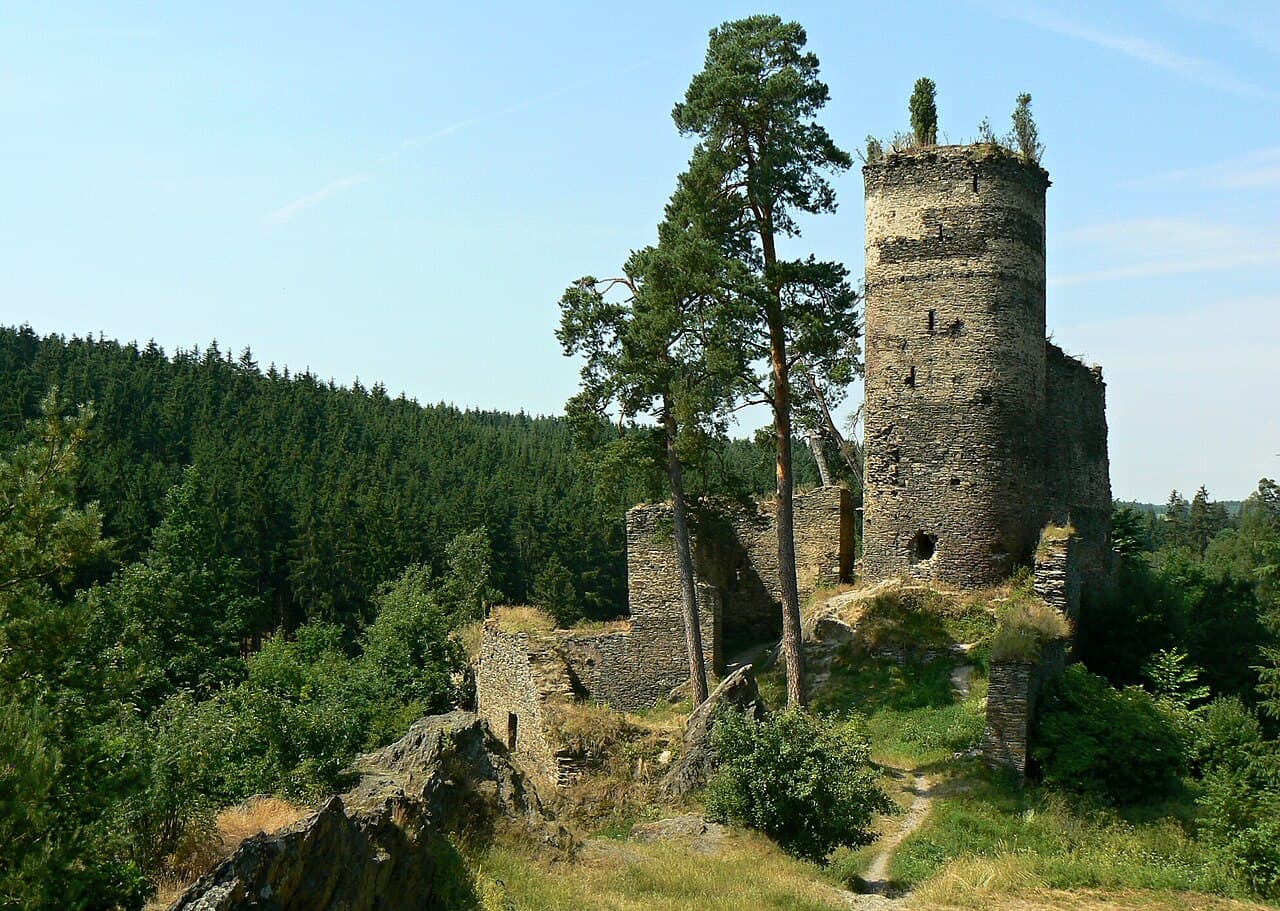
Gutstejn Castle
Gutštejn castle is a remarkable example of a late medieval hill castle located near the village of Konstantinovy Lázně in the Tachov district of Czechia. Perched on a rocky promontory overlooking the Hadovka stream, the castle was founded around 1300 by the noble Hroznatovci family, specifically by Jetřich, son of Jetřich of Krašovice. It served as the ancestral seat of the lords of Gutštejn, a cadet branch of this lineage, reflecting the feudal power structures of the region during the 14th and 15th centuries.
The castle's strategic location on a rock-bound promontory provided natural defenses, which were enhanced by man-made fortifications such as ditches and enceinte walls. Gutštejn played a notable role during the turbulent Hussite Wars in the early 15th century, enduring a siege led by the famous military leader Jan Žižka around 1422. Although historical records do not confirm whether the castle fell during this siege, it remained a significant stronghold in the region for several centuries.
Historical development and ownership
Gutštejn castle was initially established as a manor house for the lords of Gutštejn, who maintained ownership until the mid-16th century. The earliest indirect documentation dates from 1319, involving the leasing of nearby villages, which ties the family closely to the estate. Over time, the family shifted their primary residences to other estates but retained Gutštejn as part of their holdings.
In 1489, the death of Burian the Rich, a prominent chancellor of the Kingdom of Bohemia, marked a turning point. His sons became notorious as rebels and marauders in Bohemia and Bavaria, using Gutštejn as a prison for captured nobility. This turbulent period reflects the castle’s dual role as both a noble residence and a fortress of control.
Ownership changed in 1549 when the castle was sold to Hanuš Elpognar of Bezdružice, integrating it into the larger Bezdružice estate. By the 1550s, Gutštejn was already described as deserted, and it eventually fell into ruin, particularly after the devastations of the Thirty Years’ War in the early 17th century.
Architectural features and layout
The castle's layout is defined by its adaptation to the uneven, shale bedrock of the promontory. It consists of two main parts: the outer bailey and the inner stronghold, separated by a defensive neck ditch. The outer bailey once contained various functional buildings, now mostly lost except for a rock-cut cellar that hints at the castle’s logistical operations.
The inner castle is dominated by a square bergfried with rounded corners, a typical late medieval defensive tower. This tower was not accessible from the ground but entered via a drawbridge linked to a wooden hoarding, emphasizing its role as a last refuge and lookout point. Dendrochronological analysis dates the bergfried’s roof timbers to the early 15th century, with construction phases extending from the mid-14th century through post-1485 modifications.
East of the bergfried lies the entrance courtyard, which functioned as a protected economic and service area. It was enclosed by a wide defensive wall forming a zwinger, a narrow outer ward designed to trap attackers. This enceinte wall on the northern and western sides contains the oldest masonry, featuring both straight and rounded corners, indicative of the castle’s phased construction.
Two palace buildings flank the inner castle: a northern palace built around the same time as the bergfried and a larger southern palace added in a later phase. The southern palace includes a vaulted cellar and multiple chambers, some of which served as storerooms. Late Gothic renovations enhanced these palaces and the defensive structures, including the addition of firing slits, crenellated walkways, and a heightened bergfried with a new second-level entrance connecting to the northern palace.
Cultural significance and preservation
Gutštejn castle stands today as a protected cultural monument managed by the National Heritage Institute. Its ruins offer valuable insights into the evolution of medieval fortifications in the Bohemian region. Archaeological excavations have uncovered ceramic stove tiles dating from the late 15th to late 16th centuries, confirming the castle’s continued use even after its decline as a noble residence.
The castle’s preservation as a ruin allows visitors to explore the layered history of a site that witnessed noble power, rebellion, and military conflict. Its architectural features, such as the bergfried, enceinte walls, and zwinger, exemplify the defensive innovations of the late medieval period. Gutštejn remains an important landmark for understanding the feudal and military history of Czechia.
Visiting gutštejn castle
Today, visitors to Gutštejn can explore the castle’s ruins and appreciate its dramatic setting on a rocky promontory. The site’s rugged terrain and preserved defensive structures provide a tangible connection to medieval life and warfare. While much of the castle is in ruins, the remaining walls, towers, and cellars convey the scale and complexity of this once formidable fortress.
The castle’s location near Konstantinovy Lázně makes it accessible for those interested in historical architecture and medieval heritage. Visitors should be prepared for uneven terrain and limited facilities, as the site focuses on preservation rather than modern tourist infrastructure. Guided tours and informational signage help contextualize the castle’s history and architectural significance.
Architectural highlights
- Square bergfried with rounded corners dating from the 14th and 15th centuries
- Defensive neck ditch separating the outer bailey and inner castle
- Zwinger enclosure providing an additional defensive layer
- Late Gothic firing slits and crenellations enhancing defense
- Vaulted cellars and palace chambers illustrating residential aspects
Historical context
The castle’s history reflects the broader medieval political and military struggles in Bohemia, including the Hussite Wars and noble rebellions. Its use as a prison and stronghold during periods of unrest highlights its strategic importance. The transition from a noble residence to a ruin after the Thirty Years’ War mirrors the fate of many similar castles in Central Europe.
Archaeological findings
Excavations have revealed valuable artifacts such as ceramic stove tiles from the late 15th to late 16th centuries, indicating ongoing occupation and adaptation. These findings contribute to understanding the castle’s functional evolution and the daily lives of its inhabitants.
Frequently asked questions (FAQ)
- When was Gutštejn castle built?
- Gutštejn castle was founded around 1300 during the late medieval period by the Hroznatovci family.
- What architectural style characterizes Gutštejn castle?
- The castle primarily exhibits Gothic architectural features, including a square bergfried with rounded corners and late Gothic defensive elements.
- Is Gutštejn castle open to visitors?
- Yes, the ruins of Gutštejn castle are accessible to visitors, offering a glimpse into medieval fortifications and history near Konstantinovy Lázně.
- What is the current condition of Gutštejn castle?
- The castle is preserved as ruins, with remaining walls, towers, and cellars that showcase its historical and architectural significance.
- What historical events is Gutštejn castle known for?
- Gutštejn castle is notable for its role during the Hussite Wars, including a siege by Jan Žižka, and its use as a prison during noble rebellions in the late 15th century.
Photo gallery

Information
Sources & official resources
Verify the information above using these authoritative references.
Loading map...
Visitor reviews
No reviews yet. Been here? Write the first review and help other travelers!
Write the first reviewVisited this castle? Share your experience
Your review helps other travelers and adds first-hand knowledge to our encyclopedia.


