Brzeg
Brzeg Castle, located in the town of Brzeg in modern-day Poland, is a remarkable example of a Renaissance residence with deep roots in medieval fortification and the history of the Silesian Piast dynasty. Its origins trace back to the early 13th century, with the first documented mention in 1235 describing a small fortified site with a moat and defensive walls. This site evolved over centuries from a wooden ducal manor into a grand castle that served as the seat of the Duchy of Brzeg and a significant political and cultural center in the region.
The castle's development reflects the architectural and historical changes in Silesia from the High Medieval period through the Renaissance and beyond. The oldest surviving part of the complex is the square Tower of Lions, built around 1300, which originally formed part of the castle's defensive core. The castle became the ducal seat in 1342 under Bolesław III, founder of the Legnica-Brzeg Piast line, and was expanded significantly in the late 14th century by Duke Ludwik I, who added a Gothic collegiate chapel dedicated to St. Hedwig, serving as a mausoleum for the Piast family.
Early history and medieval origins
The earliest records mention a fortified manor at the site, surrounded by a moat and earthworks, likely constructed of wood. This manor was the nucleus around which the town of Brzeg grew after its formal establishment in 1248. The transition to a stone castle began in the late 13th century, attributed to Bolek I Świdnicki, regent of the Duchy of Wrocław. The initial stone structures included defensive walls and the iconic Tower of Lions, which symbolized the ducal power and served as a lookout and stronghold.
Throughout the 14th century, the castle's importance grew as it became the residence of the Piast dukes of Brzeg. The Gothic chapel constructed in the 1360s was a significant addition, reflecting the castle's dual role as a fortress and a dynastic burial site. The castle complex included a quadrangular layout with high defensive walls and residential buildings, typical of Gothic military architecture in Silesia.
Renaissance transformation and architectural features
The most dramatic transformation of Brzeg Castle occurred in the 16th century under the rule of Duke Frederick II and his son George II. Inspired by the royal Wawel Castle in Kraków, they initiated an ambitious Renaissance remodeling that converted the medieval fortress into a palatial residence. This project was led by renowned Italian architects Jakub Parr, Franciscus Pahr, and Bernard Niuron, who introduced Renaissance architectural principles to Silesia.
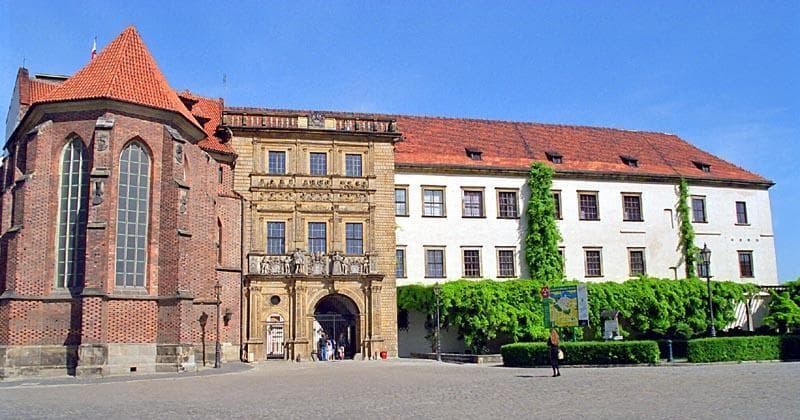
The castle was expanded into a compact four-winged complex surrounding a spacious inner courtyard. The southern wing was constructed between 1541 and 1544, followed by the eastern wing from 1544 to 1547. The crowning feature of this phase was the richly decorated three-story gatehouse built between 1554 and 1560. This gatehouse, inspired by ancient triumphal arches, features an ornate facade adorned with life-size statues of Duke George II and Duchess Barbara, heraldic shields, and two rows of busts representing legendary and historical ancestors of the Piast dynasty. These busts, carved from golden sandstone, create a visual genealogy that celebrates the lineage and legitimacy of the ruling family.
The castle's exterior walls were finished with bright plaster and divided by cornices, enhancing the Renaissance aesthetic. Inside, the courtyard is enclosed by elegant arcaded galleries on multiple levels, providing open walkways and a sense of grandeur. The castle's defensive features were modernized with bastions and reinforced walls, reflecting contemporary military needs while maintaining residential comfort.
Historical significance and later history
Brzeg Castle remained a key political center until the death of the last male Piast duke, George William, in 1675. After his death, the castle passed into the hands of imperial officials and gradually lost its status as a princely residence. The structure suffered damage during the Prussian siege in 1741 during the First Silesian War, when artillery bombardment destroyed much of the upper floors, arcades, towers, and the castle church. Subsequently, the castle was repurposed as military storage and a tavern, leading to further deterioration.
A devastating fire in 1801 destroyed the western wing, which was only partially rebuilt. The castle's chapel, once a mausoleum for the Piasts, was left in ruins until a partial restoration in the late 18th century, which unfortunately involved the removal and destruction of many funerary monuments and artworks due to religious and political tensions of the time.
Throughout the 19th and early 20th centuries, the castle was neglected, used for military warehouses, and stripped of its movable heritage. Conservation efforts began in the early 20th century, and after World War II, restoration was intensified to preserve the castle's Renaissance character. The castle now houses the Museum of the Silesian Piasts, showcasing the region's history and art, including well-preserved sarcophagi of the Piast dukes and valuable paintings from the National Museum of Wrocław.
Architectural highlights and cultural heritage
The Tower of Lions remains the oldest and most iconic element of the castle, symbolizing its medieval origins. The Gothic chapel of St. Hedwig is notable for its religious and dynastic importance, serving as the burial site for the Piast family. The Renaissance gatehouse is considered one of the finest examples of Renaissance architecture in Central Europe, with its sculptural decoration and heraldic symbolism.
The castle's layout reflects a harmonious blend of defensive and residential architecture, with its four wings enclosing a courtyard featuring triple-story arcades. The southern and eastern wings contain well-preserved Renaissance interiors on the ground floor, illustrating the luxurious living standards of the period. The castle gardens, historically arranged in the Italian Renaissance style, add to the site's cultural significance.
Brzeg Castle stands today not only as a monument to the Silesian Piasts but also as a testament to the architectural evolution from medieval fortress to Renaissance palace. It is a key heritage site in Poland, recognized for its artistic and historical value and continues to attract visitors interested in the rich history of Silesia and Central Europe.
Frequently asked questions (FAQ)
- When was Brzeg Castle originally built?
- Brzeg Castle's origins date back to the early 13th century, with the first documented mention in 1235 and stone construction beginning around 1248.
- What architectural styles are represented in Brzeg Castle?
- Brzeg Castle features a blend of Gothic and Renaissance architecture, including the medieval Tower of Lions and a richly decorated Renaissance gatehouse.
- Is Brzeg Castle open to visitors?
- Yes, Brzeg Castle currently houses the Museum of the Silesian Piasts and is open to the public for tours and exhibitions.
- What is the historical significance of the Tower of Lions?
- The Tower of Lions is the oldest surviving part of the castle, built around 1300, and symbolizes the medieval defensive strength of the Piast dukes.
- How was the castle affected by the 1741 Prussian siege?
- The 1741 siege caused extensive damage to the castle, destroying upper floors, arcades, towers, and the castle church, leading to its decline and military repurposing.
Photo gallery

Information
Website
Visit websiteSources & official resources
Verify the information above using these authoritative references.
Loading map...
Visitor reviews
No reviews yet. Been here? Write the first review and help other travelers!
Write the first reviewVisited this castle? Share your experience
Your review helps other travelers and adds first-hand knowledge to our encyclopedia.



