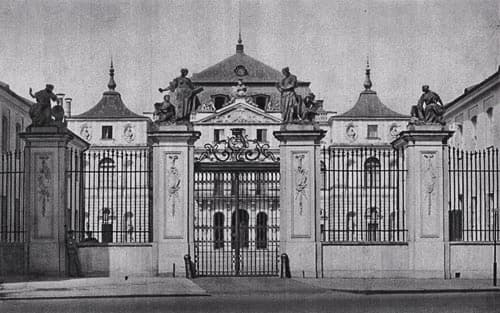
The Brühl Palace (Polish: Pałac Brühla), also known as the Sandomierski or Ossoliński Palace, was a prominent palatial residence located on Piłsudski Square in central Warsaw, Poland. Constructed in the 17th century, it was one of the largest and most architecturally significant palaces in Warsaw before its destruction during World War II. The palace was renowned as a fine example of rococo architecture, showcasing elaborate decorative elements and elegant design typical of the style, which flourished in the 18th century.
Originally built as a noble residence, the Brühl Palace was associated with several notable Polish aristocratic families, including the Brühl and Ossoliński houses, which contributed to its grandeur and cultural importance. The palace's location on Piłsudski Square placed it at the heart of Warsaw's political and social life, making it a significant landmark in the city's urban landscape.
Architectural features and style
The rococo style of the Brühl Palace was characterized by intricate stucco work, ornamental façades, and richly decorated interiors. The palace featured grand reception rooms, elegant salons, and lavishly adorned chambers designed to impress visitors and demonstrate the wealth and status of its owners. Its architectural composition included multiple wings arranged around courtyards, with detailed balconies, pilasters, and sculptural elements enhancing the exterior.
The palace's design reflected the transition from the Baroque to the Rococo period, emphasizing lightness, grace, and ornamental complexity. This made it stand out among Warsaw's palatial architecture, which included a variety of styles from Renaissance to neoclassical.
Historical significance and destruction
Throughout its history, the Brühl Palace served various functions beyond a noble residence. It was a site of political and cultural gatherings and witnessed many important events in Warsaw's history. However, like many other historic buildings in Warsaw, the palace suffered severe damage during World War II. The German forces deliberately destroyed much of Warsaw's architectural heritage, including the Brühl Palace, reducing it to ruins.
Today, only fragments of the palace remain, classifying it as archaeological ruins. The devastation erased much of the original structure, but the site's historical footprint remains significant for Warsaw's cultural memory.
Plans for reconstruction and future outlook
Efforts to rebuild the Brühl Palace have been part of a broader initiative to restore Warsaw's historic core, including the neighboring Saski Palace and surrounding tenements. The reconstruction plans aim to revive the palace's original rococo grandeur, contributing to the restoration of Piłsudski Square as a cultural and historical center.
In 2023, a tender was completed for the reconstruction project, which is currently in the design phase. The project includes rebuilding the Brühl Palace alongside the Saski Palace and the modernist Beck's Pavilion, integrating historical accuracy with contemporary urban needs. The reconstruction is anticipated to be completed by 2030, marking a significant step in Warsaw's architectural heritage revival.
Relation to the saski palace and surrounding landmarks
The Saxon Palace (Polish: pałac Saski w Warszawie) was another important historic landmark on Piłsudski Square, originally built in the 17th century and later expanded in the 18th century under the Saxon House of Wettin. Its neoclassical redesign in 1838 by architect Adam Idźkowski featured a distinctive colonnade, which partially survives today as the Tomb of the Unknown Soldier.
The Saxon Palace played a crucial role in Polish history, serving as a military headquarters and government seat, notably housing the Polish General Staff in the interwar period. It was also the site where Polish cryptologists first broke the German Enigma cipher in 1932. Like the Brühl Palace, it was destroyed during World War II, with only fragments remaining.
The reconstruction of both the Brühl and Saxon Palaces is part of a comprehensive effort to restore Warsaw's historic identity. The inclusion of nearby historic tenements and the Beck's Pavilion in the project aims to recreate the architectural ensemble that once defined this central area of the city.
Frequently asked questions (FAQ)
- How do I get to Brühl Palace in Warsaw?
- Brühl Palace is conveniently located in the city center, making it easily accessible by public transport. You can take the metro to the Centrum station or use various tram and bus lines that stop nearby.
- What is the historical significance of Brühl Palace?
- Brühl Palace, built in the 18th century, served as a residence for Polish nobility and has played a crucial role in Polish history. It is notable for its association with prominent figures such as Prince Augustus II the Strong and its involvement in the cultural life of Warsaw.
- When was Brühl Palace constructed?
- Construction of Brühl Palace began in 1740 and was completed in 1749. The palace was designed by architect Johann Friedrich Karcher and is a prime example of the Rococo architectural style.
- Can I take guided tours of Brühl Palace?
- Yes, guided tours are available and provide a deeper insight into the palace's rich history and architectural features. It's advisable to book in advance, especially during peak tourist seasons.
- Why is Brühl Palace considered an architectural gem?
- Brühl Palace is celebrated for its stunning Rococo design and intricate interior decorations, including impressive frescoes and ornate furnishings. The palace showcases the opulence of 18th-century architecture and is a significant example of the cultural heritage of Warsaw.
- Is it possible to host events at Brühl Palace?
- Yes, Brühl Palace offers facilities for hosting various events, including weddings and corporate gatherings. Interested parties should contact the palace's management for detailed information regarding availability and services.
- What are the opening hours for Brühl Palace?
- Brühl Palace is typically open to visitors from Tuesday to Sunday, from 10 AM to 6 PM. However, it's recommended to check the official website for any seasonal changes or special events that might affect opening hours.
- What are the ticket prices for visiting Brühl Palace?
- Ticket prices for Brühl Palace vary depending on the type of tour and any special exhibitions. Generally, adult tickets range from 15 to 30 PLN, with discounted rates for students and seniors.
- When is the best time to visit Brühl Palace?
- The best time to visit Brühl Palace is during the spring and early fall when the weather is pleasant, and the gardens are in full bloom. Additionally, visiting on weekdays may help avoid larger crowds.
- What nearby attractions can I visit after exploring Brühl Palace?
- After visiting Brühl Palace, you can explore the beautiful Saxon Garden and the Warsaw University Library, which are both within walking distance. The vibrant Old Town and the Royal Castle are also just a short distance away, offering a rich cultural experience.
Photo gallery

Photo by Unknown authorUnknown author•Public domain
Information
Loading map...
Visitor reviews
No reviews yet. Been here? Write the first review and help other travelers!
Write the first reviewVisited this castle? Share your experience
Your review helps other travelers and adds first-hand knowledge to our encyclopedia.