Brno
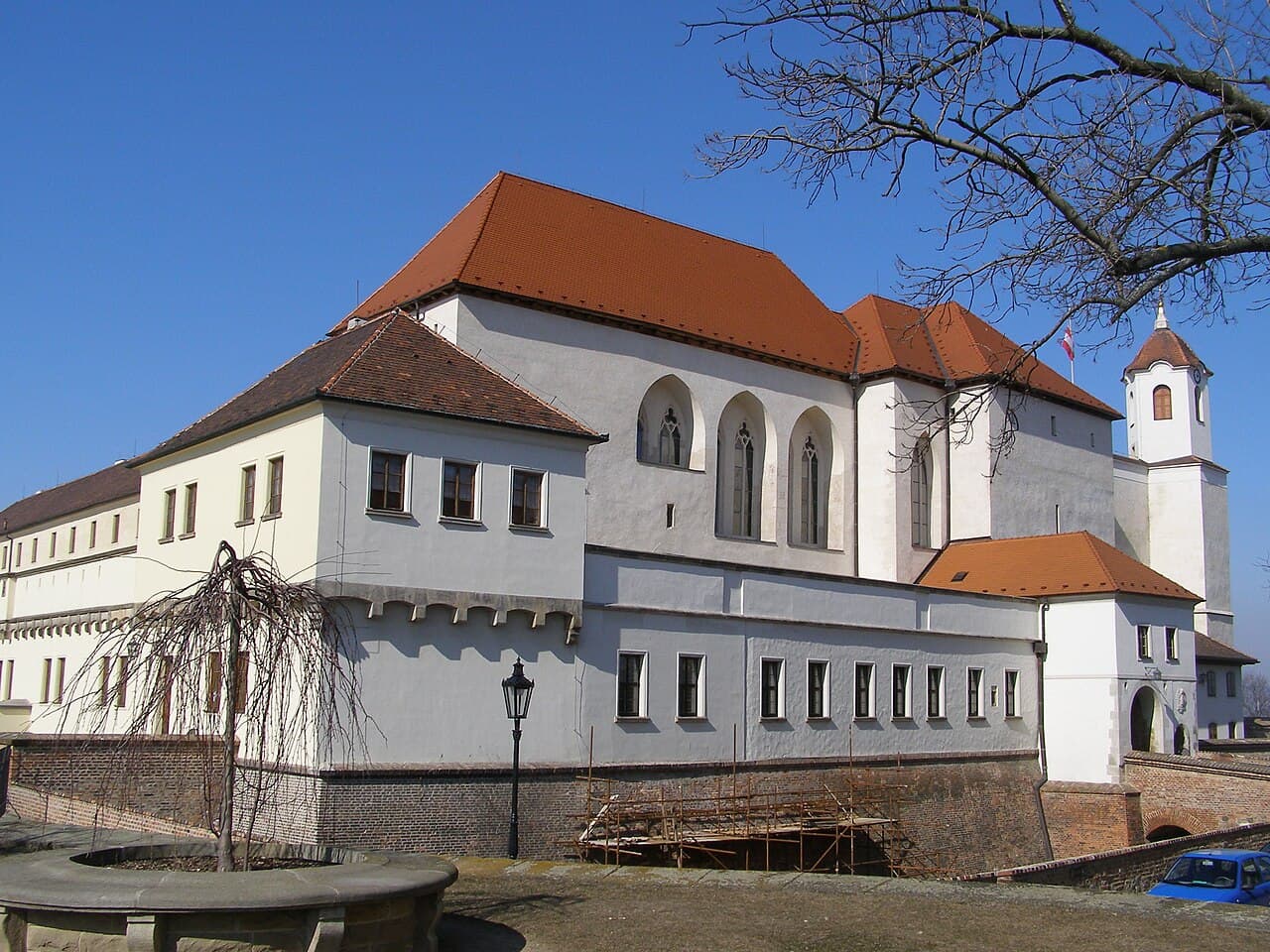
Špilberk Castle stands as a commanding bastioned fortress atop a hill overlooking the city of Brno in the Czech Republic. Its origins trace back to the mid-13th century, when it was established by the Přemyslid kings as a royal residence and administrative center for the rulers of Moravia. The castle's strategic position on a rocky hill at 282 meters above sea level provided natural defenses and a panoramic view of the surrounding region. Documented first in 1277, Špilberk has witnessed centuries of political shifts, architectural evolution, and military conflicts, shaping its role from a medieval stronghold to a formidable Baroque fortress and later a notorious prison.
Medieval origins and early architecture
The initial construction of Špilberk Castle was commissioned by Přemysl Otakar II during the mid-13th century. Designed as an irregular quadrilateral, close to a trapezoid, the castle featured robust stone defensive walls approximately 8 meters high and 2.8 meters thick. The eastern curtain wall served as the main residential area, flanked by a massive square tower with a 15-meter base that projected beyond the wall line, providing a vantage point for surveillance and defense. The main gate was situated between this tower and the residential block, while a secondary gate on the western curtain was accessible via a steep road and a bridge spanning the surrounding moat.
The southern side of the castle was fortified with a large cylindrical tower measuring 15 meters in diameter and walls 3.5 meters thick. This tower, along with other defensive features such as cisterns and a well located within the courtyard, ensured the castle could withstand prolonged sieges. Over subsequent centuries, additional buildings were added along the northern and southern walls to accommodate service quarters and housing for castle personnel, reflecting the castle's expanding administrative and military functions.
Historical significance and political role
Following the death of the last Přemyslid king, Wenceslaus III, in 1306, Špilberk Castle passed under Austrian control. When John of Luxembourg became King of Bohemia in 1310, the castle and the city of Brno emerged as central seats of power for the Luxembourg dynasty in Moravia. In 1334, John appointed his son Charles as Margrave of Moravia. After John's death in 1346, Charles IV ascended as King of Bohemia and later Holy Roman Emperor. In 1349, Charles IV granted Moravia as a fief to his younger brother John Henry, with the condition that John's descendants would not claim the Bohemian throne during the reign of Charles's line. This arrangement elevated Špilberk as the principal seat of the Moravian margraves, who invested in its maintenance and expansion.
By the early 15th century, Špilberk Castle symbolized regional authority and governance. After the death of Margrave Judok in 1411, the castle reverted to the crown under King Sigismund of Luxembourg and was later granted to Albert II of Habsburg in 1423. The castle's military importance grew during the mid-15th century conflicts over the Bohemian crown. Notably, it endured an 11-month siege by forces loyal to Matthias Corvinus of Hungary in 1469, a key episode that underscored its strategic value in Moravian and Central European history.
Fortification enhancements and military history
In the 16th century, the growing threat of the Ottoman Empire prompted modernization of Špilberk's fortifications. Although inspections revealed neglect, the Moravian estates purchased the castle in 1560 to prevent its transfer to foreign powers, subsequently transferring ownership to the city of Brno. A catastrophic fire in 1578 led to extensive repairs and further fortification efforts, especially during the turbulent times of the Thirty Years' War.
Špilberk Castle played a decisive role in defending Brno against Swedish sieges in 1643 and 1645. Under the leadership of the French Huguenot Colonel Louis Raduit de Souches, the garrison successfully withstood prolonged attacks despite being outnumbered. To mitigate fire hazards during the sieges, all roofs were removed from the castle buildings. The fortress was later expanded in the late 17th and 18th centuries into a Baroque citadel featuring bastions, moats, and integrated urban defenses, making it the largest fortification complex in Moravia. In 1742, the castle resisted an assault by Prussian forces led by Frederick the Great, further cementing its military legacy.
Prison transformation and infamous reputation
By the late 18th century, Špilberk Castle was converted into a prison, gaining notoriety as one of the harshest detention centers in the Austrian Empire. Emperor Joseph II ordered the division of casemates into individual cells in 1784 to accommodate both common criminals and political prisoners. The prison housed notable inmates such as the Austrian soldier Franz Freiherr von der Trenck, French revolutionary Jean-Baptiste Drouet, Hungarian Jacobins led by Ferenc Kazinczy, and Italian patriot Silvio Pellico, whose memoir "My Prisons" brought international attention to the castle's grim conditions.
Throughout the 19th century, the prison continued to detain political dissidents and participants of uprisings, including those involved in the Kraków Uprising of 1846. The prison was officially closed by Emperor Franz Joseph I in 1855, and the castle was repurposed as military barracks. It remained a military installation through both World Wars, during which the Nazis used it as a prison for Czech patriots, many of whom suffered and died within its walls.
Modern era and cultural significance
After World War II, Špilberk Castle ceased military operations, with the Czechoslovak army vacating the site in 1959. In 1960, the castle was transformed into the Brno City Museum, opening its doors to the public to explore its extensive history. The castle today showcases a blend of its medieval Gothic origins and Baroque military expansions. The eastern wing preserves significant Gothic elements, while the bastion fortifications and casemates reflect its Baroque military past.
Archaeological excavations have revealed medieval structures such as the cylindrical tower foundations and Gothic walls, enriching the understanding of the castle's early phases. The museum hosts exhibitions covering the castle's roles as a royal seat, fortress, prison, and barracks. Visitors can explore the dark casemates where prisoners were held and enjoy sweeping views of Brno from the hilltop.
Špilberk Castle remains a powerful symbol of Brno's historical resilience and cultural heritage, attracting tourists, historians, and scholars. Its transformation over centuries encapsulates significant chapters of Central European history, reflecting shifts in power, military technology, and societal changes.
Architectural features and layout
The castle's layout is a palimpsest of its varied history, combining medieval defensive structures with Baroque military engineering. The original medieval castle featured high stone walls, a prominent square tower, cylindrical towers, and a protective moat. The Baroque period introduced extensive bastion fortifications designed to withstand artillery fire, including thick earthen ramparts and brick-lined moats.
The fortress includes two-story vaulted casemates that served as military shelters and were later converted into prison cells. The well in the western courtyard, initially 39 meters deep and later extended to 112 meters, was vital for water supply during sieges. Adjacent to the well is a Baroque cistern for rainwater collection, underscoring the castle's self-sufficiency in times of conflict.
Most visible buildings date from the 19th century when the castle functioned as barracks, including the southern, western, and northern wings and the central block dividing the courtyard. The castle's elevated position offers commanding views over Brno, emphasizing its strategic importance throughout its history.
Visiting špilberk castle today
Today, Špilberk Castle operates as a museum and cultural venue, providing visitors with a comprehensive insight into its multifaceted history. Exhibitions detail the castle's royal origins, military significance, and its dark legacy as a prison. The preserved casemates offer a stark glimpse into the harsh conditions endured by prisoners. The castle's hilltop location provides scenic views of Brno, making it a popular destination for tourists and history enthusiasts alike.
The castle hosts numerous cultural events, exhibitions, and educational programs throughout the year. Visitors can explore the extensive grounds, including bastions, courtyards, and historical buildings. Špilberk Castle stands as a testament to Brno's rich past and enduring cultural identity.
Frequently asked questions (FAQ)
- What are the opening hours for Brno Castle?
- Brno Castle is open to visitors from 9 AM to 5 PM daily, with extended hours during the summer months. It is advisable to check the official website for any seasonal changes or special events that may affect opening times.
- How do I get to Brno Castle?
- Brno Castle is conveniently located in the city center and can be reached easily by public transport. Visitors can take trams or buses to the nearest stops, followed by a short walk to the castle entrance.
- Is it possible to take guided tours of Brno Castle?
- Yes, guided tours are available and provide an in-depth look at the castle's history and architecture. These tours are typically offered in multiple languages and can enhance your visit by offering insights into the castle's significance.
- When was Brno Castle built?
- Brno Castle dates back to the 10th century, making it one of the oldest structures in the region. Over the centuries, it has undergone numerous renovations and expansions, reflecting various architectural styles.
- Can I take photographs inside Brno Castle?
- Photography is allowed in certain areas of Brno Castle, but visitors are advised to respect any signage regarding restrictions. It’s a great opportunity to capture the stunning architecture and beautiful views of the city.
- What is the historical significance of Brno Castle?
- Brno Castle has played a crucial role in the history of the Czech Republic, serving as a royal residence and a military fortress. It has witnessed many significant events, including battles and political changes throughout the centuries.
- What are the ticket prices for visiting Brno Castle?
- Ticket prices for Brno Castle vary depending on the type of tour and access to exhibitions. General admission is quite affordable, with discounts available for students and seniors, making it accessible for all visitors.
- What is the best time to visit Brno Castle?
- The best time to visit Brno Castle is during the spring and early autumn when the weather is pleasant and the gardens are in full bloom. Additionally, visiting during weekdays can help avoid larger crowds.
- Are there any nearby attractions to visit after Brno Castle?
- Yes, Brno Castle is close to several other attractions, including the Cathedral of St. Peter and Paul, the Old Town Hall, and the Brno Ossuary. These sites can easily be included in your itinerary for a full day of exploring the rich history of Brno.
Photo gallery

Information
Opening hours
10:00-17:00, daily
Ticket prices
€5 adult, €3 child
Current owner
Brno City Museum
Website
Visit websiteSources & official resources
Verify the information above using these authoritative references.
Loading map...
Visitor reviews
No reviews yet. Been here? Write the first review and help other travelers!
Write the first reviewVisited this castle? Share your experience
Your review helps other travelers and adds first-hand knowledge to our encyclopedia.



