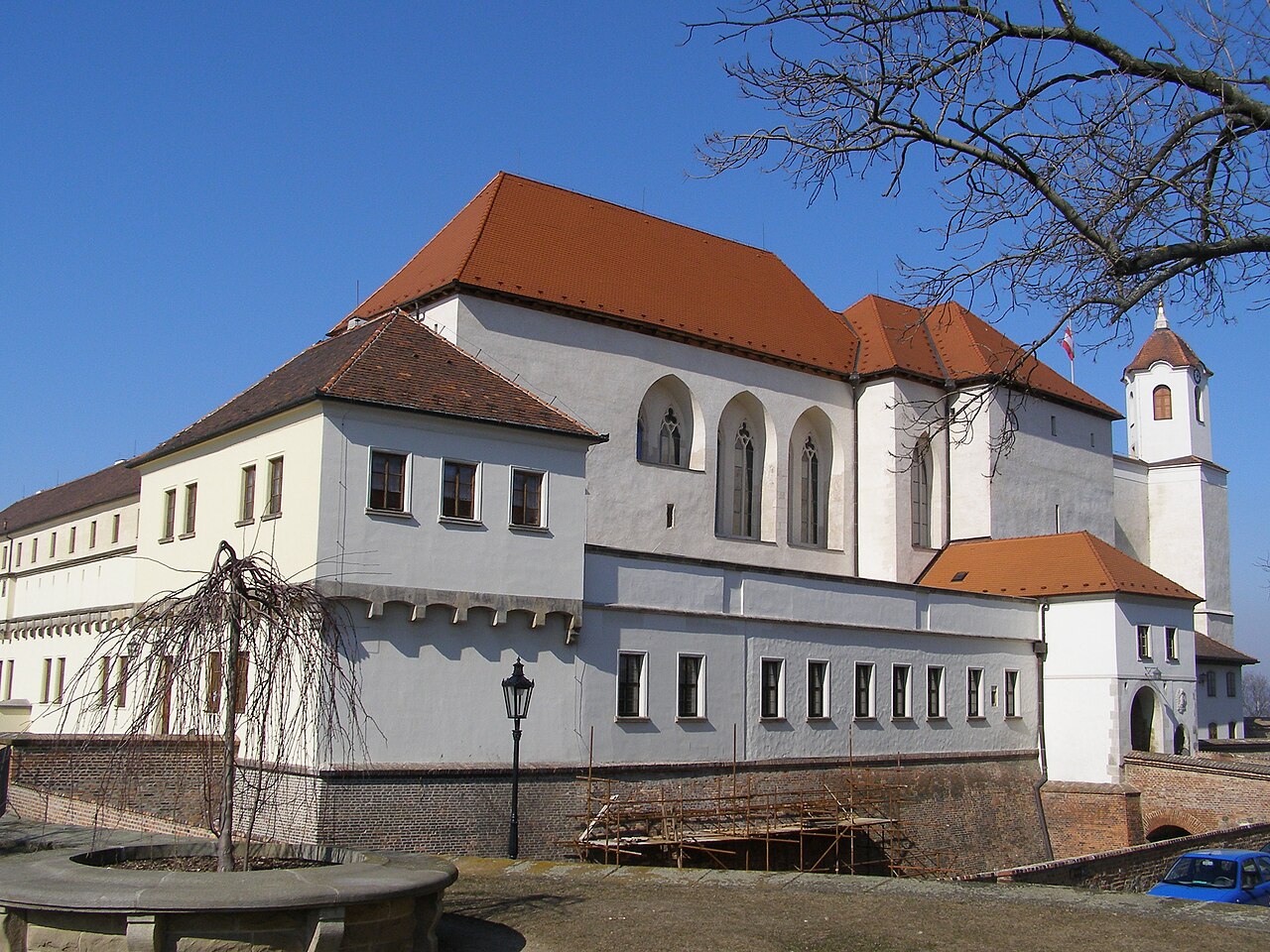
Nový hrad
Nový hrad is a significant hill castle ruin located above the Svitava river valley near the village of Adamov-Olomučany in the Czech Republic. This castle site embodies a rich historical narrative spanning from the late 14th century through the Renaissance and into the modern era, illustrating the evolution of medieval fortification techniques and noble residence architecture in Moravia.
Early origins and medieval significance
The site originally hosted Starý hrad, first documented in 1381, serving as a defensive stronghold guarding a key route from Brno through the Blansko valley. Its strategic position on a promontory overlooking the valley allowed control over important trade and military pathways. Throughout the early 15th century, Starý hrad was embroiled in the religious and political conflicts of the Hussite Wars. It changed hands multiple times, including ownership by Moravian margrave Jošt in 1411 and Vaněk Černohorský, who shifted allegiances between Emperor Sigismund and the Hussite forces. The castle was seized in 1423 by forces loyal to Bishop Jan Železný, highlighting its contested importance during this tumultuous period.
Destruction and rebirth under the Černohorský family
During the Czech-Hungarian wars, Starý hrad faced a decisive siege in early 1470 by the army of Hungarian King Matthias Corvinus, who employed six fortified siege works around the castle. The fortress was captured and destroyed, marking the end of its military prominence. In response, the brothers Dobeš and Beneš Černohorský constructed Nový hrad in 1493 on the site of an older forward fortification, reusing materials from the ruined Starý hrad. This new castle was designed as a large bastion with walls ranging from 2.3 to 5 meters thick, reflecting advancements in defensive architecture of the late medieval period.
Architectural features and layout
Nový hrad occupies the narrowest section of the promontory, featuring a gate flanked by a rectangular tower and a late Gothic building in the northeast corner. The castle complex integrates elements from different periods, including Renaissance and later additions, demonstrating continuous adaptation. The eastern side is protected by a wide ditch, behind which timber and earth fortifications survive, indicating layered defensive strategies.
The older Starý hrad had a two-part design with a substantial neck ditch 26 meters wide and 7 meters deep isolating the promontory tip. Its core was defended by a second ditch about 29 meters wide and over 10 meters deep, forming an almost rectangular plan with chamfered eastern corners to strengthen defense. At the center of Starý hrad, a large rubble mound possibly conceals remains of a significant tower or a later romantic-style gazebo. The northwest corner housed a small two-room palace serving as living quarters.
Siege works and military history
Southwest of Nový hrad lies a well-preserved elevated siege position constructed by Hungarian forces during the 15th-century assault. This position includes a ditch and rampart earthworks, and archaeological evidence suggests some siege stations had heated buildings with tiled stoves to shelter soldiers during prolonged engagements. These features underscore the castle’s military significance in regional conflicts.
Later history and transformations
Ownership of Nový hrad remained with the Černohorský family until 1562 when King Ferdinand I sold the estate to them officially. After the last male family member died in 1597, the property passed by marriage to Maximilian of Liechtenstein, marking a new chapter in stewardship. The castle endured the turmoil of the Thirty Years’ War, being captured by Swedish troops in 1645 after initial passage in 1643. Repairs were undertaken in 1655 due to fears of Turkish raids and again in 1703 amidst threats from rebel forces.
By the 18th and 19th centuries, Nový hrad’s military role diminished, transitioning to practical uses such as residence for foresters and storage for weapons linked to nearby metal forges. The Liechtenstein family renovated the castle between 1805 and 1807, adding romantic architectural elements including a tall tower, which was later shortened during mid-19th-century railway construction to prevent vibration damage.
Following the 1920 land reforms, the castle became state property and was used by a local forestry school and as a tourist inn until the mid-20th century. It gradually fell into disrepair until conservation efforts began in the 1980s. Since 1990, Nový hrad has been managed as a heritage site open to the public, preserving its layered history and architectural legacy.
Current remains and heritage significance
The castle ruins of Nový hrad and Starý hrad occupy a commanding position on a promontory overlooking the valley, offering insights into medieval defensive architecture and noble residence evolution. The ramparts of Nový hrad remain nearly at their original height, providing a vivid impression of its former strength. Surviving structures include the gate with its rectangular tower, the late Gothic building, and Renaissance-era buildings, reflecting centuries of architectural development.
The site is part of the historic Vranovsko-Křtinský Liechtenstein estate, linking it to a broader territorial domain. Archaeological and conservation efforts have preserved the castle’s fabric, allowing visitors to explore its complex history and architectural features. Nový hrad stands as a testament to Moravian noble heritage, medieval military strategy, and the cultural transformations of the region.
Frequently asked questions (FAQ)
- How do I get to Nový hrad castle ruins?
- Nový hrad is located near the village of Adamov-Olomučany in the South Moravian Region of Czechia. It is accessible by local roads and hiking trails from nearby towns such as Blansko and Brno.
- What is the historical significance of Nový hrad?
- Nový hrad was built in the late 15th century by the Černohorský family on the site of the destroyed Starý hrad. It played a strategic role during the Hussite Wars and the Czech-Hungarian conflicts, reflecting the turbulent history of Moravia.
- Is Nový hrad open to visitors?
- Yes, Nový hrad is open to the public daily during daylight hours. Visitors can explore the castle ruins and enjoy views of the Svitava river valley.
- What architectural styles are visible at Nový hrad?
- The castle features primarily Gothic architecture with later Renaissance additions. Notable elements include a late Gothic building, a rectangular tower, and bastion fortifications.
- Are there any guided tours available at Nový hrad?
- Currently, Nový hrad does not offer regular guided tours, but informational signage is available on-site to help visitors understand the castle's history and architecture.
Information
Opening hours
Open daily during daylight hours
Ticket prices
Free
Current owner
State heritage management
Website
Visit websiteSources & official resources
Verify the information above using these authoritative references.
Loading map...
Visitor reviews
No reviews yet. Been here? Write the first review and help other travelers!
Write the first reviewVisited this castle? Share your experience
Your review helps other travelers and adds first-hand knowledge to our encyclopedia.