Bridgnorth Castle
Bridgnorth Castle stands as a significant Norman hill castle located in the historic market town of Bridgnorth, Shropshire, England. Its origins trace back to the early 12th century, although the site itself bears earlier defensive importance from the Saxon period. The castle's imposing ruins, particularly its famously leaning great tower, offer a compelling glimpse into medieval military architecture and the turbulent history of England's borderlands.
The castle's strategic position atop a hill approximately 64 meters above sea level allowed it to dominate the surrounding landscape and control the vital crossing of the River Severn. This location was first fortified in 912 by Æthelflæd, Lady of the Mercians, who established a burh—an early form of fortified settlement—to defend against Viking incursions. The Norman castle was later constructed on this site beginning in 1101 by Robert de Belleme, son of Roger de Montgomery, the Earl of Shrewsbury. Although Robert’s tenure was brief, his initial fortifications laid the foundation for a complex that would evolve over several centuries.
Early construction and architectural development
Between 1105 and 1113, under the reign of King Henry I, the castle saw the erection of substantial stone outer walls, replacing earlier timber defenses. These walls were enhanced around 1120 with improved stonework and protective plastering to strengthen the fortifications. The castle’s most iconic feature, the large square great tower, was constructed circa 1160 during the reign of Henry II. This tower served as the primary fortified residence and symbol of lordly power within the castle complex.
Additional defensive structures were added over the next decades, including a turret present by 1160 and later extended in 1226 to improve surveillance and defense. The barbican, a fortified gateway equipped with a drawbridge, was built in 1212 and first documented in 1221, providing an extra layer of protection at the castle’s entrance. The castle also featured an outer bailey, which was legally incorporated into the town in 1242, reflecting the integration of the castle’s defenses with the urban environment.
Decline and medieval challenges
By the late 13th century, Bridgnorth Castle had begun to fall into disrepair. Reports from 1267 describe the castle as being in poor condition, and by 1281 it was notably dilapidated. The early 14th century brought further turmoil during the Despenser War of 1321, when rebellious barons briefly seized the castle. However, its military significance waned in the following centuries, particularly after the devastating demographic impact of the Black Death in the mid-14th century.
By the 15th century, the castle was largely neglected. Minor repairs were undertaken around 1530, but antiquarian accounts from the 1536-1542 period by John Leland noted many ruined areas within the castle’s wards. During this time, timber houses were constructed within the castle grounds, indicating a shift from purely military use to more domestic and civilian functions.
Role in the english civil war and destruction
Bridgnorth Castle regained military prominence during the English Civil War in the mid-17th century. As a key Royalist stronghold, it endured a prolonged siege from 1645 to 1646 by Parliamentarian forces led by Oliver Cromwell. The castle's defenses were severely tested, including attempts to detonate stored gunpowder via a 21-meter tunnel known as Lavington’s Hole. Despite these efforts, the castle surrendered, and Cromwell ordered its partial demolition to prevent future military use.
The demolition left the castle largely in ruins by 1647, with its stonework repurposed for repairs around the town of Bridgnorth. Notably, a royal residence within the castle grounds, known as the King’s House, remained in use until the late 17th century. The castle’s postern gate was rediscovered in 1821 during road works but was demolished soon after to accommodate traffic.
Architectural features and surviving remains
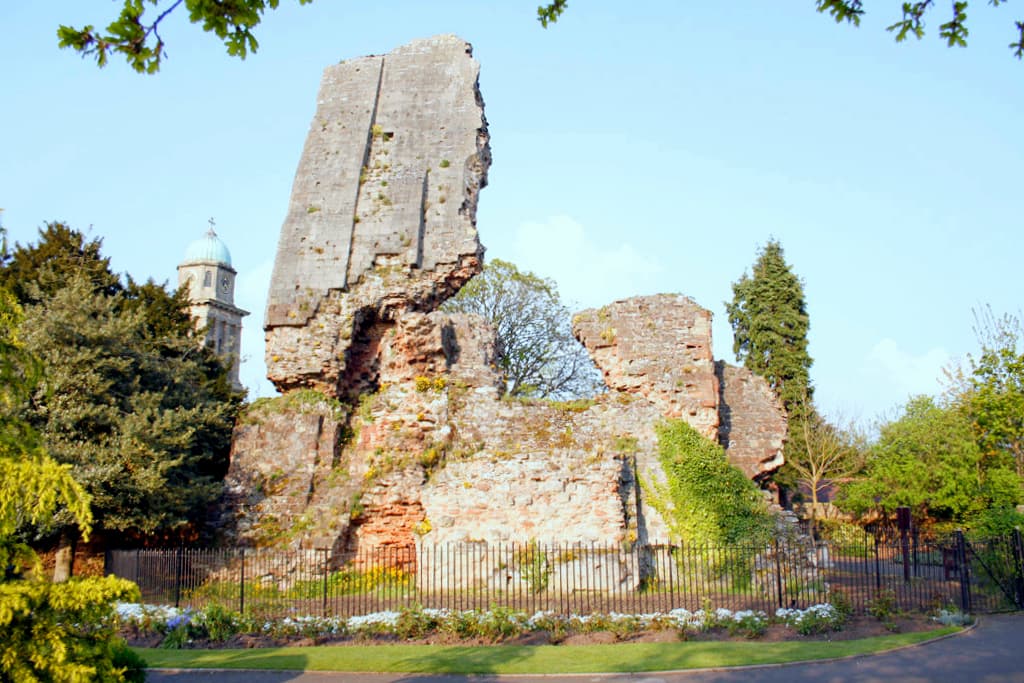
The surviving ruins of Bridgnorth Castle illustrate typical Norman military architecture enhanced by later medieval modifications. The most striking feature is the great tower, which today leans at an angle of approximately 15 degrees—four times the tilt of the Leaning Tower of Pisa. This pronounced lean results from damage sustained during the Civil War siege and subsequent partial demolition.
Sections of the early 12th-century outer walls remain, showcasing the robust stone construction and protective plastering used to reinforce the defenses. The ruins of the barbican reveal the castle’s layered defensive strategy, while the extended turret highlights the importance of surveillance along the curtain walls.
The castle grounds also include a series of man-made Hermitage Caves carved into the rock, including Lavington’s Hole, the tunnel dug during the Civil War siege. These tunnels are closed to the public for safety reasons but remain a fascinating aspect of the site’s military history.
Modern preservation and cultural significance
Recognized as a scheduled monument since 1928, Bridgnorth Castle has been the focus of conservation efforts and archaeological investigations throughout the 20th and 21st centuries. Excavations, including those conducted by the television program Time Team in 2001, have helped clarify the castle’s layout and construction phases.
The castle grounds now serve as a public space featuring a war memorial erected after World War I, which includes a notable bronze statue by sculptor Adrian Jones. This memorial links the historic site to modern remembrance and community identity.
Today, Bridgnorth Castle remains a poignant symbol of Norman military engineering, medieval history, and the enduring legacy of England’s turbulent past. Its dramatic ruins, particularly the leaning great tower, continue to attract historians, archaeologists, and visitors interested in the rich heritage of English castles.
Frequently asked questions (FAQ)
- When was Bridgnorth Castle originally built?
- Bridgnorth Castle was originally constructed in 1101 by Robert de Belleme on the site of an earlier Saxon fortification from 912.
- What is unique about the great tower at Bridgnorth Castle?
- The great tower at Bridgnorth Castle leans at an angle of approximately 15 degrees, which is four times the tilt of the Leaning Tower of Pisa, due to damage during the English Civil War.
- Can visitors explore the tunnels known as Hermitage Caves?
- The Hermitage Caves, including Lavington’s Hole, are closed to the public for safety reasons and cannot be explored during visits.
- What role did Bridgnorth Castle play during the English Civil War?
- Bridgnorth Castle was a Royalist stronghold that endured a siege from 1645 to 1646 before falling to Parliamentarian forces led by Oliver Cromwell, who ordered its partial demolition.
- Is Bridgnorth Castle protected as a historic site?
- Yes, Bridgnorth Castle has been a scheduled monument since 1928, with ongoing conservation and archaeological efforts to preserve the ruins.
Photo gallery

Information
Current owner
Local council
Loading map...
Visitor reviews
No reviews yet. Been here? Write the first review and help other travelers!
Write the first reviewVisited this castle? Share your experience
Your review helps other travelers and adds first-hand knowledge to our encyclopedia.