Bowes Castle
Bowes Castle stands as a remarkable testament to England's layered history, situated in the village of Bowes. This hill castle was uniquely constructed within the boundaries of a Roman fort known as Lavatrae, which was established during the Roman occupation of Britain to guard a vital road connecting England to Scotland through a highland pass. The site’s strategic importance spans from ancient Roman times through the medieval period and beyond.
The earliest castle at Bowes was initially a timber structure erected around 1136 by Alan de Bretagne, the Count of Brittany. He chose the northwest corner of the old Roman fort to establish this defensive position. After Alan’s death, the castle passed to his son Conan, but following Conan’s death in 1171, it came under the direct control of King Henry II. Amidst the turbulent backdrop of the Great Revolt (1173–74) and ongoing conflicts with Scotland, Henry II commissioned the replacement of the timber defenses with a substantial stone castle. By 1187, nearly £600 had been invested in these fortifications to enhance the castle’s strength and resilience.
Medieval history and military significance
Bowes Castle’s military importance was underscored during the rebellion of 1173–74, when it endured attacks from Scottish forces, including a direct siege led by King William the Lion in 1174. This siege was ultimately lifted when English relief forces arrived, forcing the Scots to withdraw. The castle’s ownership fluctuated over the next century, passing through notable figures such as Robert de Vieuxpont in the early 1200s, then briefly to William de Blockley and Gilbert de Kirketon, before coming under the control of Duke Peter of Brittany in 1232. Later, it was held by William de Valence and Peter II, Count of Savoy, the Earl of Richmond from 1241.
By the early 14th century, the castle had fallen into disrepair. In 1322, it suffered a significant assault when local tenants rebelled against John de Scargill, who had been granted the property by King Edward II. The uprising resulted in the castle being looted and partially burned, with military equipment such as armor and springalds—large medieval siege engines—stolen. This period of unrest also caused nearby farmland to be abandoned due to frequent Scottish raids. By 1340, Bowes Castle was largely in ruins.
Ownership reverted to the Crown in 1361, and the powerful Neville family controlled the castle between 1444 and 1471 before it again returned to royal possession. In the early 17th century, King James I sold the castle, and following the English Civil War of the mid-1600s, many of its remaining fortifications were deliberately dismantled. By the 20th century, the castle lay in poor condition until Lady Lorna Curzon-Howe transferred the ruins into government care in 1931.
Architectural features and remains
The hall-keep
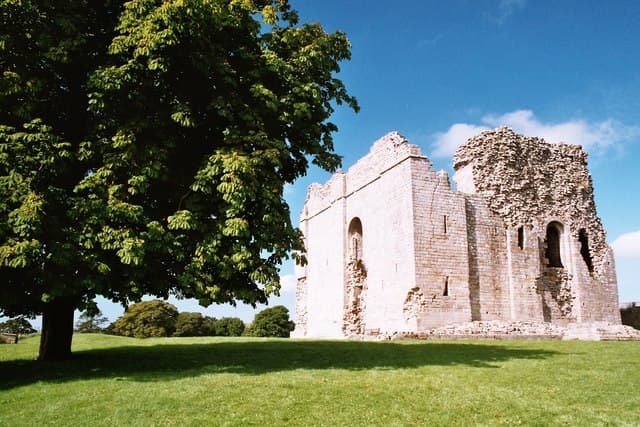
The most prominent surviving feature of Bowes Castle is its impressive three-story stone keep, built in a rare hall-keep style for England. This keep measures approximately 82 feet long, 60 feet wide, and rises to about 50 feet in height. The interior is divided lengthwise into two main sections: a large hall and a solar—a private chamber typically reserved for the lord of the castle. Both spaces are illuminated by broad, rounded windows, which provide natural light to the interior. The architectural design of the keep shares notable similarities with nearby castles such as Middleham and Pendragon, reflecting regional medieval building traditions.
Defensive structures and layout
The keep is surrounded by an enclosed courtyard or bailey, which is protected by an inner defensive ditch. This bailey itself is further defended by the extensive earthworks and ramparts of the original Roman fort, which act as an outer bailey. The reuse of these Roman fortifications provided an additional layer of defense, demonstrating a practical adaptation of ancient military architecture for medieval purposes.
Supporting infrastructure and settlement
Adjacent to the castle, a mill was constructed beside the River Greta during the castle’s active period. This mill was vital for producing flour to support the castle’s garrison and daily operations. In addition, a planned village developed close to the castle walls, featuring a church and a marketplace. This settlement layout was unusual for England at the time, indicating the castle’s role as a local administrative and economic center as well as a military stronghold.
Damage and restoration efforts
During the 1173–74 revolt, repairs to the castle included restoration of key areas such as the chamber and gates, and the construction of protective bulwarks around the keep’s perimeter. However, the 1322 rebellion caused extensive damage, including the burning of part of one hall and the theft of valuable military equipment. Despite these setbacks, the stone keep has remained largely intact through the centuries.
Following the English Civil War, many of the castle’s fortifications were dismantled in the mid-17th century, contributing to its ruinous state. Nevertheless, the enduring stone structures continue to offer valuable insights into medieval military architecture and the adaptive reuse of Roman fortifications.
Bowes Castle today
Today, the ruins of Bowes Castle stand as a significant historical monument within the boundaries defined by the ancient Roman earthworks. The site offers visitors a unique glimpse into a layered history that spans from the Roman occupation through the medieval period. The castle’s rare hall-keep, extensive earthworks, and associated village remains provide an exceptional example of military and social architecture in northern England.
Preserved under government care since the early 20th century, Bowes Castle is accessible to the public and remains an important cultural heritage site. Its combination of Roman and medieval elements makes it a fascinating destination for those interested in military history, architecture, and the complex history of the Anglo-Scottish border region.
Frequently asked questions (FAQ)
- What is the historical significance of Bowes Castle?
- Bowes Castle is historically significant for its origins within a Roman fort and its role in medieval Anglo-Scottish conflicts, including the 1173–74 rebellion and the 1322 tenant uprising.
- Can visitors explore the remains of Bowes Castle today?
- Yes, visitors can explore the ruins of Bowes Castle, including the impressive stone keep and surrounding earthworks, which are protected under government care.
- When was Bowes Castle originally constructed?
- The first castle at Bowes was a timber structure built around 1136 by Alan de Bretagne, later replaced by a stone castle under King Henry II in the late 12th century.
- What architectural style characterizes Bowes Castle?
- Bowes Castle features a rare hall-keep style with mixed architectural influences, including elements typical of northern English medieval castles and adaptations of Roman fortifications.
- Is Bowes Castle accessible year-round?
- Bowes Castle is generally accessible year-round, but visitors should check local conditions and opening hours, as access may vary seasonally or due to maintenance.
Photo gallery

Information
Sources & official resources
Verify the information above using these authoritative references.
Loading map...
Visitor reviews
No reviews yet. Been here? Write the first review and help other travelers!
Write the first reviewVisited this castle? Share your experience
Your review helps other travelers and adds first-hand knowledge to our encyclopedia.