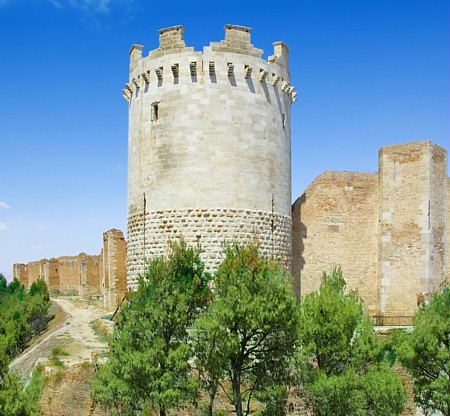
Bovino Castle
Bovino Castle is a significant historical fortress located in Bovino, Italy, with origins tracing back to the 11th century. Constructed initially by the Norman Count Drogone, the castle served as a strategic defensive stronghold perched on a rocky spur overlooking a vital valley. This location was crucial due to its position on a narrow mountain passage between the Campania region and the Adriatic coast, a route historically notorious for bandit raids targeting caravans and coaches.
Norman origins and medieval expansion
The castle's earliest phase reflects typical High Medieval military architecture, characterized by the surviving Norman tower and a massive pyramidal barbacane that provided formidable defense. The tower and the barbacane exemplify the Norman approach to fortification, emphasizing robust stone construction and strategic vantage points. During the reign of Frederick II in the 13th century, the castle underwent significant expansion, integrating additional fortifications and residential elements that enhanced both its defensive capabilities and its status as a noble seat.
Transformation into a noble residence in the 17th century
In the 1600s, the castle was transformed by the dukes of Guevara from a purely military fortress into an elegant patrician residence. This period saw the addition of refined architectural features and interior decorations befitting a noble family. The castle's structure now included the Palazzo Ducale, whose rooms display rich decor and artistic elements from the Baroque period, reflecting the tastes and wealth of its aristocratic inhabitants.
Architectural features and preservation
The castle retains a blend of medieval and early modern architectural elements. The Norman tower remains a dominant feature, supported by the distinctive pyramidal barbacane. The castle's walls incorporate vestiges of Roman construction, indicating the site's long-standing strategic importance. Additionally, remnants of hanging gardens suggest a blend of defensive and aesthetic considerations in the castle's design.
Historical significance and cultural heritage
Bovino Castle's location on a rocky spur allowed it to control and monitor the valley below, a critical function during the medieval period when banditry was common in the region. The castle's defenses were essential for protecting against raids and ensuring safe passage for travelers and merchants. The castle's historical narrative is intertwined with the broader history of southern Italy, reflecting the region's complex feudal and noble dynamics.
The private chapel and religious artifacts
Within the Palazzo Ducale, visitors can explore a small but charming private chapel notable for its majolica tiled floor. The chapel houses a fragment of the Sacred Plug embedded in a finely crafted cross, along with various relics of saints, including a particle of the purpura of Jesus Christ. These religious artifacts highlight the castle's role not only as a military and noble residence but also as a site of spiritual significance.
Current status and visitor experience
Today, Bovino Castle remains inhabited by the descendants of the Guevara family, maintaining its status as one of the most beautiful patrician residences in southern Italy. The castle's well-preserved condition allows visitors to appreciate its blend of Norman fortifications and Baroque residential elegance. The surrounding landscape and the castle's elevated position offer panoramic views of the valley, enhancing the visitor experience with both historical insight and natural beauty.
Visiting Bovino Castle
Visitors to Bovino Castle can explore the historic rooms of the Palazzo Ducale, admire the medieval defensive structures, and view the private chapel with its unique religious relics. The castle's setting provides a tangible connection to the region's medieval past and its evolution through the centuries into a noble residence.
Frequently asked questions (FAQ)
- How do I get to Bovino Castle?
- Bovino Castle is located in the picturesque town of Bovino, Italy, which can be reached by car or public transport. The nearest major city is Foggia, and from there, you can take local buses or taxis to reach the castle.
- What is the historical significance of Bovino Castle?
- Bovino Castle, dating back to the 10th century, holds great historical importance as a defensive structure in the region. It has witnessed numerous battles and sieges, serving as a symbol of feudal power and local governance throughout the centuries.
- When was Bovino Castle built?
- The construction of Bovino Castle began in the 10th century, with various modifications made over the years. Its strategic location and impressive architecture reflect the medieval military needs and the evolution of defensive techniques.
- Can I visit Bovino Castle year-round?
- Yes, Bovino Castle is open to visitors throughout the year, though specific opening hours may vary by season. It's advisable to check the official website or local tourism information for the most current visiting hours before your trip.
- Why is Bovino Castle considered an architectural marvel?
- Bovino Castle is renowned for its impressive medieval architecture, featuring robust stone walls and unique defensive structures. The castle's design reflects the military strategies of its time, making it a fascinating site for architecture enthusiasts.
- Is it possible to book a guided tour of Bovino Castle?
- Yes, guided tours of Bovino Castle are available and highly recommended for an enriching experience. These tours provide insights into the castle's history, architecture, and the surrounding area, enhancing your visit.
- What are the ticket prices for Bovino Castle?
- Ticket prices for Bovino Castle are generally affordable, with discounts available for students and seniors. It’s best to check the official website for the most accurate and up-to-date pricing information.
- What is the best time to visit Bovino Castle?
- The best time to visit Bovino Castle is during the spring and fall when the weather is mild and pleasant. These seasons also offer fewer crowds, allowing for a more enjoyable exploration of the castle and its surroundings.
- Are there any nearby attractions to visit along with Bovino Castle?
- Yes, Bovino is home to several attractions, including the charming historic center and the Church of Santa Maria Assunta. Additionally, the surrounding countryside provides beautiful hiking trails and scenic views, making it an ideal location for a day trip.
Information
Loading map...
Visitor reviews
No reviews yet. Been here? Write the first review and help other travelers!
Write the first reviewVisited this castle? Share your experience
Your review helps other travelers and adds first-hand knowledge to our encyclopedia.