Bouzov Castle
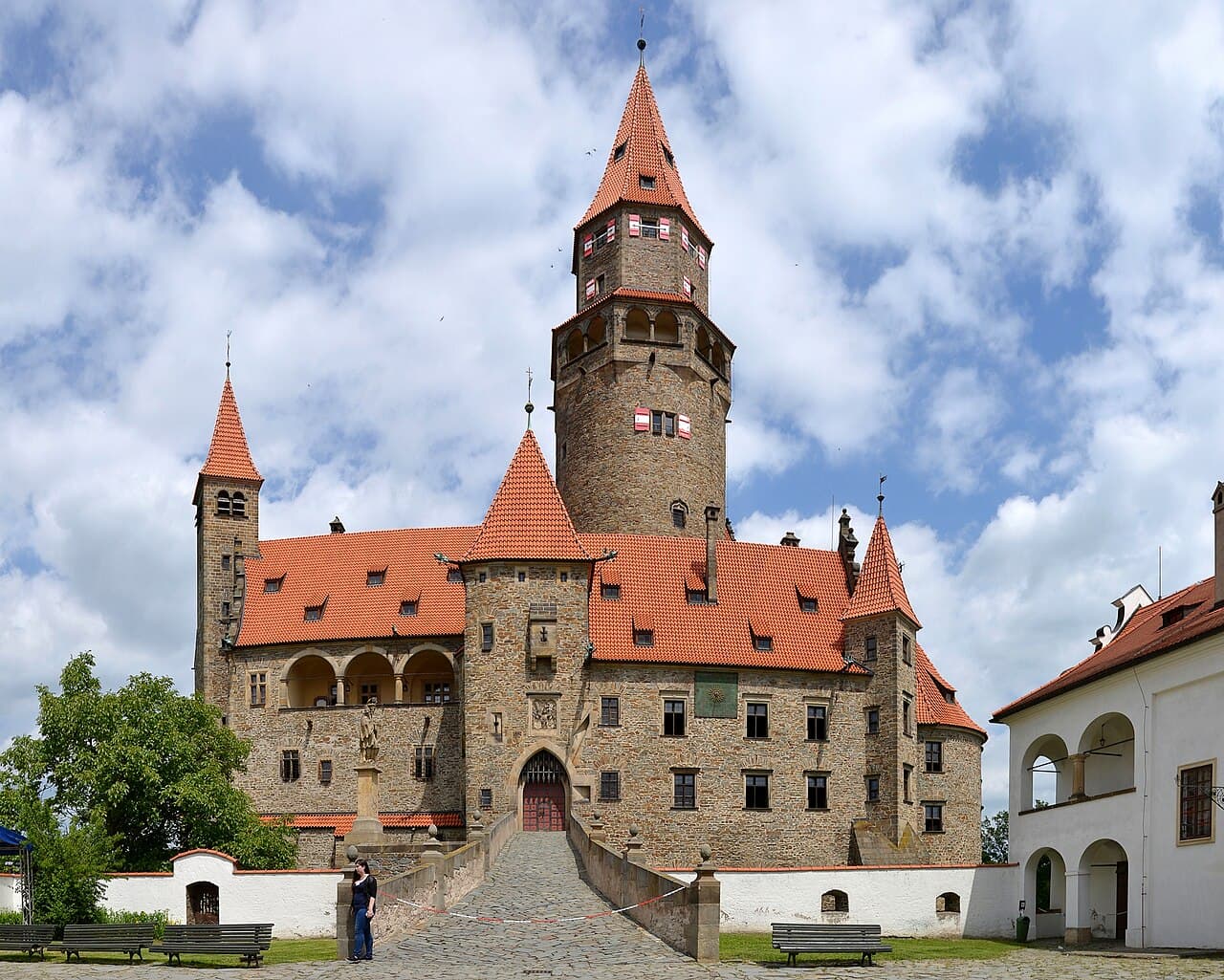
Bouzov Castle, located in the picturesque countryside of the Czech Republic near the villages of Litovel and Mohelnicka, stands as a remarkable example of a romantic neo-Gothic hill castle. Founded around the turn of the 13th and 14th centuries, this castle has witnessed centuries of historical transformation, evolving from a medieval fortress guarding vital trade routes to a majestic residence and cultural monument.
Its strategic position atop a hill was chosen to oversee the important trade route from Olomouc to Loštice, reflecting the medieval emphasis on controlling commerce and regional security. The earliest known owners were the minor aristocratic family of Búz of Bludovec, recorded from 1317 to 1339, from whom the castle derives its name. Over the centuries, ownership passed through several prominent noble families, including the Lords of Kunštát and the Lords of Vildenberk, each leaving their mark on the castle's architecture and function.
The medieval origins and defensive architecture
Initially constructed as a late medieval hill castle, Bouzov's original design centered on defense and surveillance. The castle likely began as a tower and rampart with wooden residential buildings. The Vildenberks later replaced these with a stone manor on the western side, taller than the surrounding rampart, signaling a shift towards more permanent and imposing fortifications.
By the 14th century, the castle had expanded significantly to include a fortified settlement with outhouses, surrounded by a ditch, rampart, and a moat wall. A notable feature was a 61-meter tall watchtower, which served as a vantage point for early warning and defense. Under the Lords of Kunštát, the fortifications were further enhanced with a connected rampart featuring two bastions and a moat wall rebuilt with five round bastions. A round gun bastion was also added, reflecting advancements in military architecture designed to withstand artillery.
Architectural features and layout
The castle's layout is horseshoe-shaped, with buildings grouped around the central eight-storey watchtower rising 58 meters. This tower, a typical bergfried, was both a defensive stronghold and a symbol of feudal power. The complex includes numerous towers, bastions, battlements, oriel windows, and loopholes. The two long bridges, each ending with a short drawbridge, span the deep dry moat encircling the castle, combining defensive utility with controlled access.
Historical significance and ownership changes
Bouzov Castle's history is intertwined with notable historical figures and events. It is famously associated with Jiří z Poděbrady (George of Poděbrady), born in 1420 at Bouzov, who became the King of Bohemia in 1458. His reign marked a significant period in Czech history, and the castle’s connection to him enhances its cultural importance.
Throughout the 15th to 19th centuries, the castle changed hands multiple times, including ownership by the Lords of Vildenberk, Margrave Jošt, the Haugvic family, and the Pod Štatský family. In 1558, a devastating fire damaged the castle, after which it gradually lost its defensive role and transitioned into a residential manor.
In 1696, the castle was acquired by the Order of the Teutonic Knights, who held it until the 20th century. During their tenure, Bouzov ceased to function as a defensive fortress, with only the outer settlement remaining inhabited. By the late 19th century, the castle was in ruins but attracted tourists fascinated by its medieval past.
Neo-Gothic restoration and modern history
The castle's current romantic and fairy-tale-like appearance is largely the result of a comprehensive Neo-Gothic restoration undertaken between 1896 and 1910. This reconstruction was commissioned by Archduke Eugen Habsburg, Grand Master of the Teutonic Order, and executed by the renowned architect Georg von Hauberrisser, known for his work on Munich’s town hall and St. Paul's Church.
The restoration aimed to revive Bouzov as a romantic mansion with characteristic features such as battlements, bay windows, gargoyles, and functional defensive elements like two drop-down bridges and a tramway grille. Modern amenities including running water and central heating were also installed to adapt the castle for contemporary use.
During World War II, the castle was confiscated and used by Nazi forces, notably by Heinrich Himmler, who acquired it as a gift for Adolf Hitler. After the war, Bouzov returned to state ownership and has since been preserved as a cultural monument. In 1999, it was officially declared a national cultural monument of the Czech Republic.
Interior and cultural significance today
Bouzov Castle is fully furnished and equipped with period paintings, art objects, and custom-made historical furniture. Its interiors include the knights' hall, an armoury with original Gothic vaulting, residential chambers, and a neo-Gothic chapel featuring a Gothic altar and tombs. The furniture largely comes from Archduke Eugen’s private collection and the archives of the Teutonic Order, offering visitors an authentic glimpse into the castle’s noble past.
The castle's magical ambiance and picturesque setting make it a popular venue for social events, concerts, theater performances, exhibitions, and weddings. It has also served as a filming location for numerous fairy tales and historical films, enhancing its cultural footprint in the region.
Visitors can explore a variety of interiors, including halls, attics, and courtyards, and witness unique features such as the functional drop-down bridges and tramway grille during special ceremonies and seasonal events.
Preservation and tourism
Today, Bouzov Castle is well preserved, blending its original medieval structures with the romantic Neo-Gothic additions from the late 19th and early 20th centuries. Its status as a national cultural monument ensures ongoing protection and maintenance. The castle is a key tourist destination in the Czech Republic, drawing visitors interested in medieval history, architecture, and romantic castle aesthetics.
Its accessibility and rich historical narrative make it an educational site as well as a cultural landmark, contributing significantly to the heritage and tourism economy of the region.
Frequently asked questions (FAQ)
- How do I visit Bouzov Castle and what are the opening hours?
- Bouzov Castle is open to visitors seasonally, typically from spring to autumn. It is advisable to check the official website for current opening hours and guided tour schedules to plan your visit accordingly.
- What is the historical significance of Bouzov Castle?
- Bouzov Castle was founded in the late medieval period and is notable as the birthplace of King Jiří z Poděbrady. It has served defensive, residential, and cultural roles throughout its history.
- Can I attend events or rent spaces at Bouzov Castle?
- Yes, Bouzov Castle hosts social events, concerts, theater performances, and exhibitions. Various interiors, including halls and courtyards, are available for rental for private events such as weddings.
- What architectural styles are represented in Bouzov Castle?
- Bouzov Castle features a blend of late medieval defensive architecture and extensive Neo-Gothic romantic restoration from the late 19th and early 20th centuries.
- Is Bouzov Castle accessible for visitors with limited mobility?
- Due to its historic structure and hilltop location, some areas of Bouzov Castle may be challenging for visitors with limited mobility. It is recommended to inquire in advance about accessibility options.
Photo gallery

Information
Sources & official resources
Verify the information above using these authoritative references.
Loading map...
Visitor reviews
No reviews yet. Been here? Write the first review and help other travelers!
Write the first reviewVisited this castle? Share your experience
Your review helps other travelers and adds first-hand knowledge to our encyclopedia.