Hoštejn Castle
Hoštejn castle stands as a significant medieval hill castle near the village of Hoštejn-Zábřeh in the Czech Republic. Constructed in the late 13th century by the influential Hrabišic noble family, it played a strategic role in regional power struggles during the High and Late Medieval periods. The castle's earliest documented mention dates to 1289, although references to a castle official named Mutiš de Honstein in 1267 suggest the site's importance predates this record.
The castle was originally built to serve as a counterbalance to the nearby Zábřeh fortress, held by political rivals of the Hrabišic family. This rivalry was intertwined with larger conflicts between King Rudolf of Habsburg and King Přemysl Otakar II. After Rudolf's death in 1278, Hoštejn briefly fell under the control of Protiva of Zábřeh before being reclaimed by the Hrabišic faction under Fridrich of Schonburk. The castle's strategic position and fortifications made it a valuable asset in the volatile political landscape of Moravia.
Historical context and ownership transitions
During the late 13th century, Hoštejn castle gained notoriety as a hideout for bandits, as chronicled in the Zbraslav Chronicle. This prompted King Václav II to send an army led by Záviš of Falkenštejn, who captured the castle, executed the garrison, and transferred ownership to the king's stepfather. After Záviš's death in 1290, the castle came into the possession of the Sternberg family, who controlled it from at least 1335 and integrated it with their estates of Šilperský and Zábřeh.
At the close of the 14th century, the estate passed to the Lukov branch of the Sternbergs following the death of Smil of Hoštejn in 1398. The family faced territorial disputes with Margrave Jošt of Moravia during this period. The early 15th century saw the castle become embroiled in the religious and military conflicts of the Hussite movement. In 1406, the castle was under the castellanship of Hynčík of Frývaldov, a Hussite supporter, making it a frequent target of assaults. Around 1424, it suffered significant damage inflicted by forces loyal to Albrecht of Austria.
By 1434, ownership had shifted to Jan of Zvole, aligned with Catholic interests. Despite this, the castle was largely ruined by 1437, likely due to the ongoing Hussite wars. In the early 1500s, the dilapidated fortress became a refuge for bandits until Arkleb Trnavský of Boskovice captured and reportedly demolished it in 1522. The castle's final destruction occurred in the 19th century when its stones were repurposed for embankments of the Olomouc–Prague railway, completed in 1845.
Architectural features and castle layout
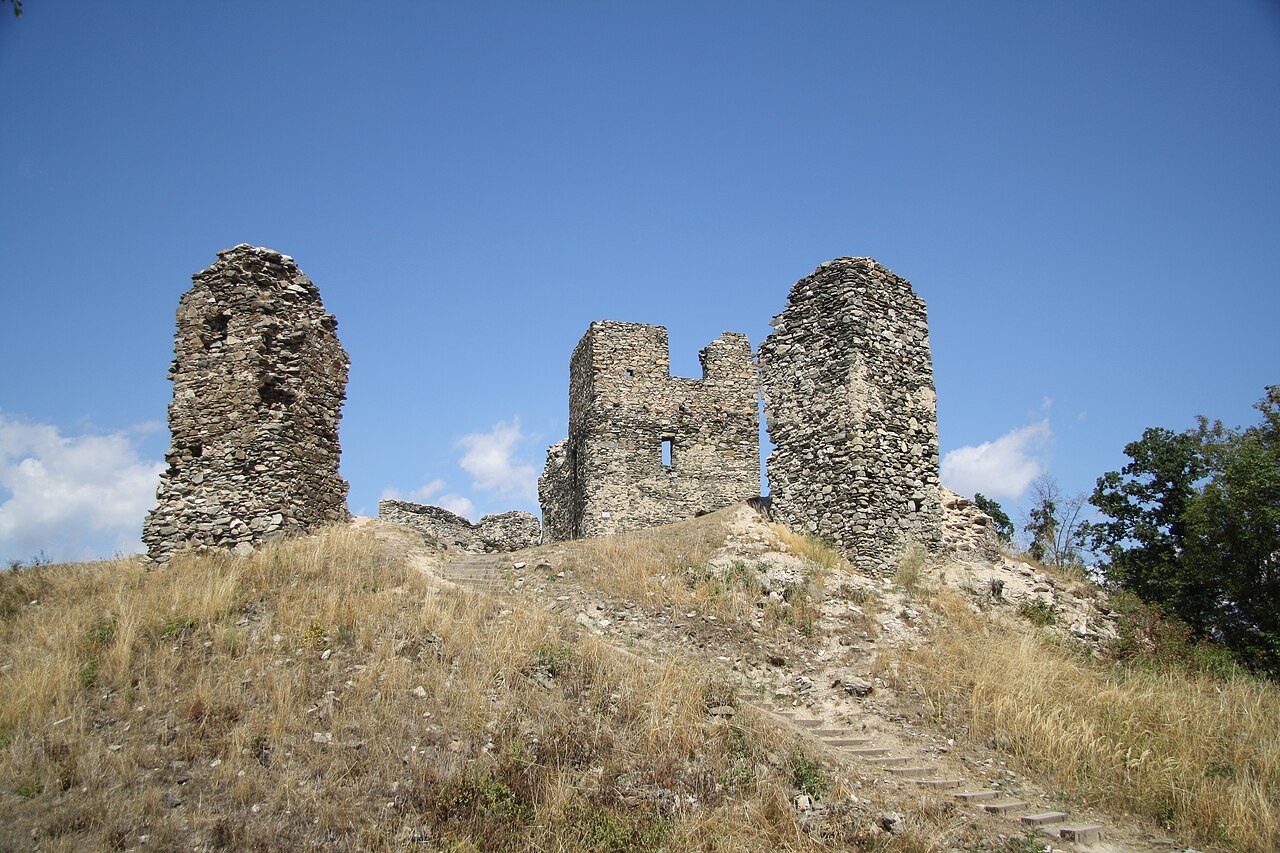
The fortifications of Hoštejn castle once extended approximately 450 meters, featuring a distinctive two-part defensive layout. The core area was almost rectangular, measuring about 50 by 20 to 25 meters. Archaeological excavations have uncovered the remains of a palace building within this core, oriented transversely and measuring roughly 25 by 9.5 meters. This palace was situated near the site of a former tower, the only significant above-ground ruin visible today. A surviving section of the palace's western wall remains, alongside parts of a cellar and a buried staircase.
Surrounding the core was a circular earthwork forming a wide ditch between 18 and 38 meters in width, serving as a formidable defensive barrier. The outer bailey lay in front of the main complex, measuring about 45 by 14 meters, enclosed by an embankment and ditch up to 25 meters wide. Interestingly, no buildings have been found within this outer enclosure, suggesting it may have served as a protected space for livestock or military staging.
Defensive mounds and additional fortifications
Near the castle, a large platform measuring 47 by 19 meters lies close to the local church. This platform is bordered on three sides by fencing traces and lower terraces, possibly indicating an earlier settlement, a military camp, or the site of the original church associated with Hoštejn. On the opposite side of the castle, a pentagonal mound measuring approximately 23 by 15 meters is separated from the main fortification by a deep ditch nearly 17 meters wide and 5 meters deep. This advanced defense likely protected the castle’s most vulnerable approach against siege engines.
A sandstone monument now marks the presumed location of the castle’s former tower. This monument stands nearly 3 meters high and measures about 7.5 meters in diameter, commemorating the completion of the Olomouc–Prague railway, which led to the removal of much of the castle's ruins in the 19th century.
Religious structures and cultural heritage
Historical records note several religious buildings near the castle site. The parish church of Saint Cunigunde, documented from 1350, no longer stands but once served the local community. An 18th-century pilgrimage chapel dedicated to Saint Anne was rebuilt in 1815 nearby, continuing the spiritual tradition of the area. Additionally, an Empire-style Holy Trinity sculpture dating from 1820 stands as a later religious landmark connected to the castle's surroundings.
Preservation and current status
Today, Hoštejn castle exists primarily as archaeological ruins with limited visible remains. The site has been protected as a cultural monument since 1964, preserving its historical significance and encouraging archaeological study. Visitors can explore the remnants of its medieval fortifications, the palace wall, and the surrounding earthworks, gaining insight into the castle's strategic importance and turbulent history.
While much of the castle was dismantled during the 19th century for railway construction, the surviving features provide valuable evidence of medieval castle architecture in Moravia. The site also offers a glimpse into the complex political and religious conflicts of the region, including the Hussite wars and noble rivalries that shaped Central European history.
Frequently asked questions (FAQ)
- What is the historical significance of Hoštejn Castle?
- Hoštejn Castle, built in the 13th century, is an important example of medieval architecture in Czechia. It served as a strategic fortress and residence for noble families throughout its history, reflecting the region's turbulent past and the evolution of defensive structures.
- When was Hoštejn Castle built?
- Hoštejn Castle was constructed in the early 13th century, around 1240. It was originally established as a royal castle and has undergone various modifications and restorations over the centuries.
- What are the opening hours for Hoštejn Castle?
- Hoštejn Castle is typically open to visitors from April to October, with specific hours varying by month. It’s advisable to check the official website or contact the castle directly for the most up-to-date information on opening hours and any seasonal changes.
- Can I visit Hoštejn Castle with children?
- Yes, Hoštejn Castle is family-friendly and offers an engaging experience for children. There are guided tours that provide interesting stories and activities, making it a fun educational visit for young explorers.
- Is it possible to access Hoštejn Castle by public transport?
- Yes, Hoštejn Castle can be accessed by public transport, with bus services available from nearby towns. However, be sure to check the local schedules in advance, as services may vary depending on the season.
- What is the best time to visit Hoštejn Castle?
- The best time to visit Hoštejn Castle is during the spring and early autumn months when the weather is pleasant for exploring the grounds. Additionally, visiting during these times allows you to enjoy the beautiful surrounding nature and less crowded tours.
- Are there any nearby attractions to visit along with Hoštejn Castle?
- Yes, there are several attractions near Hoštejn Castle, including picturesque hiking trails and other historical sites. The nearby town of Litomyšl, known for its UNESCO-listed Renaissance castle, is also worth a visit.
- What are the ticket prices for visiting Hoštejn Castle?
- Ticket prices for Hoštejn Castle are generally very reasonable, with discounts available for students and seniors. It's best to check the official website for current pricing, as it may vary based on the type of tour or special events.
Information
Loading map...
Visitor reviews
No reviews yet. Been here? Write the first review and help other travelers!
Write the first reviewVisited this castle? Share your experience
Your review helps other travelers and adds first-hand knowledge to our encyclopedia.