Bourtange Fortress
Bourtange fortress is a remarkable example of a Renaissance bastioned fortress located in the village of Bourtange in the province of Groningen, Netherlands. Constructed in 1593 under the orders of William the Silent (William of Orange) and executed by his cousin William Louis of Nassau, the fortress was strategically placed on a sandy ridge in the Bourtanger moor near the German border. Its primary purpose was to control the vital road linking Germany to the city of Groningen, which was then under Spanish control during the Eighty Years' War (1568–1648).
Historical context and military significance
The fortress was built during a turbulent period of Dutch history, when the newly emerging Dutch Republic was engaged in a protracted struggle for independence from Spanish rule. The location of Bourtange was of utmost importance because it guarded the only accessible route through the marshy moorlands, making it a critical point for military logistics and troop movements.
Between its completion in 1593 and the mid-19th century, Bourtange served as a key defensive stronghold. It saw military action notably during the Franco-Dutch War and the Rampjaar (Disaster Year) of 1672, when French troops attempted to invade the Dutch Republic. After its last battle in 1672, the fortress remained an active part of the defensive network on the eastern border of the Netherlands for nearly two centuries.
Architectural design and features
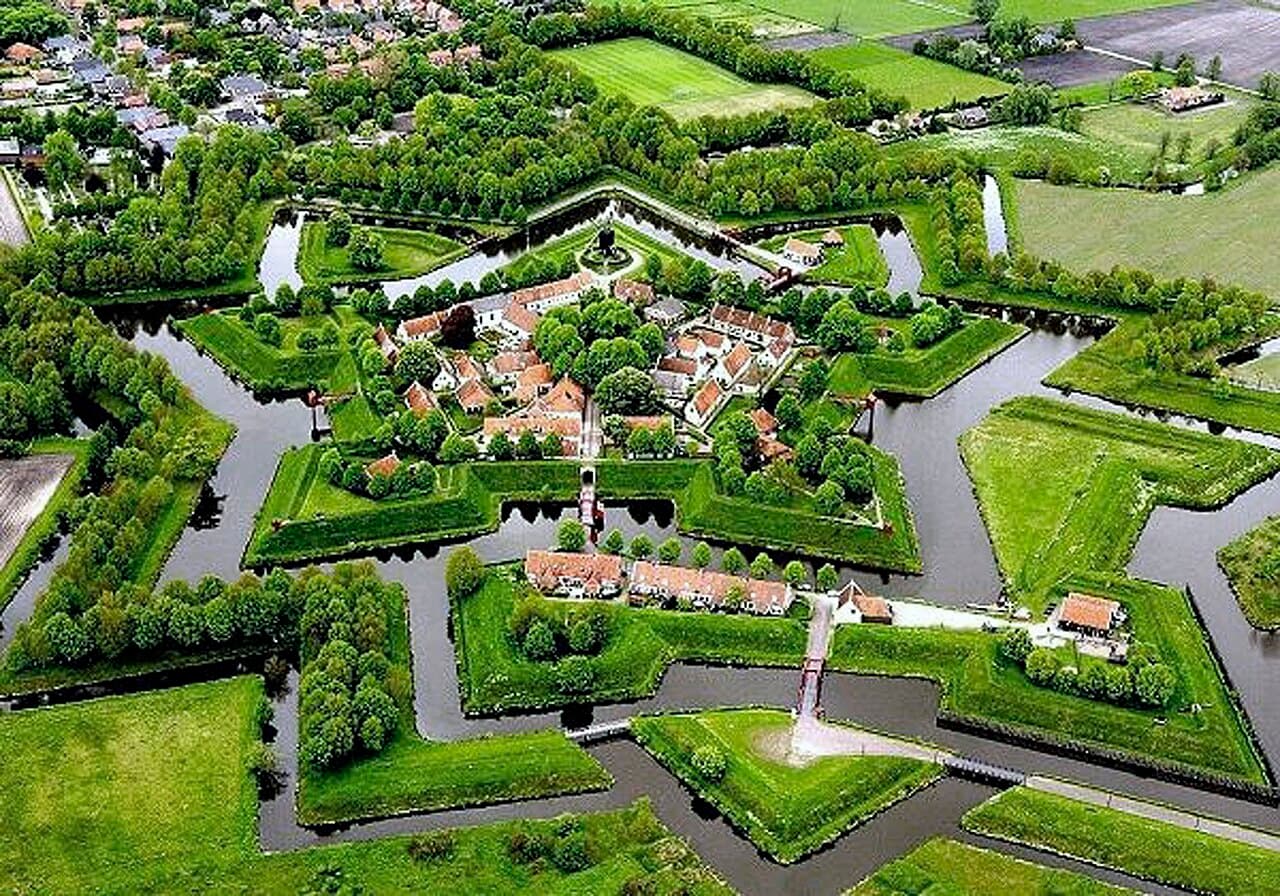
Bourtange fortress is a classic example of the bastioned fortification style that became prominent in the Renaissance period, influenced by the military engineering principles developed in Italy and France. The design features a star-shaped layout with five pointed bastions projecting outward, allowing defenders to cover all approaches with overlapping fields of fire. This design minimized blind spots and made it difficult for attackers to approach the walls without exposure to defensive gunfire.
The fort is surrounded by a system of moats and ditches, which were filled with water from the surrounding marshlands, enhancing its defensive capabilities. The walls were constructed with earthworks reinforced by brick and stone, absorbing cannon fire more effectively than traditional stone walls. Inside the fort, there were barracks, armories, magazines, and command buildings, arranged around a central courtyard.
Defensive elements
- Bastions: Five bastions provided overlapping fields of fire and were equipped with artillery placements.
- Ramparts: Earth-filled ramparts absorbed artillery impacts and provided elevated firing positions.
- Moats and ditches: Water-filled moats surrounded the fortress, complicating direct assaults.
- Ravelins and outworks: Additional defensive structures outside the main walls disrupted enemy formations.
Transition from fortress to village
By the mid-19th century, advances in military technology and changes in political borders rendered Bourtange obsolete as a fortress. In 1851, the fort was decommissioned and dismantled. The earthworks were leveled, and a small agrarian village developed on the site. Only a handful of original buildings survived, serving as faint reminders of the fort's former military importance.
Restoration and modern significance
In the 1960s, the municipality of Vlagtwedde initiated a significant restoration project to reconstruct Bourtange fortress to its original Renaissance-era appearance. Between 1967 and 1992, the ramparts were rebuilt, moats re-dug, and soldiers' barracks reconstructed using historical plans and archaeological evidence. This meticulous restoration transformed Bourtange into a living history museum and cultural heritage site.
Today, Fort Bourtange is a popular tourist destination offering visitors a chance to explore a fully restored bastioned fortress. It hosts reenactments, exhibitions, and educational programs that illustrate the military architecture and history of the Dutch struggle for independence. The fort's star-shaped layout, preserved defensive structures, and period buildings provide a vivid insight into Renaissance military engineering and the geopolitical conflicts of the 16th and 17th centuries.
Visiting Fort Bourtange
Visitors to Fort Bourtange can walk along the restored ramparts, cross the defensive moats, and enter the original soldiers' barracks and command posts. The site features informative displays on the fortress's construction, military engagements, and daily life within the fort. Guided tours are available, providing detailed historical context and architectural explanations.
The surrounding village retains a quaint atmosphere with shops, cafes, and small museums, enhancing the visitor experience. Fort Bourtange is accessible year-round, with special events held during summer months. It remains one of the best-preserved examples of a Renaissance bastioned fortress in Northern Europe.
Frequently asked questions (FAQ)
- When was Bourtange fortress originally built?
- Bourtange fortress was built and completed in 1593 under the orders of William the Silent during the Eighty Years' War.
- What is the architectural style of Bourtange fortress?
- Bourtange fortress is designed in the Renaissance bastioned fortress style, featuring a star-shaped layout with five bastions.
- Can visitors tour the interior of the fortress?
- Yes, visitors can explore the restored ramparts, barracks, and command buildings, with guided tours available for detailed historical context.
- Why was Bourtange fortress strategically important?
- It controlled the only road between Germany and the city of Groningen, crucial during the Spanish control in the Eighty Years' War.
- Is Fort Bourtange open year-round?
- Fort Bourtange is accessible throughout the year, with special events and reenactments typically held during the summer months.
Photo gallery

Information
Sources & official resources
Verify the information above using these authoritative references.
Loading map...
Visitor reviews
No reviews yet. Been here? Write the first review and help other travelers!
Write the first reviewVisited this castle? Share your experience
Your review helps other travelers and adds first-hand knowledge to our encyclopedia.