Bourglinster Castle
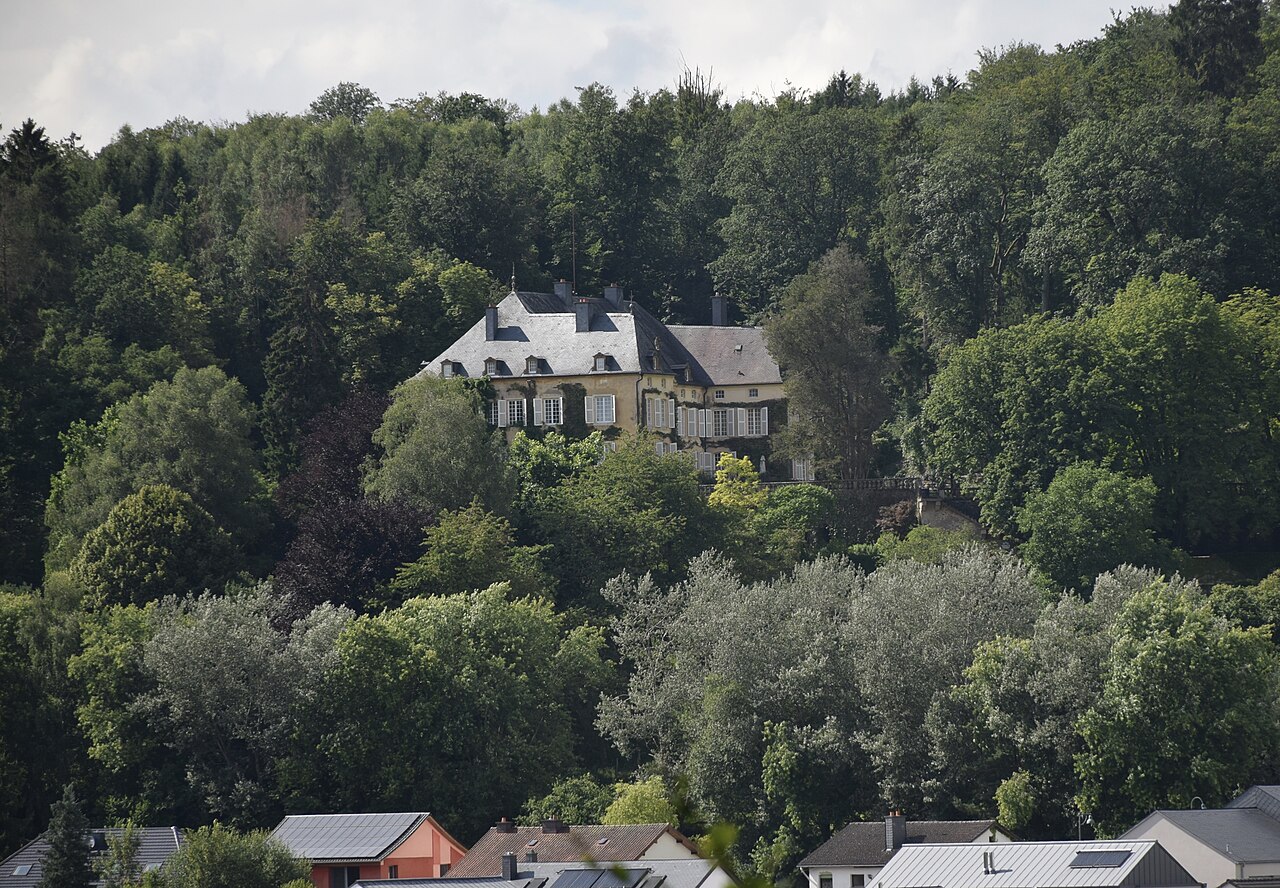
Bourglinster Castle, also known locally as Burg Linster, is a remarkable example of a late medieval hill castle located in the village of Bourglinster, about 17 kilometers east of Luxembourg City. The castle's history spans nearly a millennium, with its earliest recorded mention dating back to 1098, when it belonged to the religious institution of St Symeon of Trier. Originally, the castle complex consisted of a residential keep, a Romanesque chapel, and a defensive curtain wall, establishing it as a fortified noble residence in the medieval period.
Medieval origins and architectural evolution
The oldest surviving architectural elements of Bourglinster Castle date from the 12th century, including the residential tower, the chapel, and the surrounding curtain wall that defined the upper castle. Around 1350, the chapel was extensively rebuilt in the Gothic style, reflecting the architectural trends of the time. Concurrently, a bergfried (a tall defensive tower) was added on the northern side, significantly enhancing the castle's fortifications.
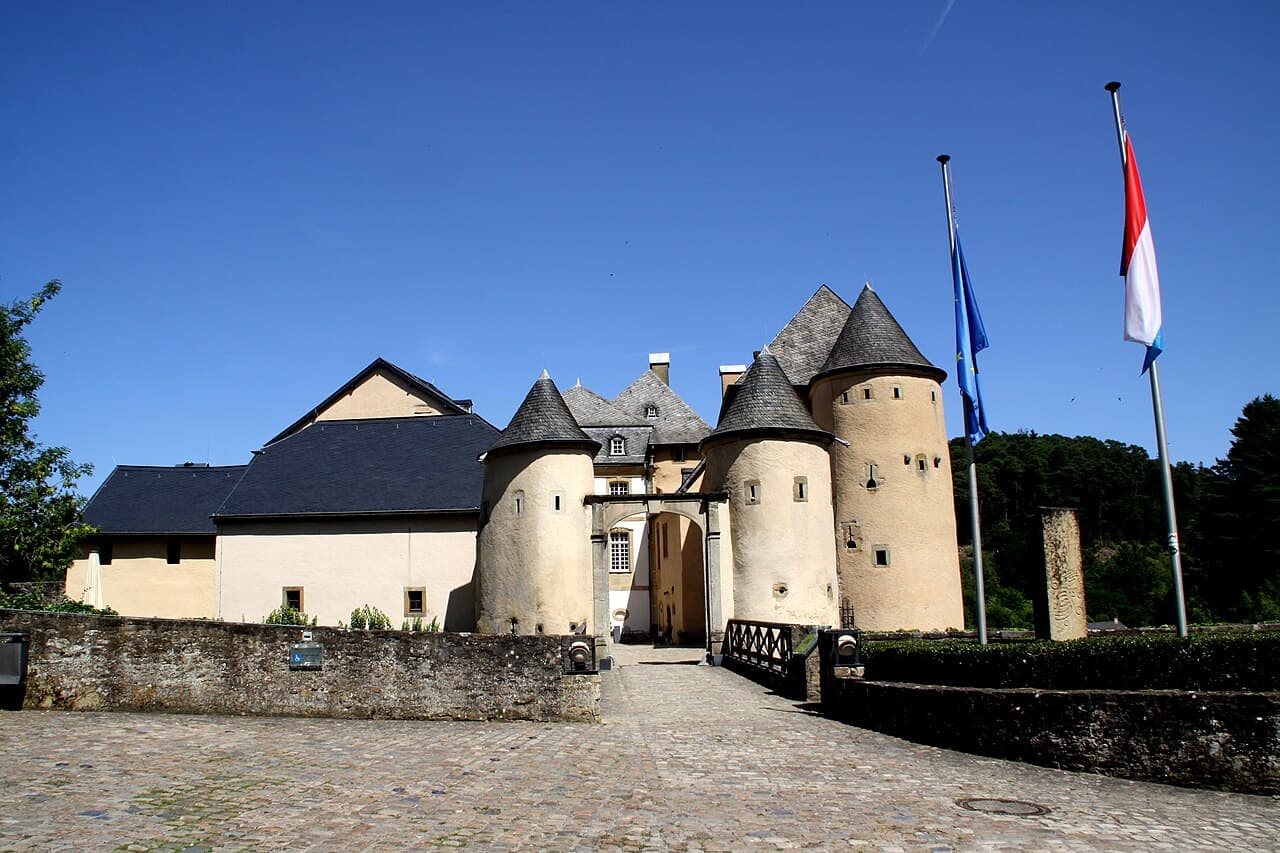
Between the late 14th century and early 15th century, the castle expanded with the construction of the lower castle or basse cour, situated to the north of the main structure. This lower section included fortified walls, two defensive towers, and the Waldeck house, providing additional residential and defensive capabilities. The moat surrounding the lower castle was dug out in the 15th century, although it proved insufficient to prevent damage during later military conflicts.
Ownership and historical significance
Throughout its history, Bourglinster Castle was owned by several noble families, including the Lords of Orley in the 14th century. In 1421, it became a Ganerbenburg, a castle jointly owned and inhabited by multiple noble families such as the Orley, Hammerstein, Bettstein, Waldeck, and Metzenhausen families. The complex rules of this shared ownership were codified in a Burgfrieden or "Castle Peace," which regulated the rights and responsibilities of the co-owners.
From the 16th to 18th centuries, the castle was held as a fief by the von Metzenhausen family, who exercised judicial rights granted by Emperor Charles V, underscoring the castle's role in local governance and administration.
Conflicts, destruction, and architectural modifications
Bourglinster Castle endured significant damage during the wars between Charles V and Francis I from 1542 to 1544. Following these conflicts, the castle was repaired and expanded with the addition of a Renaissance wing in 1548, which included a new southern wing designed in Renaissance architectural style.
Further destruction occurred during the late 17th century when French troops under Marshal de Boufflers attacked the castle in 1682 and 1684. These assaults severely damaged the lower castle, leading to the demolition of most of its buildings by the late 17th century.
In the early 18th century, the castle's appearance was updated with the construction of a Baroque façade at the far end of the courtyard, commissioned by the Mungenast brothers between 1730 and 1750. This addition reflected the evolving tastes and architectural styles of the period.
Later history, restoration, and current use
After the castle's decline as a noble residence, it was sold around 1850 and converted into a farmhouse, a function it retained until the mid-20th century. In 1968, the State of Luxembourg acquired Bourglinster Castle and undertook extensive restoration work, which was completed by 1988. The castle was officially listed as a national monument in 1982.
Today, Bourglinster Castle is well preserved and serves as a vibrant cultural venue. It houses three banqueting halls, including the elegant Salle des chevaliers (knight's hall), which hosts chamber music concerts and various events. The former stables have been repurposed as an arts center managed by a local artists' collective, while a converted barn functions as a used bookstore known as the Pabeierscheier (Paper Barn).
The castle also features La Distillerie, a renowned restaurant considered one of the finest in Luxembourg, attracting visitors who wish to experience its historic ambiance alongside gourmet dining. Although the castle's interior is generally accessible only to restaurant guests, visitors can freely explore the castle grounds and the remains of the lower castle.
Architectural features and layout
Bourglinster Castle is strategically situated on a low rocky hill, a typical location for a hill castle that provided natural defensive advantages. The complex is divided into the upper castle, containing the original residential keep and chapel, and the lower castle with its fortified walls, moat, and defensive towers.
The chapel is a significant architectural highlight, originally built in the Romanesque style and later rebuilt in the Gothic style around the mid-14th century. The addition of the bergfried provided a powerful lookout and defensive position on the northern side of the upper castle.
The Renaissance wing added in 1548 along the southern courtyard side introduces elegant architectural details characteristic of the Renaissance period. The Baroque façade from the 18th century adds a contrasting stylistic element, demonstrating the castle's architectural evolution through centuries.
Frequently asked questions (FAQ)
- When was Bourglinster Castle originally built?
- Bourglinster Castle's earliest elements date back to the 12th century, with the first recorded mention in 1098.
- What architectural styles are present at Bourglinster Castle?
- The castle features a mix of Romanesque, Gothic, Renaissance, and Baroque architectural styles due to its long history and various renovations.
- Can visitors tour the interior of Bourglinster Castle?
- The interior is generally accessible only to guests of La Distillerie restaurant, but visitors can freely explore the castle grounds and lower castle remains.
- What is the current use of Bourglinster Castle?
- Bourglinster Castle serves as a cultural venue hosting exhibitions, concerts, meetings, and gala dinners, and includes a renowned restaurant.
- Who owns Bourglinster Castle today?
- The castle is owned by the State of Luxembourg, which acquired it in 1968 and restored it by 1988.
Photo gallery

Information
Sources & official resources
Verify the information above using these authoritative references.
Loading map...
Visitor reviews
No reviews yet. Been here? Write the first review and help other travelers!
Write the first reviewVisited this castle? Share your experience
Your review helps other travelers and adds first-hand knowledge to our encyclopedia.