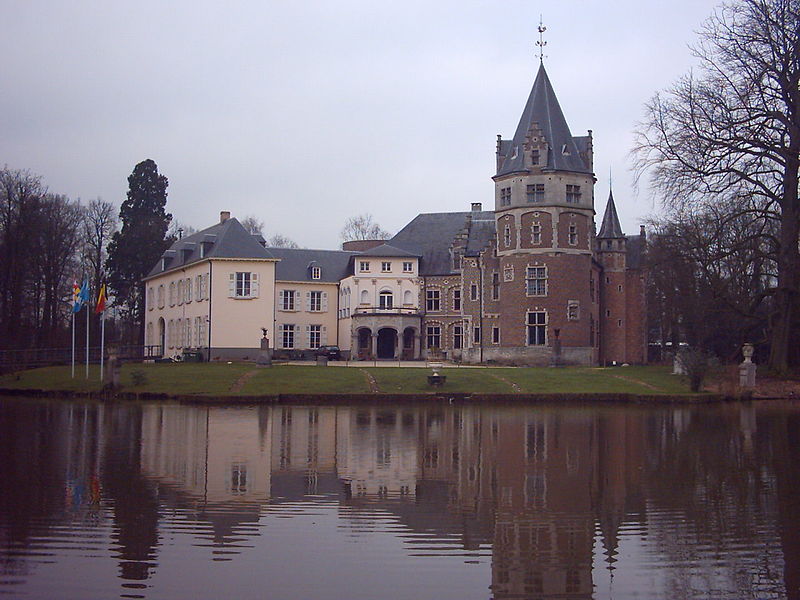
Borrekens Castle
Borrekens Castle, also known as Kasteel de Borrekens or Vorselaar Castle, is a remarkable example of a medieval water castle located in the forest northeast of the town of Vorselaar, in the province of Antwerpen, Belgium. Nestled in a swampy area near the historic Antwerp-Turnhout road, this castle has a rich history spanning over seven centuries, reflecting the architectural and social evolution of the region.
The origins and medieval construction
The castle was originally constructed around 1270 by a member of the Van Rotselaar family, who were stewards of the Dukes of Brabant. This family established the castle as a square water castle built using white Vilvoorde sandstone, a material prized for its durability and aesthetic appeal. The location was strategically chosen in a swampy terrain to maximize natural defenses, with a surrounding moat enhancing its fortification. The proximity to the Antwerp-Turnhout road, part of a trade route to Cologne, underscores the castle's importance in controlling and protecting commerce and travel in the region.
Initially, the castle featured a wooden palisade, which was vulnerable to fire and attack. Recognizing this, Arnolf van Rotselaar replaced the wooden defenses with a stone tower, marking the transition from early fortifications to a more permanent stone stronghold. By 1356, the construction of the 'master tower' further reinforced the castle's defensive capabilities, making it a formidable fortress designed to withstand sieges and protect the local population from external threats such as Norman invasions.
Feudal significance and ownership changes
Throughout the Middle Ages, Borrekens Castle served as the residence of the lords of Vorselaar, initially the Van Rotselaar family. Their power and wealth grew through the administration of local justice, taxation, and the acquisition of lands from heirs without successors. The castle was not only a military fortress but also a center of feudal authority, where tenants provided services in exchange for protection.
Ownership remained with the Van Rotselaar family until the early 16th century. Following the death of the last Van Rotselaar lord, the castle passed to Cornelis van Bergen, and subsequently to the Arensberg and Proost families. The Proost family undertook significant rebuilding efforts during the 17th century, which unfortunately led to financial difficulties, compelling them to sell the property to Phillipe Lodewijk de Pret, a former mayor of Antwerp.
Architectural transformations and neo-Gothic revival
Under the ownership of the de Pret family and later the van de Werve family through marriage, Borrekens Castle underwent extensive renovations. In the 18th century, the castle was transformed from a defensive fortress into a more comfortable residential estate, a 'huys de plaisance'. This included the demolition of the gatehouse and drawbridge, lowering of the defensive walls, and the creation of a spacious courtyard. New outbuildings, including stables, were constructed to support the estate's functions.
The most significant architectural transformation occurred in the second half of the 19th century (circa 1850-1860) under Philippe van de Werve. This renovation introduced a neo-Gothic style to the castle, characterized by the addition of turrets, ornate fireplaces, battlements, and other Gothic revival features that gave the castle its present-day romantic and fairy-tale appearance. The van de Werve family’s coat of arms was even granted as the municipal coat of arms of Vorselaar by royal decree in 1841, highlighting their influence in the region.
The Borrekens family and modern era
In 1898, through marriage, the De Borrekens family acquired the castle and gave it its current name. The family has retained ownership ever since, although the castle is private property and not open to the public. The castle farm, located on the bailey, dates back to 1686 but was rebuilt after a fire in 1920, preserving the agricultural heritage of the estate.
Today, visitors cannot enter the castle, but the surrounding forest and moat can be explored on foot, offering glimpses of the castle’s silhouette through the trees. The moat, once a vital defensive feature, is now overgrown, limiting clear views but adding to the castle's mysterious and enchanting atmosphere, especially in winter when the foliage recedes.
Architectural features and defensive elements
Borrekens Castle is a classic example of a water castle, a type of fortified residence surrounded by water to impede attackers. The original medieval design included fortified towers guarding the entrance, a moat fed by the surrounding swamp, and thick stone walls made from local sandstone. These features were typical of castles built in the High to Late Medieval periods in the Low Countries, reflecting the need for strongholds to defend against frequent regional conflicts and raids.
The castle’s evolution from a defensive fortress to a residential estate is evident in the architectural changes over the centuries. The lowering of walls and removal of the drawbridge in the 18th century signaled a shift in function from military defense to comfort and status display. The 19th-century neo-Gothic additions further emphasized aesthetics and romanticism, aligning with broader European trends in castle restoration during that era.
Historical context and cultural significance
Borrekens Castle stands as a testament to the complex feudal history of the Brabant region and the shifting political and social landscapes of Belgium. Its construction and successive ownerships mirror the rise and fall of noble families, the impact of economic fortunes, and the influence of regional governance. The castle’s proximity to important trade routes also highlights its strategic importance in controlling commerce and regional security.
As a privately owned estate, Borrekens Castle is not only a cultural landmark but also a symbol of heritage preservation in Belgium. Its continued existence and maintenance by the De Borrekens family underscore the enduring legacy of noble estates in Flemish history.
Visiting Borrekens Castle
While the castle itself is not accessible to visitors, the surrounding natural environment offers opportunities for exploration. Walking trails follow the perimeter of the moat and through the adjacent forest, allowing visitors to appreciate the castle’s setting and architectural silhouette from a distance. The best time to visit is during late autumn or winter when the foliage is sparse, providing clearer views of the castle’s distinctive neo-Gothic features.
Nearby towns such as Vorselaar offer additional cultural and historical attractions, making a visit to Borrekens Castle part of a broader exploration of the Antwerp region’s rich heritage.
Preservation and current condition
Borrekens Castle is currently in a well-preserved state, thanks to continuous ownership and care by the De Borrekens family. Despite its private status, the castle remains an important architectural and historical monument, exemplifying the evolution of fortified residences in Belgium from the medieval period through the Renaissance and into the 19th-century revival styles.
Frequently asked questions (FAQ)
- Can I visit Borrekens Castle?
- Borrekens Castle is private property and not open to the public. However, visitors can walk around the surrounding forest and follow the moat to view the castle from outside.
- When was Borrekens Castle originally built?
- The castle was originally built around 1270 by the Van Rotselaar family, making it a 13th-century medieval water castle.
- What architectural style characterizes Borrekens Castle today?
- Borrekens Castle features a neo-Gothic revival style from the 19th century, with turrets, battlements, and decorative fireplaces added during renovations.
- Where is Borrekens Castle located?
- The castle is located in the forest northeast of Vorselaar, in the province of Antwerpen, Belgium, along Kasteellaan.
- What is the historical significance of Borrekens Castle?
- Borrekens Castle served as a fortified residence controlling trade routes and local governance, reflecting the feudal history and noble families of the Brabant region.
- Is there public access to the castle grounds?
- While the castle itself is private, the surrounding forest and moat area are accessible for walking and viewing the castle exterior.
Information
Current owner
De Borrekens family
Website
Visit websiteAddress
Kasteellaan, Vorselaar, Belgium
Sources & official resources
Verify the information above using these authoritative references.
Loading map...
Visitor reviews
No reviews yet. Been here? Write the first review and help other travelers!
Write the first reviewVisited this castle? Share your experience
Your review helps other travelers and adds first-hand knowledge to our encyclopedia.