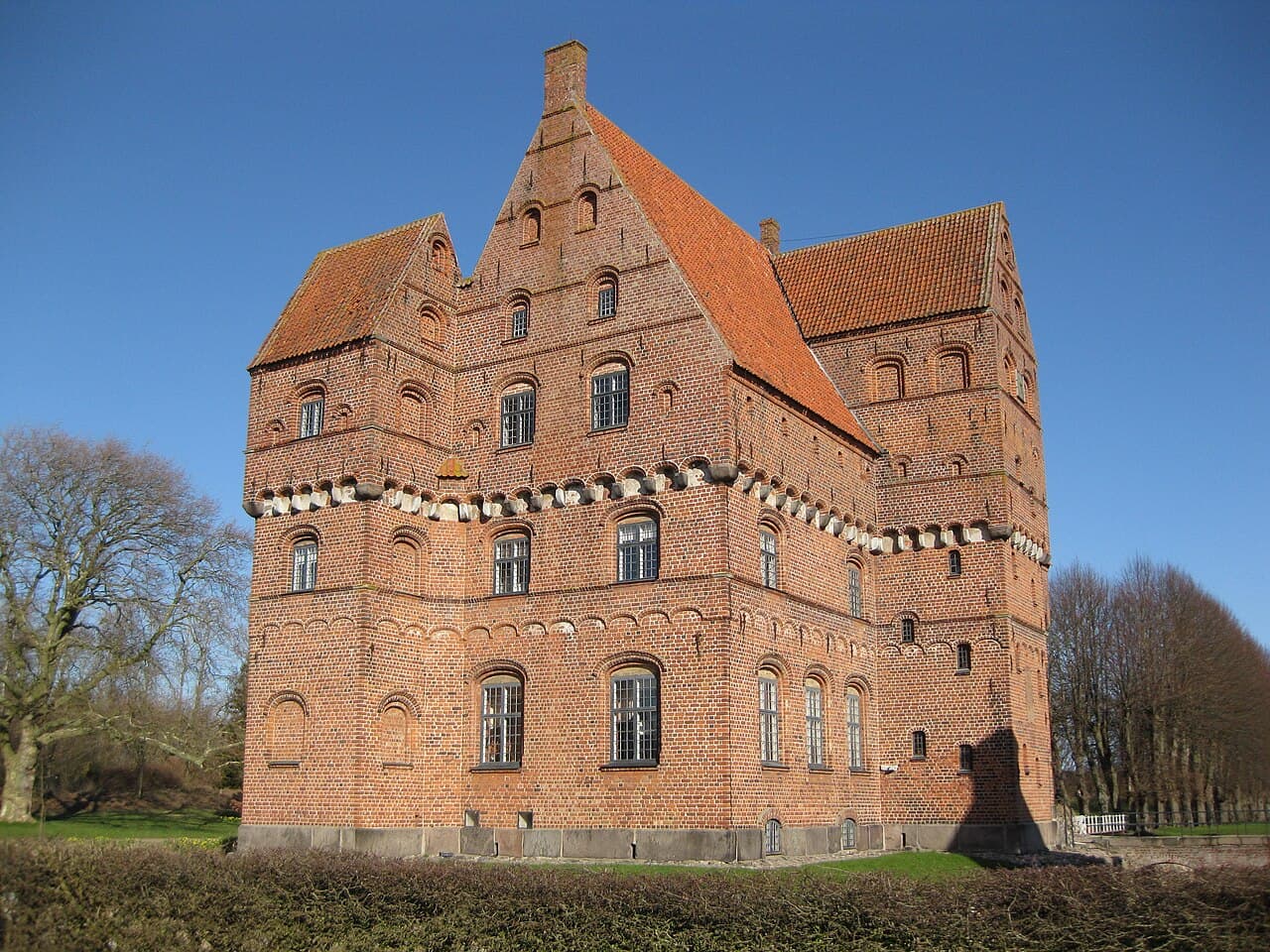
Borreby Castle
Borreby Castle is a late-medieval fortified manor house located near Skælskør in the Slagelse Municipality on the southwestern part of the island of Zealand, Denmark. The castle is an important example of a Renaissance-style manor that combines defensive features with residential and agricultural functions. It was originally mentioned in records dating back to 1345 and has a rich history tied to some of Denmark's most influential noble families and political figures.
The current main building of Borreby Castle was constructed in 1456 by Chancellor Johan Friis, one of the most powerful men in Denmark during the 16th century. The castle stands on a slight hill, approximately 300 meters north of the original medieval estate. Built primarily of red brick on a stone plinth, the structure features two and a half floors topped by a steep pitched roof and is fortified with four towers—three on the north side and a distinctive staircase tower on the south side.
Historical background and ownership
The estate was first mentioned in 1345 and came into the possession of the noble Urne family by the late 14th century. In 1410, it was acquired by Bishop Peder Jensen Lodehat and remained under the control of the Bishops of Roskilde until the Danish Reformation of 1536, when the property was confiscated by the Crown.
In 1553, King Frederick II granted Borreby to Chancellor Johan Friis, who also owned Hesselagergård on Funen. Friis was responsible for the construction of the current castle building, which replaced the older medieval structures. After his death in 1570, the estate passed to his nephew Christian Friis, who served as Chancellor from 1594 to 1616. Christian Friis expanded the estate significantly, adding an extra moat, two castle yard wings to the east and west, a gatehouse, and several large farm buildings to the west of the castle.
The estate remained with the Friis family until the mid-17th century, when brothers Oluf and Valdemar Daa inherited it but ran it into financial ruin between 1652 and 1681. In 1783, the estate was purchased by Major General Joachim Melchior Holten Castenschiold, whose family still owns the property today. The Castenschiold family played a key role in preserving the castle and adapting it for modern agricultural use.
Architectural features and style
Borreby Castle is a prime example of Renaissance architecture with defensive medieval features. The use of red brick laid on a stone plinth gives the castle a robust appearance. The building is characterized by arched friezes above each storey and windows topped by depressed arches. The castle's defensive purpose is evident in the presence of machicolation holes on all sides, which were used to drop projectiles on attackers. These holes once supported a defensive walkway that encircled the building, though the walkway itself has since been removed.
The castle's four towers provide both defense and vertical emphasis. The three towers on the north side and the staircase tower on the south side are distinctive elements of the castle's silhouette. The interior has been shaped by several phases of modernization, particularly those led by Joachim Lorentz Holten Castenschiold in the 1750s, as well as restorations in the late 19th and early 20th centuries.
Outer courtyard and ancillary buildings
The estate includes two wings forming the outer courtyard, which date from the expansions undertaken by Christian Friis. The gatehouse, constructed around 1600, marks the entrance to the courtyard and reflects the Renaissance style with its sturdy brickwork and defensive features. To the west of the main castle are large farm buildings, also from the early 17th century, which supported the estate's agricultural operations.
A chapel located in the west wing was redesigned in 1754, reflecting the 18th-century tastes and religious practices of the estate's owners. This chapel remains a notable interior feature.
Historical significance and cultural connections
Borreby Castle has been associated with several prominent historical figures in Denmark's history, including the powerful Friis family and the Castenschiold family, who have owned the estate since the late 18th century. The castle's history intersects with the Danish Reformation and the shifting political landscape of the 16th and 17th centuries.
In the 19th century, the castle became a cultural landmark as part of a cluster of manor houses including Holsteinborg and Basnæs, which were frequented by the celebrated author Hans Christian Andersen. Andersen wrote the story "The Wind Tells about Valdemar Daae and His Daughters" in 1859, inspired by the tragic fate of the last Friis descendant who lost the estate due to unsuccessful alchemical experiments.
Modern use and public access
Today, Borreby Castle functions as a modern agricultural estate with a focus on biomass production for power stations on Zealand. The estate covers approximately 722 hectares of land. The castle and several of its buildings are protected under Danish heritage laws, having been listed in 1918.
The outer courtyard and park surrounding the castle are open to the public free of charge, offering views of the historic buildings and landscape. The castle itself is accessible for guided tours by prior arrangement. It also serves as a cultural venue hosting events and exhibitions.
Borreby Art Gallery operates in the former courthouse and some converted stables, showcasing art in a historic setting. Additionally, a barn dating from 1593 has been transformed into a theatre and music venue, enhancing the estate's role as a cultural hub. Plans are underway to develop a theatre with a capacity of 450 spectators in a former barn, alongside facilities for a restaurant and café, further integrating the castle into the community's cultural life.
Frequently asked questions (FAQ)
- What is the historical significance of Borreby Castle?
- Borreby Castle, dating back to the late 16th century, is an important example of Renaissance architecture in Denmark. It has a rich history associated with notable Danish families and has served various purposes throughout the centuries, including as a noble residence and a military stronghold.
- When was Borreby Castle built?
- Construction of Borreby Castle began in 1581 and was completed in 1588. The castle was built by the noble family of Borreby and has undergone several renovations since its original completion, showcasing elements from different architectural styles over the years.
- What are the opening hours for Borreby Castle?
- Borreby Castle is typically open to visitors from April to October, with varying hours depending on the day of the week. It is recommended to check the official website for the most current opening hours before planning your visit.
- Is it possible to take a guided tour of Borreby Castle?
- Yes, guided tours are available and provide visitors with an in-depth understanding of the castle's history and architectural features. It is advisable to book your tour in advance, especially during peak tourist seasons.
- Can I access Borreby Castle with public transportation?
- Yes, Borreby Castle is accessible via public transportation from nearby towns, with several bus routes serving the area. Be sure to check local transit schedules for the most convenient options.
- What is the best time to visit Borreby Castle?
- The best time to visit Borreby Castle is during the spring and summer months when the weather is pleasant and the gardens are in full bloom. Additionally, special events and exhibitions often take place during this time, enhancing the visitor experience.
- Are there any nearby attractions to visit while at Borreby Castle?
- Yes, nearby attractions include the charming town of Skælskør, known for its picturesque harbor and historical buildings, as well as scenic coastal areas perfect for nature walks. Visitors can easily make a day trip exploring both the castle and the surrounding region.
- What are the ticket prices for visiting Borreby Castle?
- Ticket prices for Borreby Castle vary depending on the season and any special events taking place. Generally, entrance fees are affordable, and discounts may be available for students, seniors, and families.
Photo gallery

Information
Loading map...
Visitor reviews
No reviews yet. Been here? Write the first review and help other travelers!
Write the first reviewVisited this castle? Share your experience
Your review helps other travelers and adds first-hand knowledge to our encyclopedia.


