Borl Castle
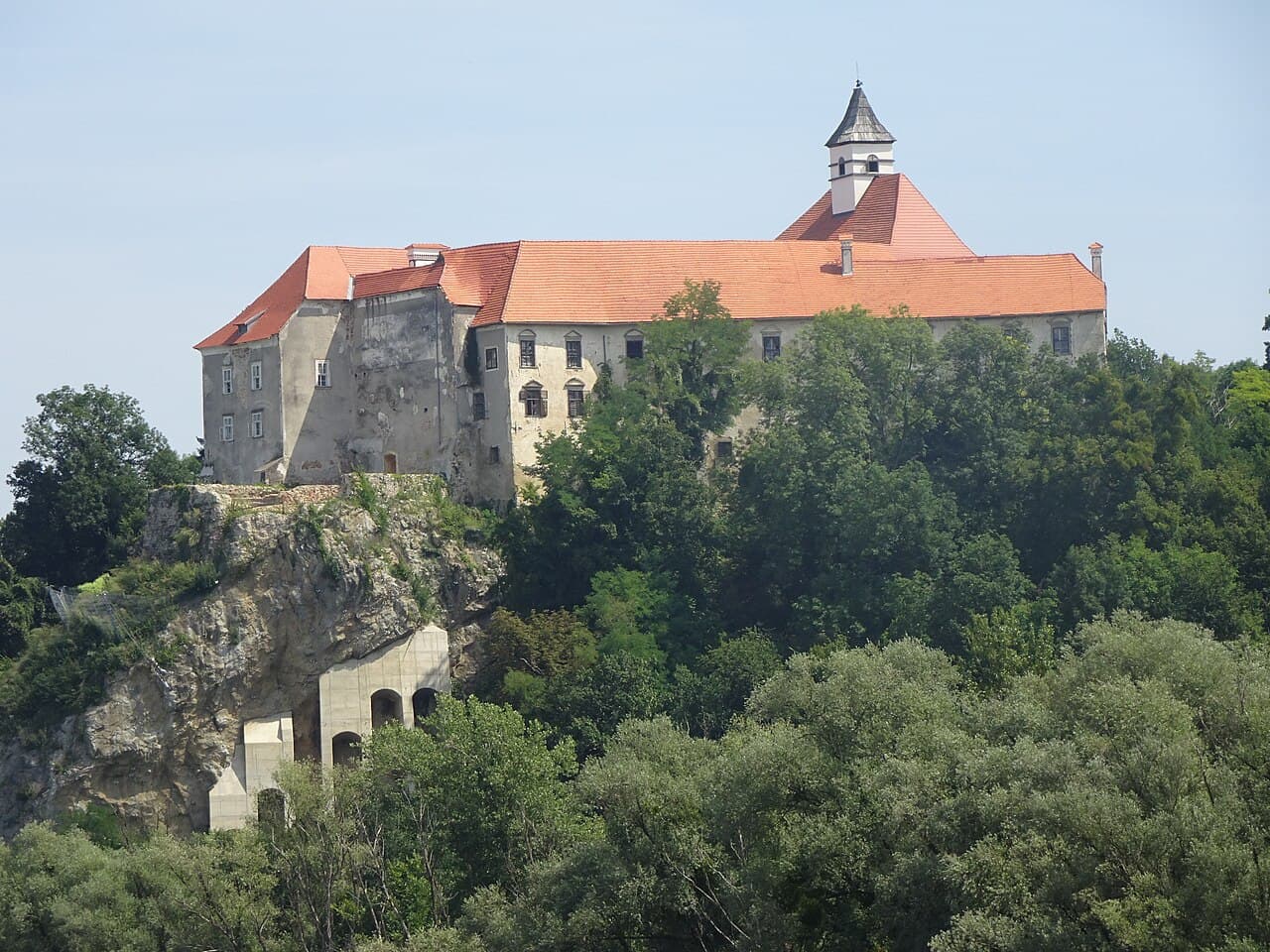
Borl Castle, also known by its German name Ankenstein, is a significant medieval hill castle located above the banks of the Drava River near the settlement of Dolane in Cirkulane, Slovenia. Constructed in the 13th century, the castle occupies a naturally formed rock prominence that provided strategic control over river traffic and border crossings during the Middle Ages and beyond. Its position at a key geographical and political junction made it a focal point of military and territorial conflicts over several centuries.
Early history and medieval significance
The first written mention of Borl Castle dates to 1255, when the Magyar king Bela IV issued a document granting the castle, then known as Anchenstein, to Friedrich, Lord of Ptuj. The initial known owners were the Anchenstein family, who bore the castle's coat of arms and resided there until their line ended in 1323. Ownership then passed to the Lords of Ptuj, an influential noble family who maintained the castle until their extinction in 1438.
Throughout its early history, Borl Castle's location was of paramount importance. It guarded a vital river crossing on the Drava, a major trade and military route. The castle's elevated position on a rocky outcrop allowed for extensive surveillance and defense against incursions, making it a coveted stronghold in the region. Its proximity to various medieval borders meant it was frequently contested in territorial disputes.
Architectural evolution and later ownership
From the 15th to the 17th centuries, Borl Castle underwent significant architectural modifications. The Herberstein family owned the castle until 1620, after which the Thurn family took possession in 1639. It is believed that during the Thurns' tenure, the castle was adapted to contemporary living standards, including the addition of arcade corridors and other Renaissance-style features that enhanced both its defensive capabilities and residential comfort.
In the early 20th century, the castle changed hands several times. In 1922, it was sold to the joint-stock company Borlin, involved in the wine and beer industry. Prior to World War II, the owner was Zora Weiss. These changes reflected a shift from purely military and noble functions toward commercial and hospitality uses.
World war ii and post-war history
During World War II, from 1941 to 1943, Borl Castle was repurposed by the German occupying forces as a Gestapo transit camp. Initially, the castle's stables and later the main building were used to imprison, interrogate, and torture suspects before their deportation. This dark chapter is commemorated by a memorial room opened in 1956 and a commemorative plaque honoring the victims.
Following the war, the castle was nationalized and briefly served as a refugee camp in 1948. However, unsuitable living conditions led to the camp's closure. In 1952, Borl Castle was renovated and converted into a restaurant. The business expanded, and by 1972, it operated as a hotel. Unfortunately, frequent and poorly managed renovation efforts, combined with insufficient funding, led to gradual deterioration of the structure.
The castle's decline accelerated after 1981, when high waters destroyed the bridge over the Drava River, cutting off access and forcing the hotel to close. Since then, Borl Castle has remained largely unused but retains its status as a protected cultural monument of national significance.
Architectural features and cultural significance
Borl Castle exhibits characteristics typical of high medieval hill castles, with later additions reflecting Renaissance influences. Its fortified walls, arcade corridors, and strategically positioned towers illustrate the evolution of defensive architecture adapted for residential use. Some wall paintings, sculptural elements, and internal furnishings have survived, offering insight into the castle's historical interior design.
The castle's location on a rocky prominence above the Drava River provided natural defenses and control over river traffic, essential for medieval trade and military movements. Its role as a border fortress underscores its importance in regional power dynamics.
Today, Borl Castle stands as a monument to Slovenia's medieval heritage and its complex 20th-century history. The memorialization of its wartime role as a Gestapo prison adds a layer of solemn historical significance, attracting visitors interested in both medieval architecture and World War II history.
Preservation and current status
While Borl Castle has suffered from neglect and inappropriate renovations, it remains a protected cultural monument. Efforts to preserve its remaining architectural features and memorial spaces continue to be important for maintaining its historical legacy. The castle's setting and surviving structures offer valuable opportunities for education and tourism related to Slovenia's medieval and modern past.
Frequently asked questions (FAQ)
- How do I get to Borl Castle?
- Borl Castle is located in Dolane, Slovenia, and can be accessed by car or public transport. The nearest major city is Maribor, from where you can take a taxi or local bus to reach the castle. It is advisable to check local transport schedules in advance to plan your trip efficiently.
- What is the historical significance of Borl Castle?
- Borl Castle dates back to the 12th century and has played an important role in the region's history. It was originally built for defensive purposes and has witnessed various historical events over the centuries. Today, it stands as a testament to Slovenia's rich heritage and architectural evolution.
- When was Borl Castle last renovated?
- Borl Castle underwent significant renovations in the early 21st century, restoring much of its original structure and features. The efforts aimed to preserve its historical integrity while making it accessible to visitors. Ongoing maintenance ensures that the castle remains a beautiful site for future generations.
- Can I take guided tours of Borl Castle?
- Yes, guided tours are available at Borl Castle, providing visitors with in-depth insights into its history and architecture. These tours are typically led by knowledgeable guides who can share fascinating stories and facts about the castle. It is recommended to check the schedule and book in advance, especially during peak tourist seasons.
- Why is Borl Castle a popular tourist destination?
- Borl Castle attracts visitors due to its stunning architecture, rich history, and picturesque surroundings. The castle offers panoramic views of the Drava River and the surrounding countryside, making it a perfect spot for photography. Additionally, its proximity to other attractions in Slovenia enhances its appeal to tourists.
- Is it possible to host events at Borl Castle?
- Yes, Borl Castle can be rented for various events such as weddings, corporate gatherings, and private parties. The unique setting and historical ambiance create an unforgettable experience for guests. It is advisable to contact the castle’s management for details regarding availability and booking procedures.
- What are the ticket prices for visiting Borl Castle?
- Ticket prices for Borl Castle vary depending on the type of tour and the visitor's age. Discounts are often available for children, students, and seniors. It is best to check the official website for the most up-to-date pricing and any special offers.
- What are the opening hours of Borl Castle?
- Borl Castle is typically open to visitors from March to October, with varying hours depending on the season. During peak tourist months, the castle may extend its hours for visitor convenience. Always check the official website for current hours and any holiday closures before planning your visit.
- What are some nearby attractions to Borl Castle?
- In addition to Borl Castle, visitors can explore the nearby town of Maribor, famous for its wine culture and the oldest vine in the world. The region is also home to picturesque nature trails and other historical sites, making it a great area for exploration. Don't miss the opportunity to enjoy the local Slovenian cuisine at nearby restaurants as well.
Photo gallery

Information
Loading map...
Visitor reviews
No reviews yet. Been here? Write the first review and help other travelers!
Write the first reviewVisited this castle? Share your experience
Your review helps other travelers and adds first-hand knowledge to our encyclopedia.