Bobrowniki
Bobrowniki Castle stands as a compelling relic of medieval military architecture and borderland history in Poland. Situated on the right bank of the Vistula River in the village of Bobrowniki, this fortress originated in the late 14th century as a strategic bastioned stronghold guarding an important river crossing and trade route. Its location on an artificial mound, formed by natural changes in the river's course, placed the castle effectively on a river island, enhancing its defensive capabilities.
The earliest mentions of the Bobrowniki settlement date back to the early 14th century, documented in records from the Duke of Dobrzyń and Łęczyca, Władysław II. It is believed that a wooden-earth fortification existed on the site as early as the 13th century, possibly with some masonry elements. This early stronghold protected the vital crossing over the Vistula River and later served as a customs chamber on the trade route from Toruń to Rus'.
Construction and architectural features
In 1377, King Louis I of Hungary granted Bobrowniki and the entire Dobrzyń Land to Władysław Opolczyk, a duke whose hostile stance toward Poland and conflict with King Władysław Jagiełło shaped the region's turbulent history. In 1391, Opolczyk pawned the Dobrzyń Land to the Teutonic Knights, who promptly began erecting a new stone castle on the site of the earlier fortification.
The initial construction phase included the building of the main residential building, a rectangular structure measuring approximately 15 by 46 meters, aligned along the western curtain wall. This was soon followed by the construction of a perimeter wall and a projecting gate tower, which guarded the entrance. In the southeast corner, a unique two-part tower was built, featuring a square base with a cylindrical upper section, a design that combined robust defense with improved observation capabilities.
Along the eastern side of the castle courtyard, economic buildings were likely constructed of wood, supporting the castle's operational needs. A second masonry building was erected between the tower and the western wing. Due to the unstable ground conditions caused by the river's proximity, the castle's walls and main structures were reinforced with buttresses to enhance stability.
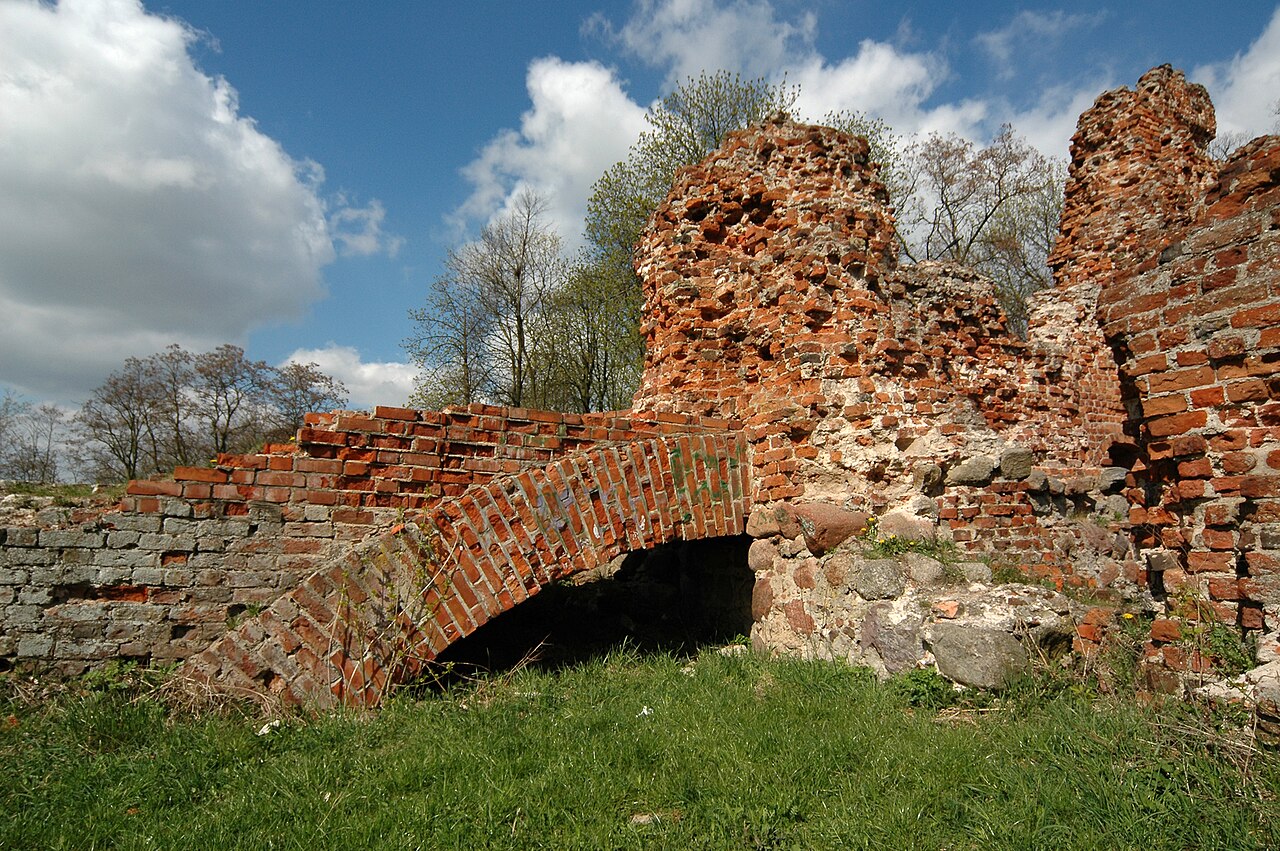
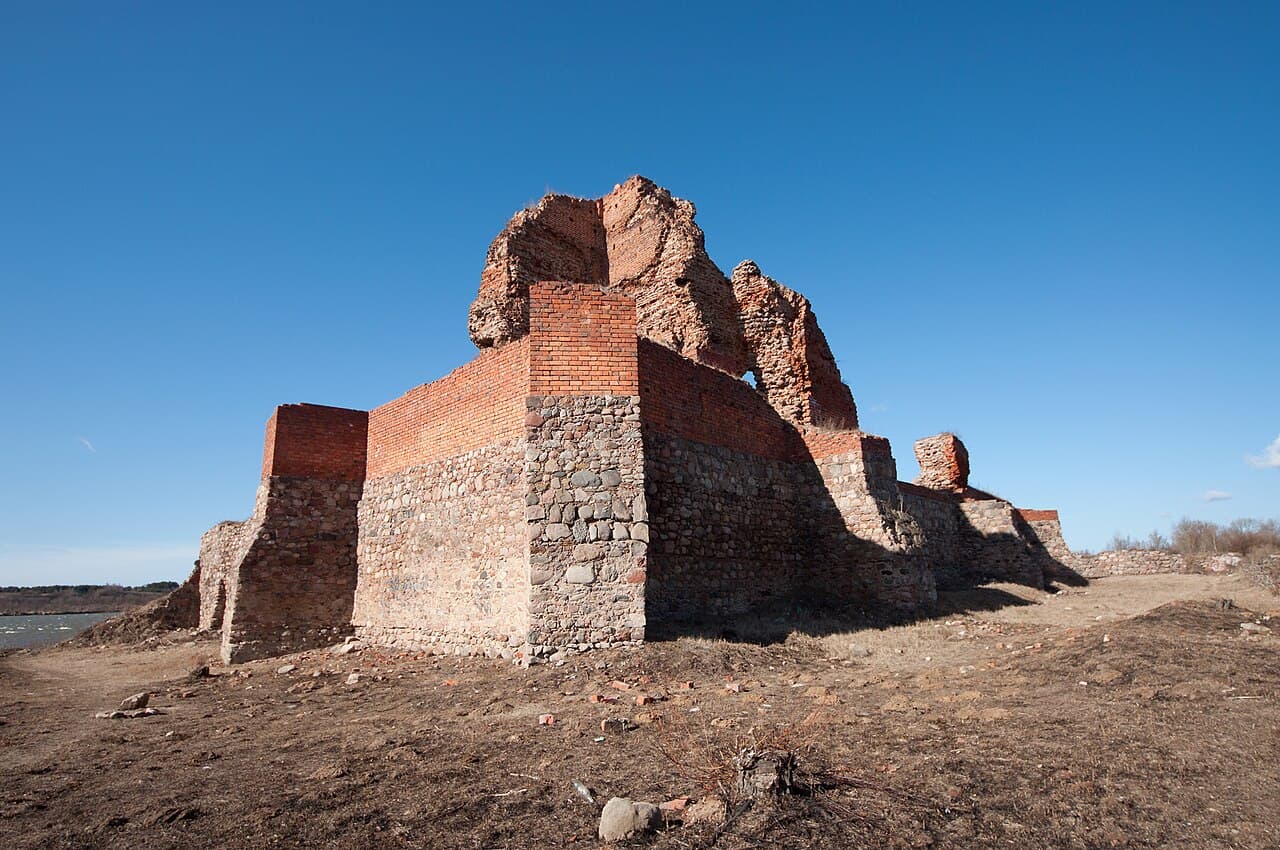
Later expansion included the addition of a second line of defensive walls, creating a bailey or outer ward, which provided an additional layer of protection. The primary building material was brick, with the outer walls and foundations constructed from stone, reflecting typical late-medieval construction practices in the region.
Historical significance and military role
Bobrowniki Castle's strategic position on the border between Poland and the Teutonic Order made it a focal point of military and political conflict throughout the late medieval period. Following diplomatic efforts, the Peace of Raciąż in 1404 returned the Dobrzyń Land to Polish control, and the castle was garrisoned by Polish troops. However, during the Great War in 1409, the Teutonic Knights besieged and captured the fortress, only for it to be returned to Poland under the First Peace of Thorn in 1411.
Recognizing its strategic importance, King Władysław Jagiełło ordered further fortifications, including the construction of a foregate connected to the main gate by a narrow passage known as the "neck." Corner bastions were added to the outer walls, designed to accommodate artillery, marking an early adaptation to gunpowder weaponry in castle defenses.
Despite these enhancements, shifting political borders gradually diminished the castle's military relevance. By the 17th century, Bobrowniki had become an administrative center rather than a fortress, serving as the seat of the Dobrzyń starosty and a repository for judicial records. New buildings were constructed within the castle grounds to support court functions.
Decline and ruin
The castle's decline was hastened by neglect and its location in a flood-prone area near the Vistula. Attempts at repair in the early 1600s were incomplete, and the castle suffered significant damage during the Swedish invasions known as the "Deluge" (1655-1660). By the 18th century, inspections reported the walls as cracked and semi-ruined.
In the 19th century, the remaining structures were systematically dismantled to provide building materials for local construction projects. Today, Bobrowniki Castle exists only as a picturesque ruin on the riverbank, with remnants of the tower, sections of the inner walls, and parts of the western wing still visible.
Archaeological research and preservation efforts
Archaeological investigations conducted in the late 20th century have shed light on the castle's layout and construction techniques. These studies have been crucial in preserving the memory of Bobrowniki Castle's historical and architectural significance. The ruins, though fragile, remain a testament to the region's complex medieval history and the evolving nature of fortification architecture in response to changing military technologies.
Castle layout and defensive elements
The fortress was likely designed with a square or two-winged plan, typical of late-medieval bastioned fortifications. The surrounding moat and thick walls provided formidable defense against attackers. The cylindrical tower served as a lookout and strongpoint, while the bastions allowed defenders to mount artillery, reflecting the transition from traditional medieval fortifications to early modern military architecture.
Cultural and heritage importance
Bobrowniki Castle is an important cultural landmark in the Kuyavian-Pomeranian region of Poland. It symbolizes the turbulent history of the Polish-Teutonic borderlands and the shifting fortunes of medieval European powers. The castle's ruins attract historians, archaeologists, and visitors interested in medieval military architecture and Polish history.
Frequently asked questions (FAQ)
- When was Bobrowniki Castle built and by whom?
- Bobrowniki Castle was built in 1377, initially under the ownership of Władysław Opolczyk and later developed by the Teutonic Knights after 1391.
- What architectural style characterizes Bobrowniki Castle?
- The castle features late-medieval bastioned fortress architecture, with brick and stone construction, buttresses for structural support, and early artillery bastions.
- What is the current condition of Bobrowniki Castle?
- Today, Bobrowniki Castle remains in ruins, with visible fragments of defensive walls, a cylindrical tower, and parts of the western wing.
- Can visitors access Bobrowniki Castle?
- Bobrowniki Castle is an open ruin located on the Vistula riverbank. Visitors can explore the site freely, but facilities and guided tours may be limited.
- Why was Bobrowniki Castle strategically important historically?
- Its location on the Vistula River crossing and borderlands between Poland and the Teutonic Order made it a key defensive and administrative site during medieval conflicts.
Photo gallery

Information
Loading map...
Visitor reviews
No reviews yet. Been here? Write the first review and help other travelers!
Write the first reviewVisited this castle? Share your experience
Your review helps other travelers and adds first-hand knowledge to our encyclopedia.