Blutenburg Castle
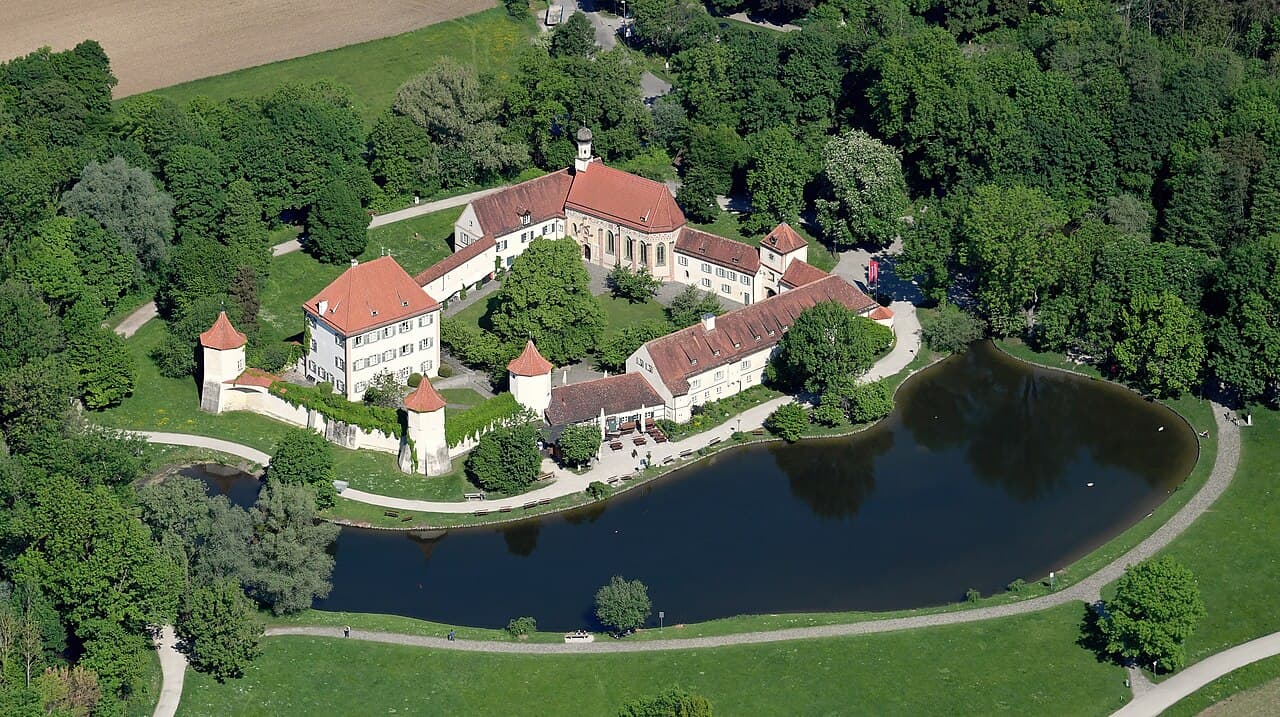
Blutenburg Castle stands as a remarkable example of a late medieval ducal residence nestled in the western outskirts of Munich, Germany. Situated on a near-island formed by the Würm River and two ponds, the castle's strategic location reflects its origins as a moated water castle dating back to the 13th century. This historic site evolved from a medieval residential tower, uncovered during archaeological excavations in 1981, into a distinguished hunting lodge and country seat for the Dukes of Bavaria.
Constructed primarily between 1438 and 1439 for Duke Albert III of Bavaria, Blutenburg Castle replaced an earlier fortress destroyed by war. It was designed to serve as a luxurious hunting retreat, embodying the transition from purely defensive architecture to a more residential and representational function. The castle's history is closely intertwined with notable figures such as Albert III and his son Duke Sigismund of Bavaria, who expanded the complex and commissioned the exquisite late Gothic chapel that remains a centerpiece of the site.
Medieval origins and ducal expansions
The earliest documented mention of Blutenburg Castle dates to 1432, yet its foundations lie in a 13th-century water castle. The original structure centered around a residential tower, the remains of which were revealed in the early 1980s. Between 1431 and 1440, Duke Albert III undertook extensive rebuilding, transforming the castle into a ducal hunting lodge and country residence. This period marked a shift from fortification to comfort and status, reflecting the changing needs of the Bavarian nobility.
Albert III's personal history is deeply connected to the castle, particularly through his tragic relationship with Agnes Bernauer, a commoner whose death in 1435 profoundly affected him. After this event, Albert resided at Blutenburg with his second wife, Anna of Brunswick, further establishing the castle as a familial retreat.
Following Albert III, his son Duke Sigismund retired to Blutenburg in 1467. Sigismund's contributions included significant architectural enhancements, notably the construction of the castle chapel in 1488. This chapel, dedicated to the Holy Trinity and St. Sigismund, is attributed to the workshop of the renowned architect Jörg von Halsbach, famed for his work on the Munich Frauenkirche. Sigismund died at Blutenburg in 1501, cementing the castle's role as a ducal residence.
Architectural features and the late Gothic chapel
The castle complex comprises the main residential building known as the Herrenhaus, an outer bailey (Vorburg), and several defensive structures including a ring wall with three towers and a gate tower. The original moat that separated the main castle from the bailey has since disappeared, but the site retains its characteristic water castle appearance.
The Herrenhaus began construction in 1437 and was expanded around 1530 with an additional story. Its 17th-century extensions shaped a rectangular layout with a high hipped roof and four corner towers capped by curved spire helmets. Defensive features were reduced during 17th-century renovations, reflecting the diminished military importance of the castle.
The castle chapel is a masterpiece of late Gothic architecture, built in 1488 within the outer bailey. It replaced an earlier chapel located in a northeastern tower. The chapel retains much of its original medieval fabric, including the roof truss and stained glass windows, some dating from 1497 and recently restored. A baroque onion dome turret was added in 1676, blending architectural styles.
The chapel measures nearly 20 meters in length and 9 meters in width, with walls soaring over 15 meters high. Its exterior features flattened buttresses, pointed arch windows with simple tracery, and a painted ornamental frieze reminiscent of those in Landshut. The portal is notable for its stepped wall projection adorned with niches bearing ancestral coats of arms and a depiction of the Holy Trinity.
Inside, a deeply springing net vault covers the space, with a chancel arch separating the choir from the nave. The chapel houses an almost complete set of late Gothic furnishings, including a cycle of apostle statues from around 1490–1495 attributed to the anonymous "Master of the Blutenburg Apostles." Some identities of the apostles remain uncertain due to lost or swapped attributes over time.
The choir contains statues of the Man of Sorrows and the Blutenburg Madonna, set on heraldic consoles matching those of the apostles. The chapel's three altars, likely designed by Jan Polack, feature paintings on gold backgrounds by four different artists. The main altar triptych depicts the Holy Trinity as the "Throne of Grace," with detailed scenes including the Baptism of Christ, the Coronation of Mary, and portraits of Duke Sigismund and his patron saint.
Historical transformations and later uses
Contrary to earlier assumptions, Blutenburg Castle was not destroyed during the Thirty Years' War; instead, it experienced decline and dereliction. The main building was rebuilt in 1680–81, though its defensive character was significantly diminished. By the late 17th century, the castle's military function had largely ceased, and it transitioned into a more residential and administrative role.
Ownership changes in the 17th and 18th centuries saw the castle pass to Electress Henriette Adelaide in 1663 and later to Baron Anton von Berchem in 1676, who undertook renovations including shortening towers and altering fortifications. The castle returned to the Electorate in 1702 but gradually lost prominence as the court's focus shifted to the newly constructed Nymphenburg Palace.
Throughout the 18th and 19th centuries, the castle's functions varied widely, serving as a noble residence, tavern, and even a planned distillery. From 1866 to 1957, it was leased to the Institute of the English Ladies and later functioned as a retirement home for nuns. By the 1970s, the castle was in a state of near collapse, prompting restoration efforts beginning in 1980.
Modern restoration and cultural significance
Since 1983, Blutenburg Castle has housed the International Youth Library (Internationale Jugendbibliothek), making it a vibrant cultural center. The castle's courtyard hosts annual events such as the Blutenburg wine festival, celebrating the Southern Wine Route, and the Blutenburg concerts are renowned for their cultural contribution to Munich.
A notable modern addition is the bronze monument "A Monument for Love" by Joseph Michael Neustifter, installed in 2013 near the castle entrance. This commemorates the poignant love story of Duke Albert III and Agnes Bernauer, linking the castle's history to its present cultural identity.
The castle grounds also feature a memorial by Hubertus von Pilgrim honoring victims of the Dachau concentration camp death march, part of a series of identical monuments erected since 1989. Efforts to restore historical sightlines between Blutenburg and Nymphenburg Palace are underway, aiming to revive the visual connection that once linked these two significant Bavarian landmarks.
Architectural layout and surviving structures
The castle complex includes the main castle with the Herrenhaus, the outer bailey with the "Old Hall" (Alte Saalbau) built in 1529 as a stable, and the "New Hall" (Neue Saalbau) from circa 1456 used for economic purposes. The northern entrance features a gate tower from 1430 with a pyramid-shaped roof added around 1980, alongside the gatehouse and the chapel.
Underground magazine rooms beneath the courtyard now house approximately 500,000 volumes of the International Youth Library, illustrating the adaptive reuse of the castle's historic spaces. Defensive walls and towers remain, though their military function has long since ceased. The castle's architecture reflects a blend of late medieval defensive elements and Renaissance residential expansions, with later Baroque modifications.
Frequently asked questions (FAQ)
- What is Blutenburg Castle known for?
- Blutenburg Castle is renowned for its picturesque setting along the banks of the Würm River, its stunning Gothic architecture, and its rich history dating back to the 15th century. It serves as a cultural hub, hosting the International Youth Library, and is a popular spot for both locals and tourists seeking tranquility and beauty in Munich.
- When was Blutenburg Castle built?
- Blutenburg Castle was originally constructed in the early 15th century, specifically in 1438, as a hunting lodge for Duke Albrecht III of Bavaria. Over the centuries, it has undergone various renovations and expansions, evolving into the charming castle it is today.
- Can I visit Blutenburg Castle?
- Yes, Blutenburg Castle is open to the public, allowing visitors to explore its beautiful grounds and historical interiors. Guided tours are also available, providing insight into the castle's history and architectural features.
- What are the opening hours of Blutenburg Castle?
- Blutenburg Castle typically opens to visitors from 10 AM to 6 PM during the summer months and from 10 AM to 4 PM in the winter. It is advisable to check the official website for any seasonal changes or special events that may affect these hours.
- Is there an entrance fee for Blutenburg Castle?
- Yes, there is a small entrance fee for accessing certain areas of Blutenburg Castle, including the museum and exhibitions. Prices may vary for adults, children, and families, so it's best to check the official site for the latest information.
- What is the best time to visit Blutenburg Castle?
- The best time to visit Blutenburg Castle is during the late spring and early summer months when the gardens are in full bloom and the weather is pleasant. Additionally, visiting on weekdays can help you avoid larger crowds, allowing for a more peaceful experience.
- Is Blutenburg Castle accessible for visitors with disabilities?
- Yes, Blutenburg Castle is committed to making its facilities accessible to all visitors. Ramps and designated pathways are available to ensure that those with mobility challenges can navigate the grounds and enjoy the surrounding beauty.
- What nearby attractions can I explore while visiting Blutenburg Castle?
- While at Blutenburg Castle, you can also explore the nearby Nymphenburg Palace, the picturesque Botanical Garden, and the charming neighborhoods of Pasing and Obermenzing. Each of these attractions offers a unique glimpse into Munich's history and culture.
Photo gallery

Information
Website
Visit websiteSources & official resources
Verify the information above using these authoritative references.
Loading map...
Visitor reviews
No reviews yet. Been here? Write the first review and help other travelers!
Write the first reviewVisited this castle? Share your experience
Your review helps other travelers and adds first-hand knowledge to our encyclopedia.