Blois Castle
Blois Castle stands as a monumental testament to French royal history and Renaissance architecture, located in the heart of the city of Blois on the banks of the Loire River within the Centre-Val de Loire region. This urban castle uniquely integrates into the fabric of the town, reflecting centuries of political power, artistic patronage, and architectural evolution. Its strategic position in the Loire Valley, often called the "Valley of the Kings," underscores its historical importance as a royal residence and cultural hub.
The castle's origins trace back to the 9th century when the first fortifications, known as the Blisum castrum, were established under the reign of Charles the Bald in 854. Initially a wooden stronghold, it suffered destruction from Viking raids, prompting the construction of a more durable fortress in the 10th century. This early fortress was commissioned by Thibaud I, Count of Blois, a powerful feudal lord who expanded his territories significantly and fortified his holdings with robust walls and towers, laying the foundation for the castle's medieval structure.
The counts of Blois and medieval fortifications
During the Middle Ages, the castle served as the residence of the influential Counts of Blois, who wielded considerable power across regions including Blois, Chartres, and Champagne. The fortress was a symbol of their authority, featuring high walls, defensive towers, chapels, and residential quarters. The counts often found themselves in conflict with the French crown, notably Louis de Blois, who allied with Richard the Lionheart against King Philip Augustus. Louis also participated in the Fourth Crusade, including the 1204 capture of Constantinople.
The Salle des Etats, a great hall within the castle, dates back to 1214 under Thibaud VI, the last count of Blois from the original lineage. After his death, the county passed to the House of Châtillon-sur-Seine, which continued to influence the region through religious foundations but saw a decline in political power. Eventually, the county was transferred to the House of Orleans, marking a new chapter in the castle's history.
The dukes of Orleans and cultural prominence
Louis I, Duke of Orleans, acquired the castle in the late 14th century, making it the principal residence of the Orleans family. His son, Charles of Orleans, a notable poet and statesman, transformed Blois into a vibrant cultural center, attracting literary figures such as François Villon. The castle became a venue for poetry contests and artistic patronage, reflecting the Renaissance spirit emerging in France.
The castle also played a role in the Hundred Years' War era, with Charles imprisoned in England for 25 years following the Battle of Agincourt. His half-brother, Jean d'Orléans, a companion of Joan of Arc, defended the castle and was instrumental in the liberation of Orléans, further embedding Blois in French national history.

Photo by Władysław Bakałowicz • Public domain
Renaissance transformation and royal residence
The castle's most significant architectural transformation occurred in the late 15th and early 16th centuries under the reigns of Louis XII and Francis I. Louis XII, born in Blois in 1462, married Anne of Brittany and initiated extensive renovations, including the construction of a new wing that bears his name. This period marked the castle's elevation to a royal residence, hosting notable figures such as Cesare Borgia, Philip of Austria, and Machiavelli.
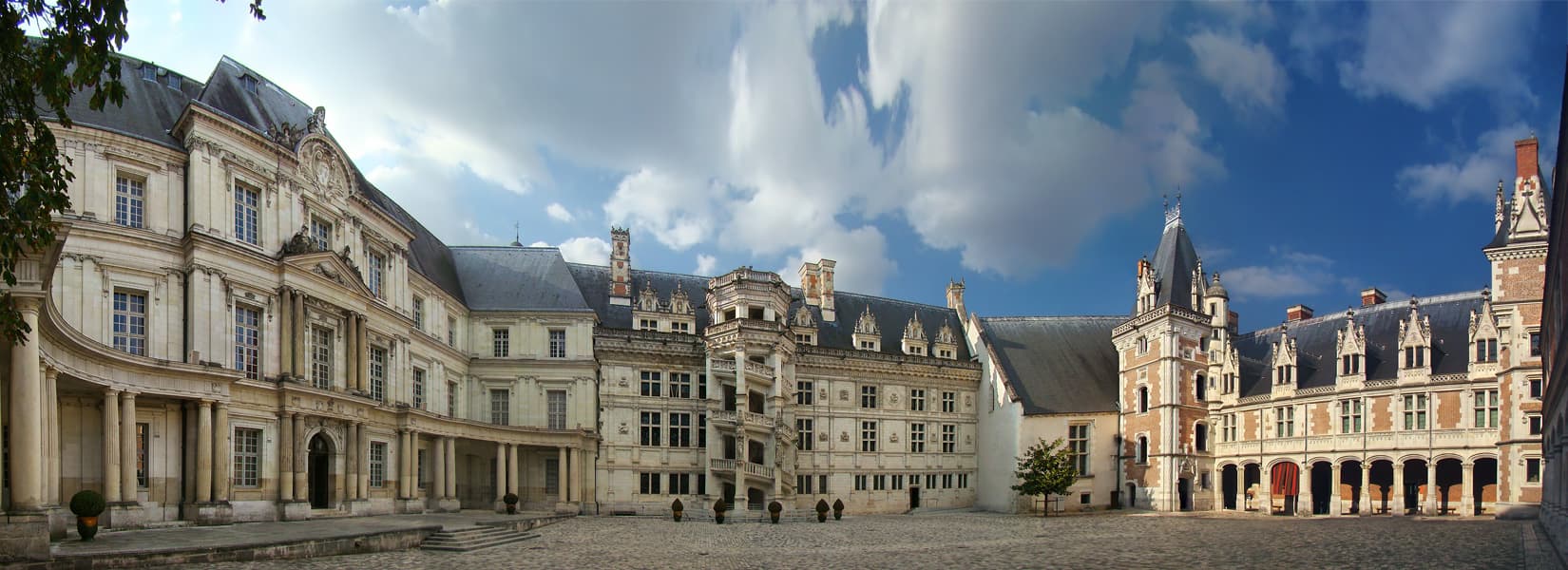
Francis I, a key patron of the French Renaissance, further expanded Blois with two new wings, including the iconic François I wing featuring a monumental spiral staircase and a vast library, emphasizing the castle's role as a center of learning and culture. The castle also served as the residence for royal children and witnessed significant events such as the death of Anne of Brittany in 1514 and the education of future monarchs.
Architectural styles and features
Blois Castle is a remarkable example of architectural evolution, showcasing styles from the medieval fortress to Gothic and Renaissance elements. The castle comprises several wings built across different centuries, each reflecting the tastes and priorities of its royal occupants. Its layout includes 564 rooms and 75 staircases, with 23 staircases used regularly, and boasts a fireplace in every room, underscoring the castle's grandeur and functionality.
The François I wing is particularly celebrated for its ornate Renaissance decoration, intricate stone carvings, and the famous spiral staircase that symbolizes the artistic innovation of the period. The castle's main courtyard is surrounded by these diverse architectural elements, creating a cohesive yet richly varied ensemble.
Historical events and royal intrigue
Blois Castle was the stage for pivotal moments in French history, including the Wars of Religion in the 16th century. It was here that King Henry III orchestrated the assassination of the Duke of Guise in 1588, a dramatic event that underscored the intense political and religious conflicts of the era. The castle also hosted the Estates General in 1576 and 1588, attempts to resolve these conflicts.
The castle's association with prominent queens such as Anne of Brittany, Claude of France, Catherine de Medici, and Marguerite de Valois adds layers of cultural and historical significance. Catherine de Medici, in particular, resided at Blois frequently and died there in 1589, leaving a lasting legacy.
Decline, exile, and restoration
Following the rise of the Bourbon dynasty with Henry IV, Blois lost its status as a royal residence but remained significant as a place of exile for notable figures such as Marie de Medici and Gaston d'Orléans. Marie de Medici's dramatic escape from the castle in 1619 inspired artistic works and legends, highlighting the castle's role in the tumultuous political landscape of the 17th century.
By the late 18th century, the castle was repurposed as a military barracks, which, while causing damage, also preserved the structure from complete ruin during the French Revolution. The castle was looted and emptied of royal furnishings during the revolution, but it avoided destruction thanks to its military use.
In the 19th century, under the guidance of Prosper Mérimée, the castle was classified as a national historical monument and underwent significant restoration led by architects like Félix Duban. It was transformed into a museum, housing collections of fine arts and serving as a cultural institution that celebrates its rich history and architectural heritage.
Modern-day significance and tourism
Today, Blois Castle is owned by the city of Blois and is a major tourist attraction in the Loire Valley. It features sound and light shows that bring its history to life, drawing visitors interested in French royal history, Renaissance art, and medieval architecture. The castle's extensive rooms, grand halls, and beautifully preserved wings offer a comprehensive glimpse into centuries of French history and culture.
Visitors can explore the castle's museum of fine arts, admire its Renaissance staircases, and learn about the dramatic events that shaped France. Its location within the Loire Valley, a UNESCO World Heritage site, further enhances its appeal as a cultural landmark.
Frequently asked questions (FAQ)
- How do I get to Blois Castle?
- Blois Castle is located in the city center of Blois, accessible by car, train, or local bus. The castle is a short walk from Blois train station and well-signposted within the town.
- What are the opening hours of Blois Castle?
- The castle is open daily from 10:00 to 18:00, with last admission typically 30 minutes before closing. Hours may vary seasonally, so it is advisable to check ahead.
- Is Blois Castle wheelchair accessible?
- While some areas of the castle are accessible to visitors with mobility impairments, due to its historic nature, certain parts may be challenging. Assistance is available, and it is recommended to contact the castle in advance for specific accessibility information.
- What is the historical significance of Blois Castle?
- Blois Castle was a royal residence for several French kings and a cultural center during the Renaissance. It played a key role in political events such as the Wars of Religion and hosted notable figures including Joan of Arc and Catherine de Medici.
- Can I visit the museum inside Blois Castle?
- Yes, the castle houses a museum of fine arts with collections related to its history and the Loire Valley. Visitors can explore exhibitions showcasing Renaissance art, medieval artifacts, and royal memorabilia.
- When is the best time to visit Blois Castle?
- Spring through early autumn offers the best weather for visiting Blois Castle and exploring the Loire Valley. The castle hosts special events and light shows during summer months, enhancing the visitor experience.
Photo gallery


Information
Opening hours
10:00-18:00, daily
Ticket prices
€9 adult, €6 child
Current owner
City of Blois
Website
Visit websiteFeatured in
Articles on the Castlopedia blog that feature Blois Castle.
Sources & official resources
Verify the information above using these authoritative references.
Loading map...
Visitor reviews
No reviews yet. Been here? Write the first review and help other travelers!
Write the first reviewVisited this castle? Share your experience
Your review helps other travelers and adds first-hand knowledge to our encyclopedia.



