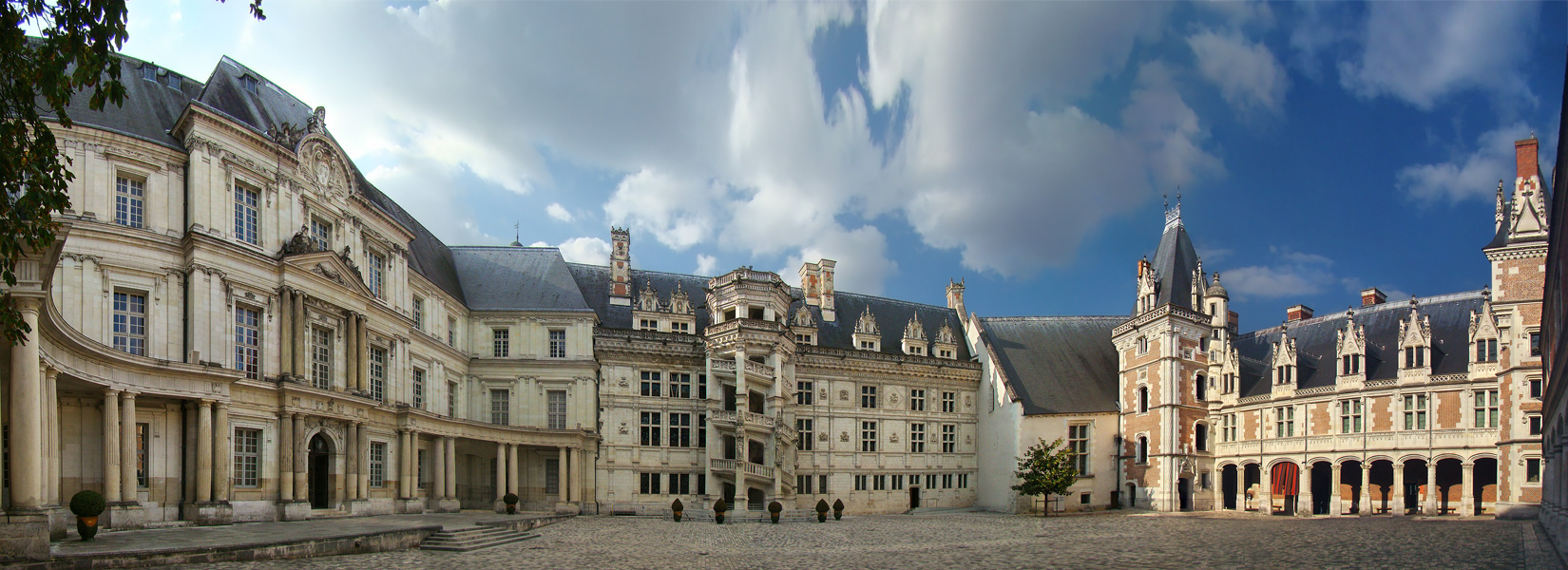
Castle of Blois
The Castle of Blois, also known as the Royal Chateau de Blois, stands prominently in the heart of the city of Blois, France. This historic castle served as the residence of several French kings and played a vital role in the political and cultural history of France. Notably, it is the place where Joan of Arc was blessed by the Archbishop of Reims in 1429 before she embarked on her campaign to liberate Orleans from English forces during the Hundred Years' War.
The castle's strategic location in the center of the town allowed it to exert control over the surrounding region. The complex is a fascinating architectural ensemble comprising several buildings constructed over a broad period from the 13th century through to the 17th century. These structures are arranged around a large central courtyard, reflecting the castle's evolution through multiple historical periods and styles.
Architectural evolution and styles
The Castle of Blois is renowned for its eclectic architecture, showcasing a blend of medieval fortifications, Gothic elements, Renaissance innovations, and early classical influences. The oldest part of the castle dates back to the 13th century, corresponding to its initial construction as a high medieval fortress. This section features characteristic defensive elements such as thick stone walls, battlements, and towers designed for protection and surveillance.
The castle underwent significant enlargement and transformation during the 15th and 16th centuries, particularly under the rule of the House of Valois. The Louis XII wing is a prime example of early French Renaissance architecture, distinguished by its ornate stone carvings, elegant windows, and decorative galleries. Another notable addition is the Francis I wing, which exhibits lavish Renaissance style with intricate sculptural details and expansive galleries that overlook the courtyard.
Interior features and layout
The castle boasts an impressive scale, containing approximately 564 rooms and 75 staircases. Remarkably, there is a fireplace in every room, reflecting the castle's role as a royal residence designed for comfort and status. The presence of around 100 bedrooms indicates its capacity to accommodate a large royal court and numerous guests.
The interior spaces include grand halls, private chambers, chapels, and reception rooms, many of which are richly decorated with period furnishings, tapestries, and artworks. The layout reflects the castle's dual purpose as both a fortified stronghold and a luxurious palace.
Historical significance and royal connections
The Castle of Blois was a favored residence of several French monarchs, including Louis XII and Francis I. It witnessed important historical events, such as the assassination of the Duke of Guise in 1588 during the Wars of Religion. The castle also played a role in the political intrigues of the French Renaissance court.
Joan of Arc's visit in 1429 is a particularly significant episode, symbolizing the castle's connection to key moments in French national history. Her blessing at Blois marked a turning point in her military campaign and the broader conflict between France and England.
Preservation and current status
Today, the Castle of Blois is well preserved and functions as a museum open to the public. Visitors can explore its diverse architectural styles, historical rooms, and extensive collections that illustrate the castle's rich heritage. The castle's location in the historic center of Blois makes it a major cultural attraction in the Loir-et-Cher region of France.
Its preservation allows for an immersive experience into the architectural and historical development of French royal residences from the high medieval period through the Renaissance and beyond.
Frequently asked questions (FAQ)
- How do I get to the Castle of Blois?
- The Castle of Blois is easily accessible by public transportation, with regular train services from Paris to Blois. Once in Blois, local buses and taxis can take you directly to the castle, which is located in the city center.
- What is the historical significance of the Castle of Blois?
- The Castle of Blois is a vital piece of French history, serving as a royal residence for several kings and queens, including Louis XII and Catherine de' Medici. Its architectural evolution reflects the artistic styles of the Renaissance and Gothic periods, making it a key site for understanding France's royal past.
- When was the Castle of Blois built?
- Construction of the Castle of Blois began in the 13th century and continued over several centuries, with significant expansions and renovations occurring during the Renaissance. The castle showcases a blend of architectural styles that illustrate its long and varied history.
- Can I take photos inside the Castle of Blois?
- Yes, photography is allowed inside the Castle of Blois, but flash photography may be restricted in certain areas to protect the artwork. Make sure to check for any specific guidelines at the entrance.
- Why is the architecture of the Castle of Blois unique?
- The architecture of the Castle of Blois is unique due to its combination of Gothic and Renaissance styles, featuring intricate facades and a grand staircase designed by architect Domenico da Cortona. Each section of the castle reflects different historical periods and influences, making it a fascinating site for architecture enthusiasts.
- Is it possible to access the Castle of Blois with a wheelchair?
- Yes, the Castle of Blois is partially accessible for visitors with mobility challenges. While some areas may have limited access, there are ramps and elevators available to help navigate the castle's main attractions.
- What are the opening hours of the Castle of Blois?
- The Castle of Blois is typically open daily from 9:00 AM to 6:30 PM, with extended hours during the summer months. It is advisable to check the official website for any seasonal changes or special closures before your visit.
- What are the ticket prices for the Castle of Blois?
- Ticket prices for the Castle of Blois vary, with discounts available for students and seniors. As of now, a standard adult ticket costs around €12, while children under 18 can enter for free, making it an affordable option for families.
- When is the best time to visit the Castle of Blois?
- The best time to visit the Castle of Blois is during the spring and early fall when the weather is mild and the gardens are in full bloom. Additionally, visiting on weekdays can help you avoid the larger crowds typically found on weekends and holidays.
- What nearby attractions are there to explore?
- Nearby attractions include the charming town of Blois itself, with its quaint streets and shops, as well as the Maison de la Magie, dedicated to magic and illusion. The beautiful gardens of the castle also provide a serene spot for relaxation after exploring the historic site.
Information
Website
Visit websiteSources & official resources
Verify the information above using these authoritative references.
Loading map...
Visitor reviews
No reviews yet. Been here? Write the first review and help other travelers!
Write the first reviewVisited this castle? Share your experience
Your review helps other travelers and adds first-hand knowledge to our encyclopedia.