Blankenstein Castle
Blankenstein Castle stands as a remarkable example of a high medieval hill castle located in Hattingen, Germany. Constructed initially between 1227 and 1243 by Adolf I, Count of Mark, the castle was strategically situated on a sandstone rocky spur overlooking the Ruhr River. This location provided commanding views and control over a vital river ford along an important trade route, underscoring its military and economic significance in the region.
The castle's origins are closely tied to the territorial expansion of the Counts of Mark following the confiscation of the Isenberg estates in the early 13th century. Although local tradition attributes the foundation to Ludolf von Bönen, historical documentation confirms the castle's establishment under Adolf I. By 1243, the castle was officially recorded as "castrum Blankensteene," marking its operational status within the county.
Architectural evolution and medieval significance
During the reign of Engelbert I of the Mark (1249–1277), Blankenstein Castle underwent significant expansion. Notable additions included the Graf-Engelbert Tower and a semicircular ring wall with a guarded gate, enhancing the fortress's defensive capabilities. Around this fortified core, a small settlement known as the Burgfreiheit developed, laying the groundwork for today's Blankenstein district.
By the early 14th century, the castle was a center of regional authority. In 1321, Engelbert II of the Mark granted market rights to nearby Bochum from within the castle walls, facilitating urban growth. Despite inheritance disputes delaying major construction, the early 15th century saw further enhancements under Duke Adolf II of Cleves, including a prominent residential building on the castle's east side.
At this time, the castle featured three main towers: a large square tower, a round tower, and the Graf-Engelbert Tower. Archaeological evidence confirms their existence, though the exact function of each—particularly which served as the main keep—remains uncertain. Ownership transitioned to John I of Cleves after 1461, but financial difficulties led to abandonment under John II of Cleves in 1494.
Military history and decline
The 17th century brought turbulent times for Blankenstein Castle. In 1614, Spanish troops occupied the fortress during the Eighty Years’ War, using it as a base for raids in the region. The subsequent Thirty Years’ War inflicted further damage through repeated sieges and military occupations.
From 1637, Johann Georg von Syberg served as castellan, residing at the castle for a decade before moving to Haus Kemnade. The castle was captured by troops of Palatinate-Neuburg in 1651 during the Jülich-Cleves succession conflict. By 1662, the fortress had lost its strategic importance. Frederick William, Elector of Brandenburg, ordered its demolition, and stones from the castle were repurposed to repair damage at Haus Kemnade.
Despite its ruinous state, the castle's remnants served military purposes during the Seven Years’ War when the French army used it as a magazine in 1757. By 1768, surviving walls were auctioned, and from 1771, the estate was adapted for residential use by local families who converted parts of the ruins into homes.
19th and 20th century transformations
In 1860, industrialist Gustav vom Stein acquired the site and initiated significant redevelopment. By 1863, a yarn finishing factory operated in the former stables, and a restaurant opened the following year, designed in the Romantic historicist style with decorative towers and turrets. Around 1900, the castle grounds were rebuilt on their original foundations, forming a semicircular courtyard that hosted a large beer garden capable of accommodating thousands during events.
The city of Bochum purchased the property in 1922 with plans for a youth hostel, though it was instead leased for restaurant use. During World War II, the main tower functioned as an anti-aircraft position and sustained shell damage. Post-war, from 1947 to 1950, the castle served as a recuperation center for prisoners of war returning primarily from the Soviet Union.
Restoration efforts began in 1949 under Werner and Leni Rauterkus, who leased the tower and factory ruins, transforming them into living, working, and exhibition spaces. Supported by the Friends of Blankenstein Castle society, founded in 1950, the castle saw further preservation. Between 1957 and 1959, many 19th- and early 20th-century historicist additions were demolished, leaving only select workshop buildings and a structure often misidentified as a chapel.
Further restoration and clearing from 1968 to 1972 improved visitor access, including opening the gate tower in 1971 and thinning surrounding forest to enhance views over the Ruhr and Kemnader Lake.
Architectural features and remaining structures
Blankenstein Castle occupies a horseshoe-shaped area approximately 90 by 70 meters atop a sandstone spur rising about 70 meters above the Ruhr River. The site’s geology of Ruhr sandstone provided durable building material used throughout the fortress.
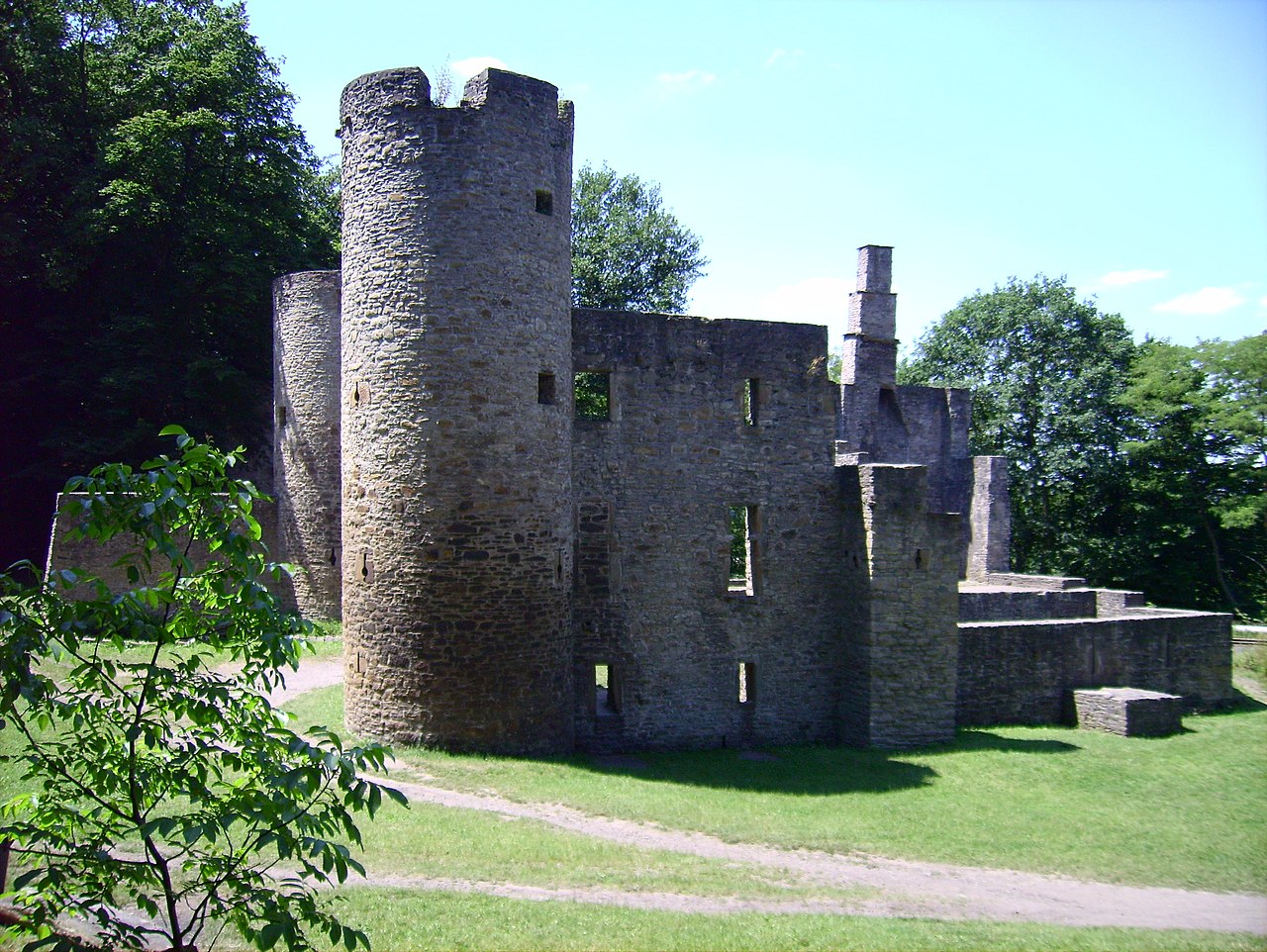
Among the oldest surviving elements are parts of the ring wall and the lower stories of a large nearly square tower measuring about nine meters wide and 26 meters tall. Traditionally called the Bergfried, this tower functioned as the castle’s gate tower, evidenced by a wide gate passage now sealed. The tower’s walls on the first floor are between 2.5 and 3.4 meters thick, highlighting its defensive role. Access to the tower’s current entrance is elevated roughly nine meters, reached via a narrow internal passage through the wall thickness.
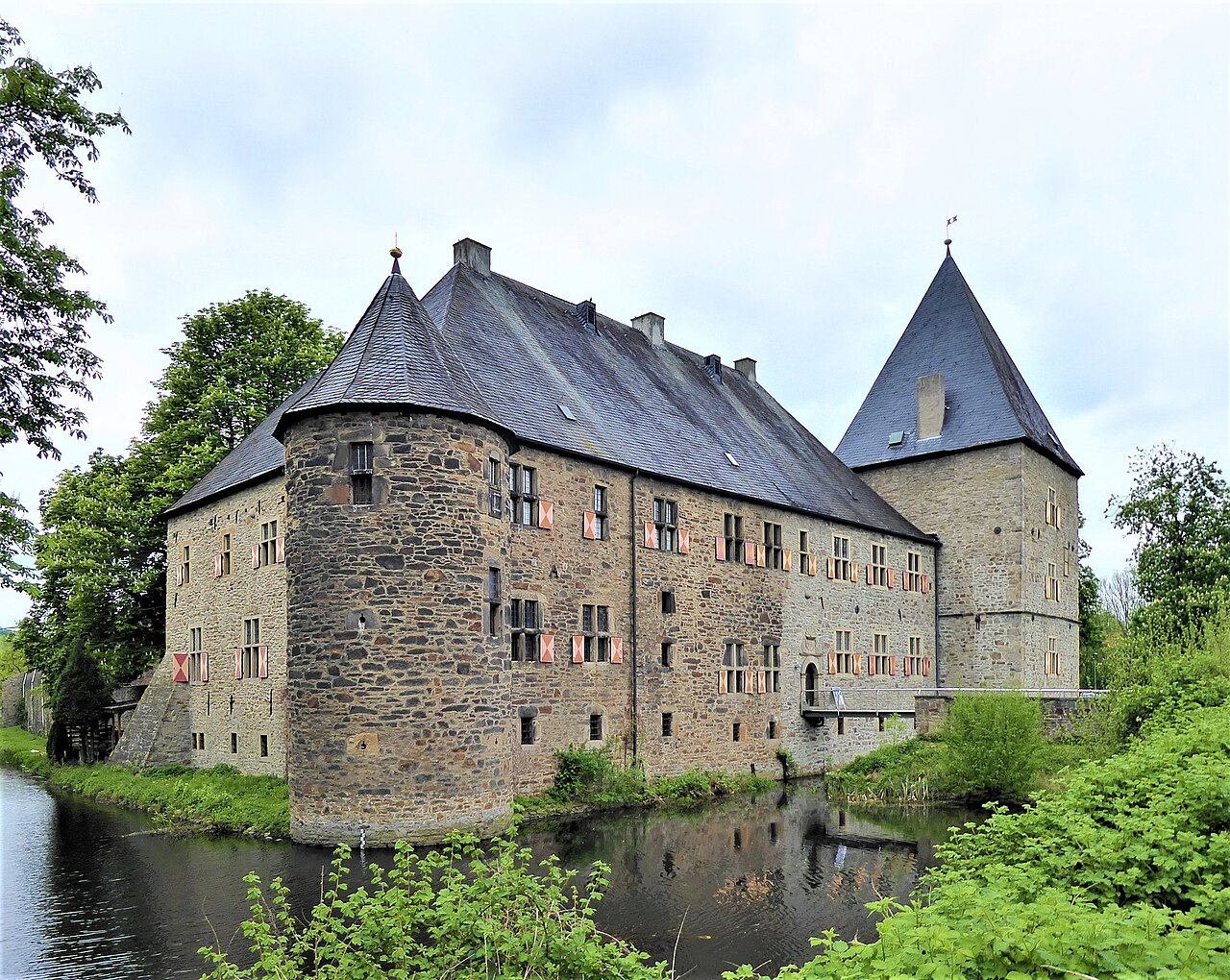
Nearby remains include a 14th-century zwinger or outer ward with round towers that enhanced defense. To the south lies a round-arched gateway flanked by a round tower with a conical roof, leading into a rectangular building part of the fortified entrance.
North of the main tower stands a two-story rubble stone building now housing a restaurant, integrating medieval heritage with modern use. At the eastern corner, a 19th-century tower with a pyramidal roof reflects the historicist renovations of that era.
Additional remnants include foundational walls and ruins from various periods, including a 19th-century guesthouse often mistaken for a chapel, which was never a religious building. Decorative towers and turrets added during 19th-century restorations were largely removed in the late 1950s.
Archaeological insights
Excavations confirm the castle had three major towers in the 15th century, though the exact functions of each remain unclear. The layered construction phases and adaptations reflect centuries of military, residential, and industrial use, making Blankenstein Castle a rich site for historical and architectural study.
Visiting blankenstein castle today
Today, visitors can explore the remaining tower and parts of the curtain wall, enjoying panoramic views over Bochum and the nearby Kemnader Lake. The castle's location on a high sandstone spur offers a unique vantage point to appreciate the surrounding landscape and the Ruhr valley's historical significance.
The site includes a restaurant housed in a historic building, blending medieval ambiance with contemporary hospitality. Efforts by local organizations continue to preserve this cultural landmark, making it accessible for educational and recreational purposes.
Frequently asked questions (FAQ)
- How do I get to Blankenstein Castle?
- Blankenstein Castle is located in Hattingen, Germany, and can be reached by car or public transport from Bochum. The castle is situated on a hilltop, so be prepared for a moderate uphill walk from the nearest parking or transit stop.
- What is the best time to visit Blankenstein Castle?
- The best time to visit Blankenstein Castle is during the spring to early autumn months when the weather is pleasant and the surrounding views of the Ruhr River and Kemnader Lake are at their most spectacular.
- Is Blankenstein Castle accessible to visitors with mobility issues?
- The castle's hilltop location and historic structures mean that accessibility is limited. Visitors with mobility issues should contact the site in advance to inquire about specific accommodations or guided tours.
- Can I tour the tower at Blankenstein Castle?
- Yes, the main tower of Blankenstein Castle is open to visitors. It offers panoramic views over Bochum and the Kemnader Lake, providing a unique perspective on the castle's strategic location.
- Are there guided tours available at Blankenstein Castle?
- Guided tours are occasionally offered by local historical societies or the Friends of Blankenstein Castle. It is recommended to check in advance for tour availability and schedules.
- What architectural styles are visible at Blankenstein Castle?
- Blankenstein Castle primarily features <strong>high medieval</strong> defensive architecture with later <strong>19th-century Romantic historicist</strong> additions, though many of these were removed during mid-20th-century restorations.
Information
Sources & official resources
Verify the information above using these authoritative references.
Loading map...
Visitor reviews
No reviews yet. Been here? Write the first review and help other travelers!
Write the first reviewVisited this castle? Share your experience
Your review helps other travelers and adds first-hand knowledge to our encyclopedia.